"Sin Is When You Treat People as Things": Granny Weatherwax's Moral Philosophy

How Granny Weatherwax articulated a complete ethical framework in three sentences. Her conversations with Mightily Oats reveal Pratchett's clearest moral philosophy.
"Sin Is When You Treat People as Things": Granny Weatherwax's Moral Philosophy
Immanuel Kant spent decades and thousands of pages constructing the categorical imperative—the idea that you should never treat a person merely as a means to an end. Philosophy students have been arguing about it ever since.
Granny Weatherwax said the same thing in fourteen words. On a donkey. In the rain.
"Sin, young man, is when you treat people as things. Including yourself. That's what sin is."
That's it. That's the entire ethical framework. No footnotes. No peer review. No tenure required. And somehow, in the space of a single conversation with a priest who couldn't decide what he believed, an eighty-year-old witch from the mountains articulated one of the clearest moral philosophies in all of fiction.
The Priest Who Couldn't Decide
"Sin, young man, is when you treat people as things. Including yourself. That's what sin is."— Granny Weatherwax
Carpe Jugulum gives us Mightily Oats, an Omnian priest whose name is the most ironic thing about him. Oats is weak where he should be strong, uncertain where he should be resolute. He'd written a paper on "the crisis of religion in a pluralistic society," which tells you everything. This is a man who intellectualized his faith until there was nothing left to feel.
He came to Lancre for a christening. He stayed because vampires attacked and somebody had to help Granny Weatherwax trek across the mountains to deal with them. He didn't volunteer so much as fail to run away fast enough.
What follows is one of the most remarkable philosophical dialogues Pratchett ever wrote—not between two academics, not in a lecture hall, but between a doubting priest and a witch who has no patience for doubt, trudging through mud and freezing rain on the back of a donkey.

Oats wants to discuss the complexity of evil. He suggests sin isn't "a black and white issue" and that there are "so many shades of gray." He's hedging. He's qualifying. He's doing what educated people do when they want to sound thoughtful without actually committing to a position.
Granny shuts it down in a single sentence.
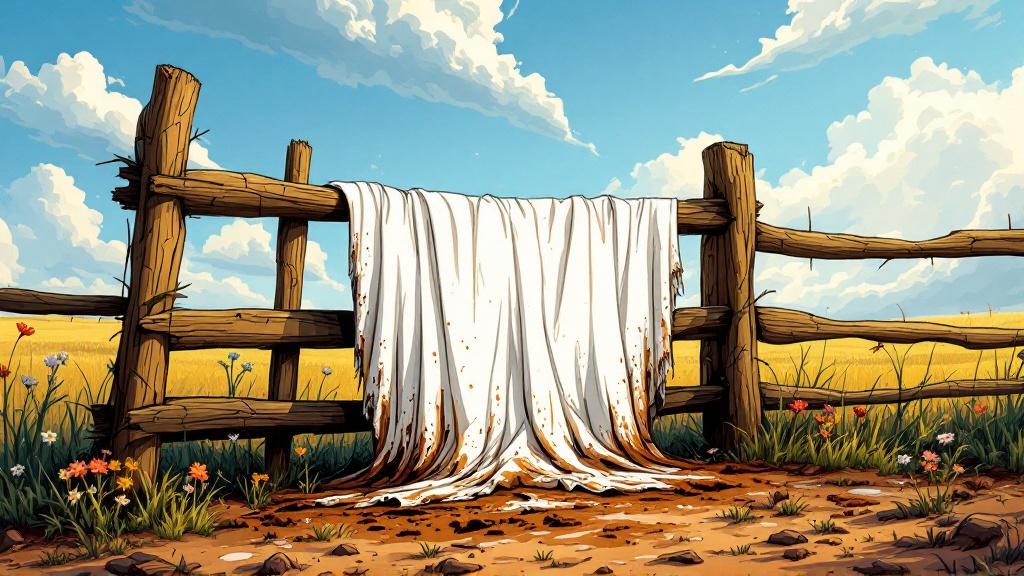
"There's no grays, only white that's got grubby."
The Simplicity That Isn't Simple
That line sounds like the kind of thing your grandmother might say—folksy, a bit stubborn, probably wrong in a sophisticated philosophical sense. But sit with it for a moment.
Granny isn't saying the world is simple. She's saying that complexity is what happens to goodness when people get their hands on it. The white is still there underneath. People are fundamentally capable of good—they just let it get dirty. And when someone tells you things are complicated, "they means they're getting worried that they won't like the truth."
"There's no grays, only white that's got grubby. I ain't too certain about where people stand. P'raps what matters is which way you face."— Granny Weatherwax
This isn't naivety. This is a woman who has spent seventy years dealing with people at their worst—delivering babies that won't survive, sitting with the dying, facing down elves who torture for entertainment and vampires who think they're progressive. She knows exactly how bad things can get. She's choosing clarity anyway.
The distinction matters. Moral relativism—the idea that right and wrong are just perspectives—is comfortable. It asks nothing of you. If everything's gray, then nobody's responsible for anything. Granny's framework says no: the standard exists. You know what it is. The only question is whether you're facing toward it or away.
"P'raps what matters is which way you face."
Not where you stand. Not how far you've come. Which direction you're pointed. That's an ethics built for real people—people who mess up, who get grubby, who sometimes face the wrong way. It doesn't demand perfection. It demands orientation.
People as Things
The centerpiece of Granny's philosophy—"sin is when you treat people as things"—works on multiple levels that unfold the longer you think about it.
On the surface, it's a statement about empathy. Don't use people. Don't reduce them to their utility. Don't treat the barmaid like a drinks dispenser, the soldier like a weapon, the prisoner like a problem to be solved. See the person.
But then there's the kicker: "Including yourself."
That's where it stops being a bumper sticker and starts being a complete ethical system. Because treating yourself as a thing is exactly what martyrs do, what workaholics do, what people-pleasers do. It's what Oats has been doing—reducing himself to his theological doubts, his institutional role, his inadequacy. He's turned himself into a thing: A Priest Who Can't Decide.
Granny is telling him that self-neglect is a sin too. That burning yourself up for others isn't noble if you've stopped seeing yourself as a person in the process. You can't properly value other humans if you've already devalued the one you know best.
Fans have pointed out that this is essentially Kant's second formulation of the categorical imperative: "Act so as to treat humanity, whether in your own person or in that of another, at all times also as an end, and not only as a means." Except Kant needed a full academic framework. Granny needed fourteen words and a hard stare.
Teaching Faith Without Having It
Here's the most remarkable thing about their journey: Granny Weatherwax—a woman who explicitly does not believe in any god—helps a priest find his faith.
She doesn't do it by arguing theology. She doesn't offer evidence for Om's existence. On the Discworld, gods demonstrably exist, which makes their existence a matter of fact rather than faith, and Granny knows this. "I know they exists," she tells Oats. "I just don't believe in them." Knowing something exists and believing in it are different things entirely. You know your dentist exists. That doesn't mean you have faith in dentistry.
What she does instead is show Oats what faith actually looks like in practice—not as theological conviction, but as the daily decision to face the right direction and keep walking.
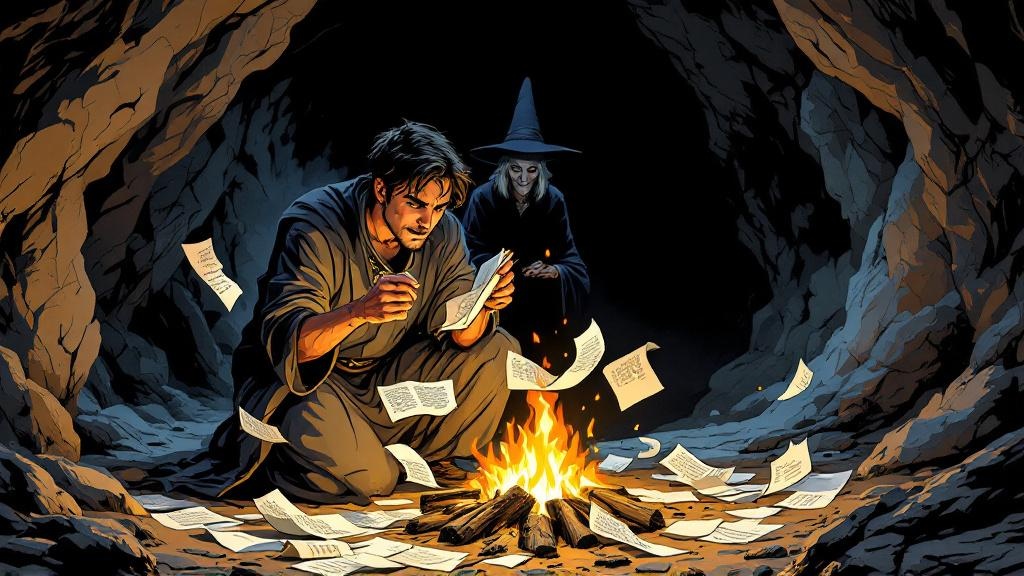
The pivotal moment comes when Oats burns his holy book—the Book of Om—to start a fire and save Granny's life. It's not a dramatic crisis of faith. He does it practically, without agonizing, because a person is more important than paper. When Granny says, "Terrible thing, having to burn all them words, though," Oats replies with the line that changes everything: "The worthwhile ones don't burn."
He's found it. Not certainty—he'll never have certainty. But the understanding that faith is what you do, not what you think. Granny tells him that real religion is "sacrificin' your own life, one day at a time, to the flame, declarin' the truth of it, workin' for it, breathin' the soul of it." Not believing in the right things. Doing the right things, day after day, even when you're not sure why.
That's faith as practice rather than proposition. And it's a woman with no religion who taught him that.
Good Is Not Nice
One of the most common misunderstandings about Granny Weatherwax is that she's harsh despite being good. The truth is she's harsh because she's good—or at least, because she understands what goodness actually requires.
"We do right," she says. "We don't do nice."
"I ain't got to be nice; I've got to be right."— Granny Weatherwax
Being nice is easy. Niceness tells people what they want to hear. Niceness avoids uncomfortable truths. Niceness lets you feel good about yourself without actually helping anyone. Granny's sister Lilith was nice—she gave people what she thought they wanted, arranged their lives into tidy fairy tales, and genuinely believed she was the good sister. She was, in fact, a tyrant who treated people as characters in her story. Things, in other words.
Granny gives people "what they know they really need." Sometimes that's a cure. Sometimes it's a hard truth. Sometimes it's sitting with a dying person through the night when everyone else has left, doing the thing nobody wants to do because it has to be done and she won't pretend otherwise.
This is why no one, except possibly Nanny Ogg and Tiffany Aching, actually likes Granny Weatherwax. She's not likeable. She's not trying to be. But when the crisis comes—when the vampires bite, when the elves return, when something terrible needs doing—she's there. Every time. Because that's what right looks like.
The Philosophy She Won't Admit To
The funny thing is, if you told Granny Weatherwax she was a moral philosopher, she'd deny it. Probably with a glare. Philosophers sit around thinking about things. Granny does things.

But that's the point. Her philosophy isn't a system of thought—it's a system of action. Don't treat people as things. Face the right direction. Accept that the white gets grubby and clean it when you can. Do right, not nice. Keep going.
It's not original, strictly speaking. Kant said some of it. Virtue ethicists said more. Existentialists would recognize the emphasis on choice over essence—you are what you do, not what you were born as. But Granny didn't read any of them. She arrived at these conclusions the hard way, through decades of delivering babies, laying out the dead, and choosing to be good when she had the personality for villainy.
That's what makes her version hit harder. It's not theoretical. It's tested. Every principle she articulates came from a life of actually living it—not in a university office, but in a cottage in the mountains where the winters are long and the nearest doctor is you.
Pratchett's Clearest Voice
Terry Pratchett was an atheist who wrote some of the most compelling moral fiction of the twentieth century. He embedded his ethics in stories rather than arguments, in characters rather than essays. And of all his characters—of all the vehicles he used for his own moral vision—Granny Weatherwax is the one who says it most plainly.
Not Sam Vimes, who carries a similar philosophy but expresses it through anger and action rather than words. Not Death, who sees everything but intervenes rarely. Granny is the one who sits down with a doubting priest and lays it out in plain language that a child could understand and a philosopher could spend years unpacking.
Sin is when you treat people as things. The white gets grubby but it's still white underneath. What matters is which way you face.
Three sentences. A complete ethical framework. No footnotes required.
And she said it on a donkey, in the rain, to a man named Mightily who had never been anything of the sort—until she was done with him.



For more on Granny's character, read about the burden of choosing goodness, the mirror test that proved her identity, and the gambit that turned vampires into tea drinkers. To understand her approach to magic, explore why headology beats wizardry and her most impossible feat with bees.