L-Space and the Librarians of Time and Space: The Secret Order That Guards All Knowledge
How Discworld's L-space connects every library ever built, the three rules that govern it, and why the Librarian is one of the few who can navigate it.
"Knowledge equals power. Power equals energy. Energy equals matter. Matter equals mass. And mass distorts space."
That's not a physics lecture. It's a navigation manual. Because in Terry Pratchett's Discworld, that simple equation means something extraordinary: every library, everywhere, in every time and every dimension, is connected. The accumulated weight of all those words, all that knowledge, warps the fabric of reality itself into something called L-space.
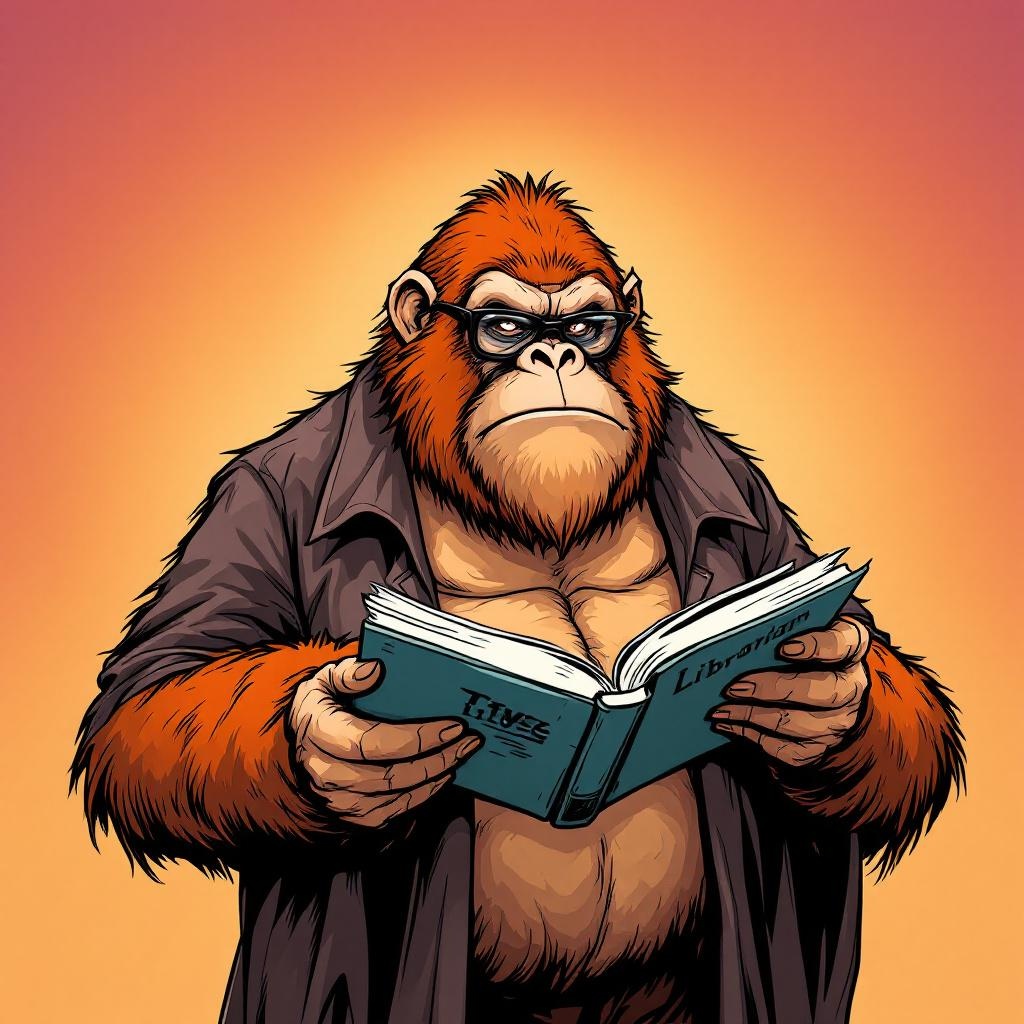
And the Librarian—an orangutan who used to be a wizard and has no interest in going back—is one of the very few beings who can navigate it.
The Equation That Bends Reality
L-space, short for library-space, starts with a joke. Pratchett takes the physicist's chain of equivalences—knowledge is power, power is energy, energy is matter, matter has mass—and follows it to its logical conclusion. Mass warps space. Therefore, enough books in one place will distort space and time around them.
"A good bookshop is just a genteel Black Hole that knows how to read."
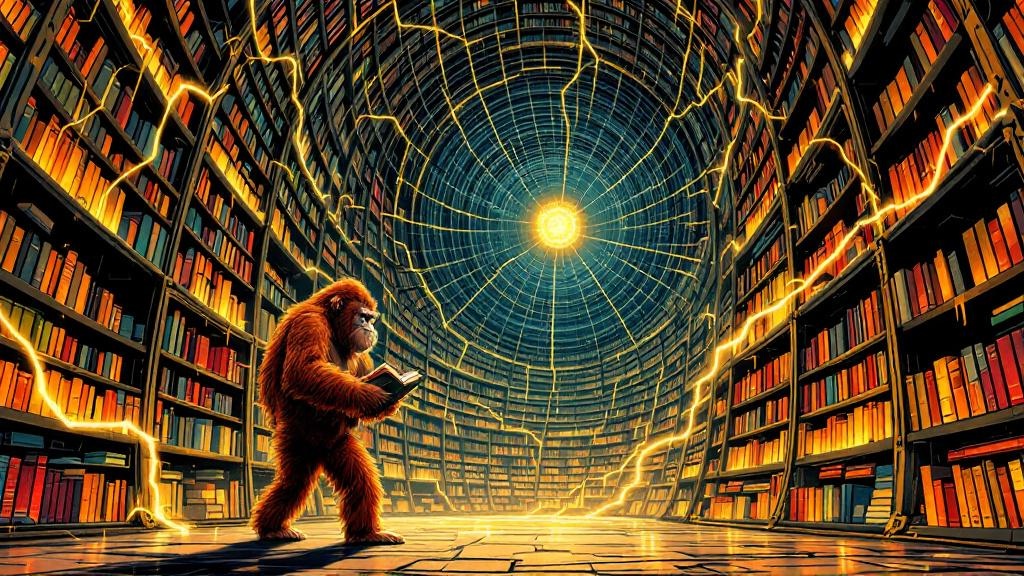
On Roundworld, that's a metaphor. On the Disc, it's literal. The Unseen University Library doesn't just contain a lot of books. It contains so many magical texts, so densely packed, that the interior of the building no longer obeys the normal rules of geometry. Distance and direction become "only vaguely defined." Shelves that should lead to walls lead instead to other shelves, and other shelves beyond those, stretching into impossible configurations that no architect designed.
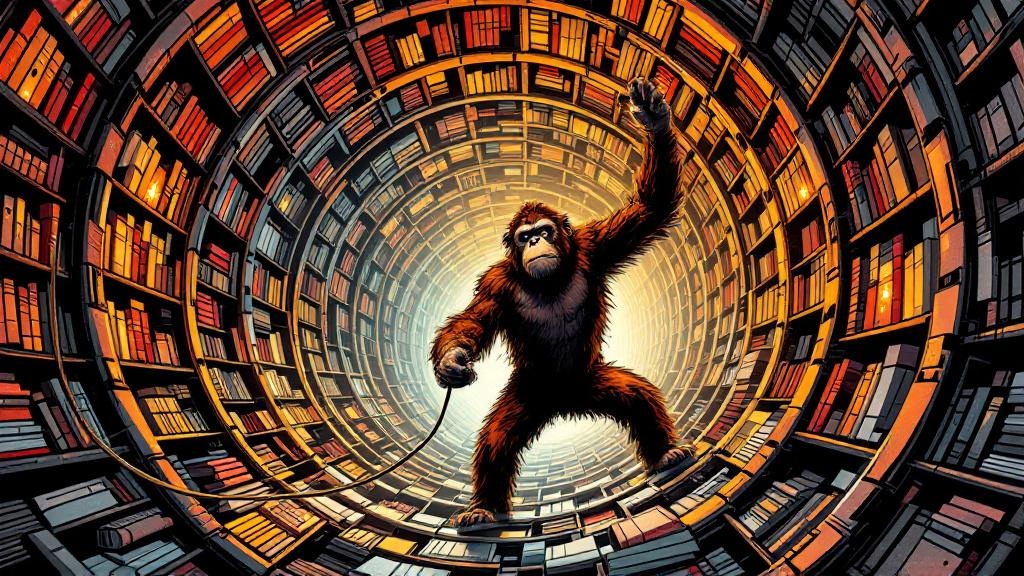
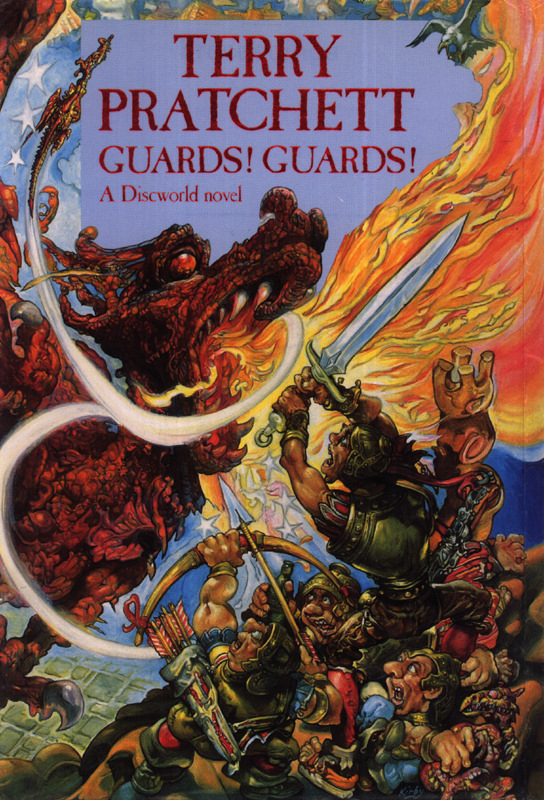
"It distorts it into polyfractal L-space," Pratchett writes in Guards! Guards!. "So, while the Dewey system has its fine points, when you're setting out to look something up in the multidimensional folds of L-space what you really need is a ball of string."
This is vintage Pratchett—taking a grand cosmic concept and grounding it with something as mundane as a ball of string. The universe is strange and vast and terrifying, and the best way to navigate it is the same method Theseus used in the labyrinth. Some problems are older than physics.
All Libraries, Everywhere
Here's where the concept goes from clever gag to genuinely beautiful idea.
All libraries are connected through L-space. Not just the big ones. Not just the magical ones. All of them, everywhere, in every time period. The tiny secondhand bookshop on the corner with the owner who always seems slightly otherworldly? Connected. The great Library of Alexandria? Connected. Libraries that will exist a thousand years from now? Connected. Libraries that could exist, in worlds that never quite happened? Connected.
"Books bend space and time," Pratchett writes. "One reason the owners of those aforesaid little rambling, poky secondhand bookshops always seem slightly unearthly is that many of them really are, having strayed into this world after taking a wrong turning in their own bookshops in worlds where it is considered commendable business practice to wear carpet slippers all the time and open your shop only when you feel like it."
It's a joke. But it's also the kind of joke that makes you look at your local bookshop slightly differently the next time you visit. That sense of stepping into a different world when you walk through the door? Pratchett says it's not just a feeling. It's geography.
L-space supposedly contains every book that has ever been written, will be written, or could possibly be written. The content of any book, anywhere, "may, in the right circumstances, be deduced from a sufficiently close study of books already in existence." Every library is a gateway to every other library. Every bookshelf is a portal to infinity.
The Secret Order
Not everyone can access L-space. Most people walk through libraries without ever noticing the seams in reality between the shelves. It takes a special kind of person—or, more accurately, a special kind of librarian—to find the doors.
Very senior librarians, once they have proved themselves worthy by performing "some valiant act of librarianship," are accepted into the secret order of the Librarians of Time and Space. They're taught the raw arts of survival beyond the Shelves We Know—how to navigate by booksign carved on shelves by past explorers, how to follow the scent of old paper through dimensional rifts, how to avoid the dangers that lurk in the spaces between the stacks.
"Silence. Books must be returned no later than the last date shown. Do not interfere with the nature of causality."— The Librarians of Time and Space
And they're bound by three rules. Just three. They're beautifully, perfectly librarianish:
- Silence.
- Books must be returned no later than the last date shown.
- Do not interfere with the nature of causality.
The first two rules are exactly what you'd expect from any library. The third is slightly more ambitious. Because when your library connects to every other library across time and space, "returning a book late" and "accidentally destroying the fabric of causality" are closer together than you might think.
The Librarian of Unseen University is a member of this order. Possibly its most distinguished living member. And in Guards! Guards!, we get to see him put all three rules to the test.
The Investigation
When someone steals The Summoning of Dragons from the Unseen University Library, the Librarian takes it personally. A book has been taken from his collection. Someone has violated the sacred trust between library and reader. This will not stand.
So the Librarian does what any self-respecting L-space navigator would do: he follows the thief through time.
Moving through the impossible geometries of the library's interior, navigating "by booksign carved on shelves by past explorers, navigating by smell, navigating even by the siren whisperings of nostalgia," the Librarian travels backward through L-space to the moment of the theft. He sees himself, asleep at his desk, and feels the temptation to reach out—to wake his past self, to warn him, to prevent the theft entirely.
He doesn't. Rule three: do not interfere with the nature of causality.
Instead, he watches the Elucidated Brethren of the Ebon Night steal the book. He follows the thief through the streets of Ankh-Morpork—demonstrating that L-space works outside libraries too, once you know how to ride it. He gathers his evidence. And then he brings it to Captain Vimes and the Night Watch, because even an interdimensional traveller needs someone with a badge to make the arrest.
It's a detective story solved through library science. Only Pratchett could make that work.
The Rescue Mission
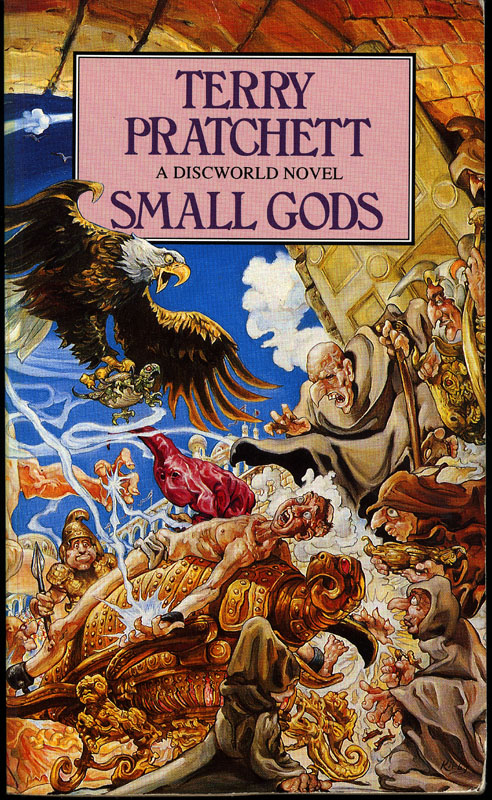
But the Librarian's most extraordinary use of L-space happens in Small Gods, and it gets exactly four paragraphs. It's a throwaway scene. It might be the most moving thing in the entire book.
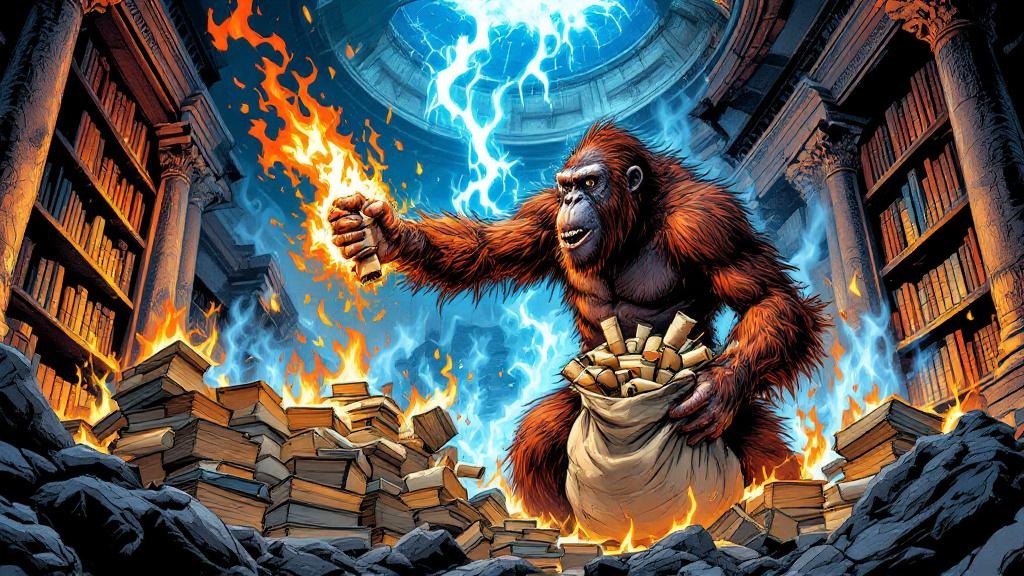
The Library of Ephebe is burning. Vorbis, the fundamentalist Omnian inquisitor, has ordered its destruction. The flames burn blue where the melted copper roof drips onto the shelves. Centuries of accumulated knowledge—philosophy, mathematics, poetry, science—is turning to ash.
And then there's a small pop, utterly unheard among the crackling of the bookshelves, and a figure drops out of nowhere onto a small patch of unburned floor in the middle of the library.
"It looked ape-like, but moved in a very purposeful way. Long simian arms beat out the flames, pulled scrolls off the shelves, and stuffed them into a sack. When the sack was full, it knuckled back into the middle of the room... and vanished, with another pop."
That's it. Four paragraphs. No name given. No explanation needed. The Librarian has traveled through L-space, across continents and possibly centuries, to rescue books from a burning library. Not because anyone asked him to. Not because the books are magical or dangerous or valuable in any measurable way. Because they're books, and books are being destroyed, and that's enough.
The justification is delicious in its circularity: if a library is on fire, and it's down in the history books as having been on fire, then traveling back to rescue what you can doesn't change anything. History says the library burned. It doesn't say everything in it was destroyed. The Librarian isn't breaking rule three. He's exploiting a loophole—one that only a truly dedicated librarian would spot.
The Dangers Between the Shelves
L-space isn't safe. The spaces between libraries are home to creatures that have evolved to fill ecological niches that only exist in the margins of accumulated text.
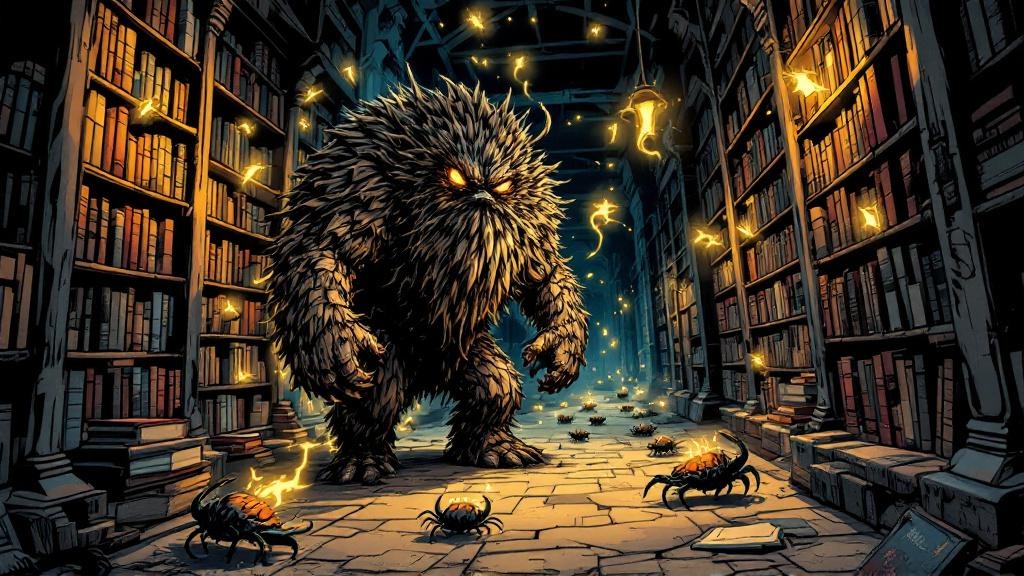
There are harmless kickstool crabs, which scuttle between the shelves and look like exactly what their name suggests. There are large and heavy wandering thesauri—great lumbering beasts that roam the deeper stacks. There's the .303 bookworm, which has evolved to eat books at such incredible speeds that it can be found "shooting out of books, ricocheting off the opposite wall" like literary bullets.
And then there are the dreaded clichés, which must be avoided at all costs. Pratchett never fully explains what a cliché looks like when it's roaming wild in L-space, and honestly, that's probably for the best.
The Librarian navigates all of this with the confidence of someone who knows every corridor, every shortcut, every dangerous corner. He's not just a librarian. He's a ranger, a guardian, a keeper of paths through the most dangerous and wonderful wilderness in the multiverse.
Why L-Space Matters
There's a reason this concept resonated so deeply with Pratchett's readers—deeply enough that the major Discworld fan community named itself after it. The L-Space Web has been the primary online hub for Pratchett fans since the earliest days of the internet. That's not a coincidence.
L-space works because it's a metaphor that doesn't feel like one. Every serious reader has experienced something like it—that sensation of following a footnote from one book to another, of discovering that a reference in a novel leads to a history book which leads to a philosophy text which leads to a poem which leads back, somehow, to where you started but seeing everything differently. The feeling that books are connected, that knowledge forms a web, that every library contains doors to places you haven't been yet.
Pratchett made that feeling literal. He said: yes, libraries really are portals. Books really do connect to other books across time and space. The sense of the uncanny you feel in a good secondhand bookshop is real. The world really is stranger and more wonderful than the geometry of its buildings would suggest.
"Without over-egging it," Pratchett once said, "the library and journalism, those things made me who I am." He received letters from librarians telling him, "What is so marvellous is that you get people into the library so that we can introduce them to real books."
The connection between the concept and the tradition runs deep. Librarians in ancient Egypt were priest-scribes, "Keepers of the Sacred Books." Jorge Luis Borges imagined the Library of Babel, an infinite space containing every possible book. Neil Gaiman created Lucien's Library in The Sandman, housing every book ever dreamed of but never written. Pratchett's L-space sits alongside these, perhaps the most playful and human version of the idea—a cosmic concept explained through the lens of overdue fines and balls of string.
The Orangutan in the Labyrinth
And at the centre of it all: an orangutan with a library card.
The Librarian doesn't navigate L-space because he's the most powerful magical being in the Discworld. He navigates it because he's the most dedicated. He loves his books with a ferocity that transcends species, transcends time, transcends the normal boundaries of space. When a book is stolen, he follows the thief through dimensional rifts. When a library is burning, he pops across centuries to save what he can. When his own collection grows restless and dangerous, he calms the books by hand—or by foot, since orangutans have four of them and they're all prehensile.
He's the perfect L-space navigator because he approaches the infinite with the mindset of a professional. Infinity is just a very large collection that needs proper shelving. Time travel is just an extended loan period. The fabric of reality is just another system that needs maintaining.
Rule one: silence. Rule two: return your books on time. Rule three: don't break the universe.
Everything else is just cataloguing.





For more on the Librarian's story, read about his transformation from Dr. Horace Worblehat and why he refused to change back. Or explore the Night Watch that gave an orangutan a badge—and never regretted it.