'What Some Bloke In The Pub Told Me': Fred Colon's University of Prejudice
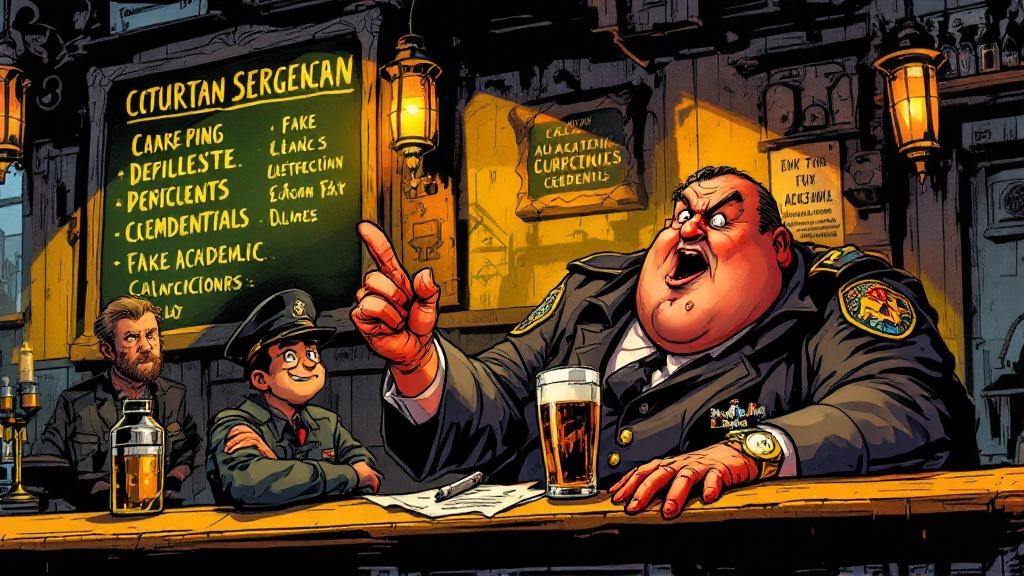
How Terry Pratchett used Fred Colon and Nobby Nobbs in Jingo to expose casual racism through comedy—letting prejudice demolish itself one daft question at a time.
"What Some Bloke In The Pub Told Me": Fred Colon's University of Prejudice
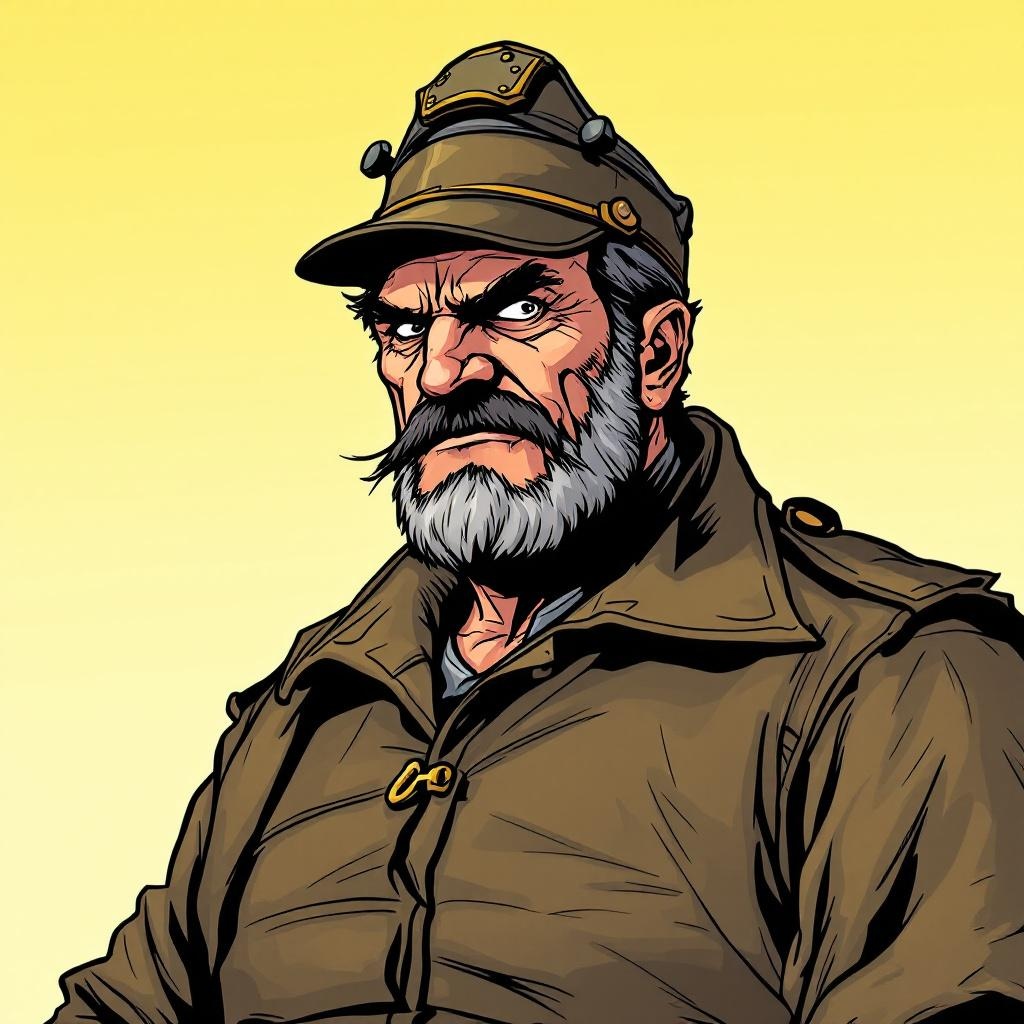
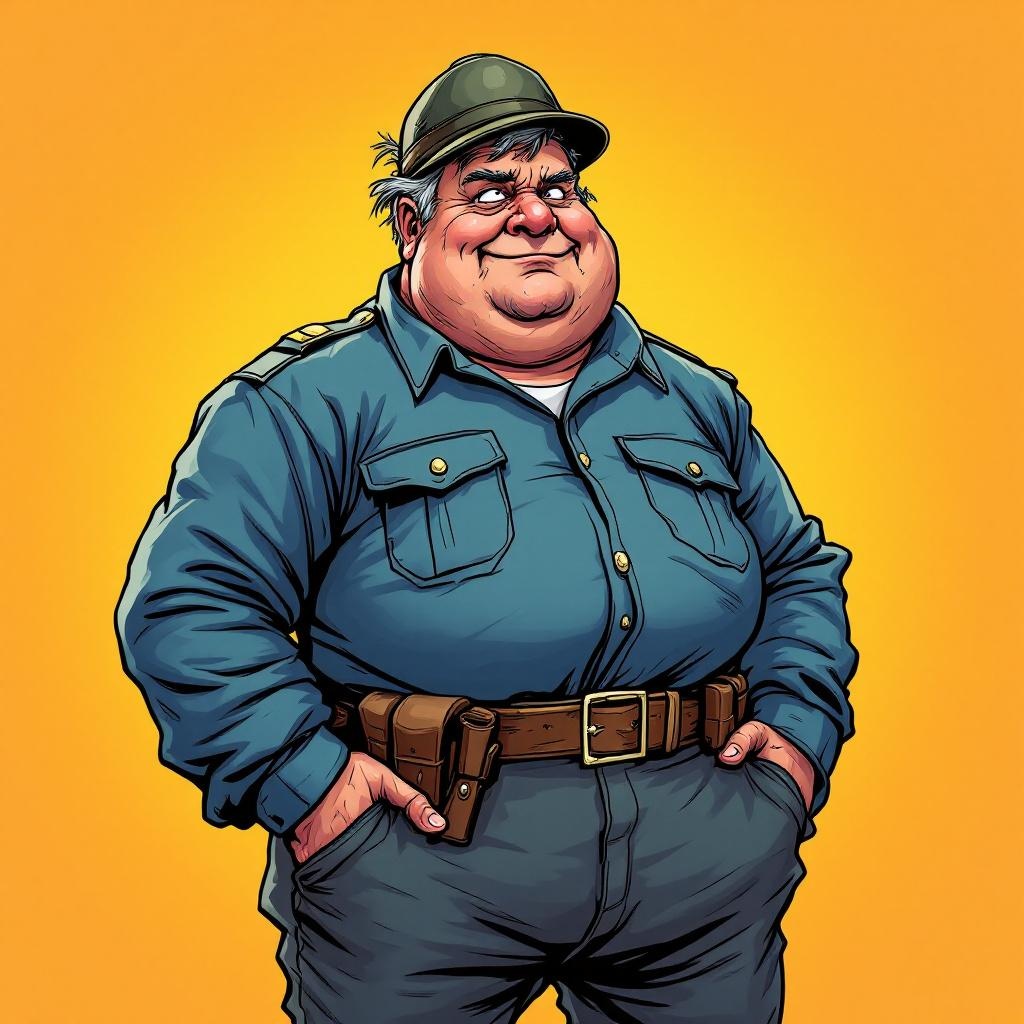
You know this man. You might work with this man. You might be related to this man. You might, in certain moods and on certain topics, be this man.
He doesn't think of himself as prejudiced. He's just saying what everyone knows. What his dad always said. What stands to reason. What some bloke in the pub told him last Tuesday.
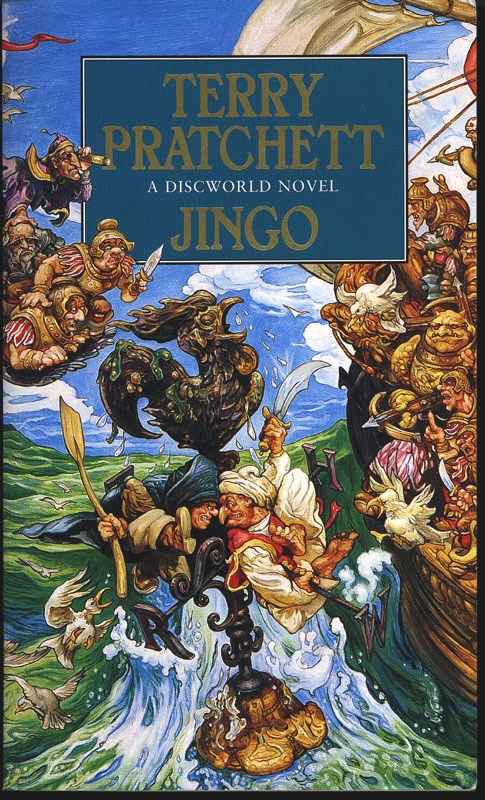
In Jingo, Terry Pratchett built one of his sharpest pieces of social satire around Fred Colon—a man whose education consisted entirely of received wisdom, inherited assumptions, and pub-quality logic. And then Pratchett did something brilliant: he let Nobby Nobbs, of all people, take it apart.
The Curriculum of Common Sense
The quote that defines everything Fred believes about the world comes early in Jingo:
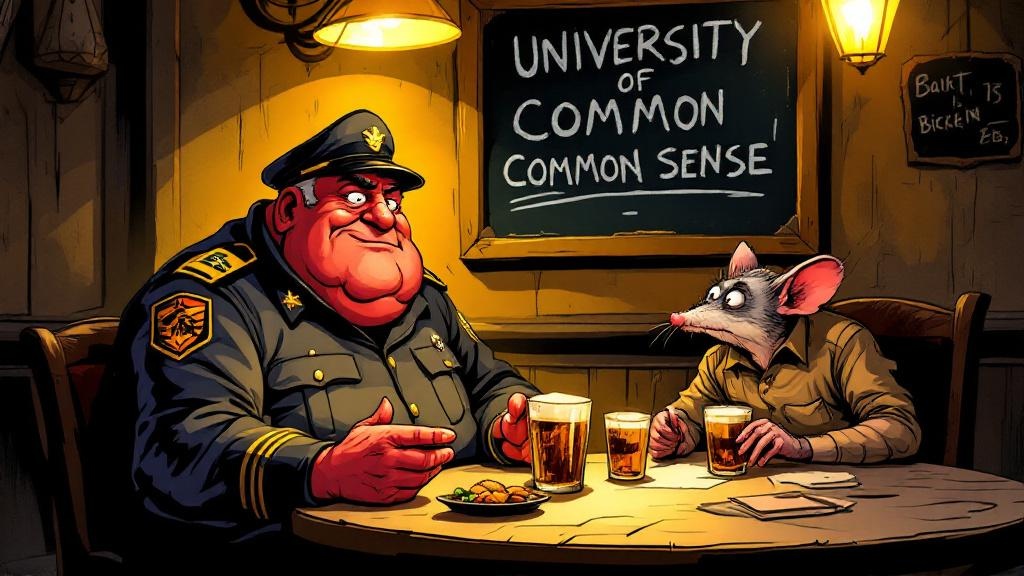
"Sergeant Colon had had a broad education. He'd been to the School of My Dad Always Said, the College of It Stands to Reason, and was now a postgraduate student at the University of What Some Bloke In the Pub Told Me."
"He'd been to the School of My Dad Always Said, the College of It Stands to Reason, and was now a postgraduate student at the University of What Some Bloke In the Pub Told Me."
That's not just a joke. That's a taxonomy of how prejudice reproduces itself.
The School of My Dad Always Said is generational. These are beliefs inherited from parents, absorbed before you're old enough to question them. They arrive pre-packaged as wisdom because they come from someone you trust.
The College of It Stands to Reason is where those inherited ideas get intellectualized—poorly. "It stands to reason" is the phrase people use when they haven't actually reasoned anything. It's the sound of someone mistaking familiarity for logic.
And the University of What Some Bloke In the Pub Told Me is where it all gets reinforced. Your mates agree with you. The bloke at the next table agrees with you. And if everyone you talk to thinks the same thing, well, it must be true.
Three institutions. Zero critical thinking. A complete education in knowing nothing while being certain of everything.
The Contradictions Fred Can't See
When war with Klatch looms and nationalist fervor sweeps Ankh-Morpork, Fred becomes a one-man propaganda machine. But his propaganda has a problem: it contradicts itself every other sentence, and he genuinely can't tell.
The Klatchians are cowards who run at the first taste of cold steel. Also, they're vicious fighters and a serious threat. Nobby, bless him, spots the issue immediately: so they viciously attack you while simultaneously running away?
Fred doesn't notice the contradiction because prejudice doesn't need internal consistency. It just needs confidence. The Klatchians are whatever they need to be to justify whatever Fred already feels—lazy when he needs to feel superior, dangerous when he needs to feel threatened.
This is Pratchett at his most surgical. He doesn't have a wise character deliver a speech about tolerance. He just lets Fred talk, and lets the bigotry collapse under its own weight.
Nobby the Demolition Expert
Here's the joke that Pratchett spins across the whole of Jingo: Nobby Nobbs—the man who needs a certificate to prove he's human, the man who steals anything not nailed down—is the one who dismantles Fred's racism.
Not through eloquent arguments. Not through moral outrage. Through the deadliest weapon in the arsenal against prejudice: genuinely stupid questions.
Fred claims Klatchians are lazy. Nobby points out that Mr. Goriff, the Klatchian who runs the takeaway shop down the street, works all day and all night. Fred claims they steal jobs. Nobby wonders how people can be lazy and also stealing everyone's jobs. Fred insists they eat sheep's eyeballs and have multiple wives, as if this settles the argument definitively.
"Look, Nobby, when all's said and done they ain't the right colour, and there's an end to it."— Fred Colon
And when all else fails, Fred retreats to the last fortress of the bigot: "Look, Nobby, when all's said and done they ain't the right colour, and there's an end to it."
To which Nobby asks the devastating question: "What is the right colour?"
Fred tries. He really tries. "White's a state of, you know... mind," he manages. It's like doing an honest day's work. Washing regular. Being decent.
Nobby, who hasn't washed regularly since the reign of the previous Patrician, just stares at him.
The beauty is that Nobby isn't trying to be clever. He isn't making a philosophical argument. He just genuinely doesn't understand how any of this makes sense—and his inability to understand is the point. It doesn't make sense. It never did. It's just that most people are too polite, too comfortable, or too similarly educated to say so.
The "Al" Argument
One of Pratchett's cleverest exchanges comes when Fred dismisses Klatchian culture entirely. They haven't contributed anything to civilization, he insists. They're backwards.
Nobby mentions that they invented all the words starting with "al." Algebra. Alcohol. Alchemy.
Fred pauses. Algebra is "sums with letters. For people whose brains aren't clever enough for numbers." That's Fred dismissing mathematics he doesn't understand by reframing ignorance as sophistication.
But the real kicker is that Pratchett is drawing from actual history. The Arabic world did give us algebra, algorithm, alchemy, alcohol, and—crucially—the concept of zero. The prejudice Fred expresses about Klatchians maps directly onto the West's historical amnesia about Islamic scholarship.
Pratchett was writing in 1997. The Iraq War hadn't happened yet. The War on Terror hadn't happened yet. But the attitudes Fred parrots were already ancient—and Pratchett knew they'd remain current because they're not really about Klatch at all. They're about the comfort of looking down on someone.
What Pratchett Understood About Prejudice
Most writers who tackle prejudice do one of two things: they preach, or they create a cartoonishly evil bigot for the reader to feel superior to.
Pratchett does neither. Fred isn't evil. He's not stupid, exactly—not in the ways that matter on the street. He's a man who has absorbed his city's assumptions like a sponge absorbs beer, and he's never been given a reason to wring himself out.
That's what makes Fred so uncomfortable to read. He's not a villain. He's a mirror. His prejudices don't come from malice; they come from the path of least resistance. It's easier to believe what your dad said, what stands to reason, what the bloke in the pub told you. Thinking for yourself requires effort, and Fred Colon is a man who has elevated the avoidance of effort to an art form.
Pratchett also understood something subtle about how prejudice works in conversation. Fred doesn't arrive at his racism through careful thought. He arrives at it through momentum. Each statement leads to the next, each assumption builds on the last, and by the time he's saying things he'd probably never say in isolation, the train has left the station and he can't figure out how to stop it.
That's why Nobby's questions are so effective. They're not counterarguments—they're speed bumps. They force Fred to stop, back up, and actually think about what he just said. And every time Fred thinks about it, even for a second, the whole thing falls apart.
Fred in Thud!: The Pattern Continues
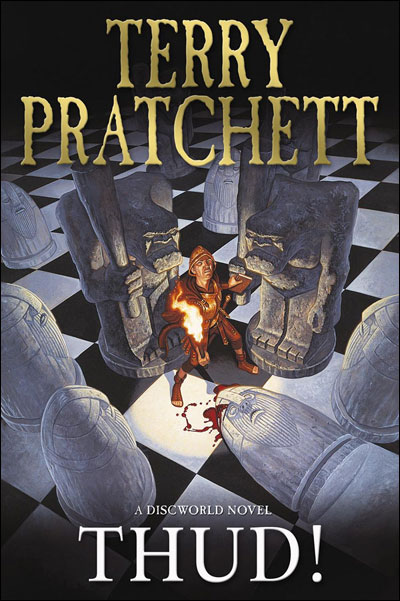
Jingo isn't the last time Fred's unexamined assumptions cause problems. In Thud!, when tensions between dwarfs and trolls threaten to tear Ankh-Morpork apart, Fred is once again a barometer for street-level prejudice.
But he's also something more useful: an early warning system. Fred picks up the grumbling, the suspicious gatherings, the change in atmosphere, before anyone with more sophisticated intelligence methods notices. His "bloke in the pub" network—the same source of his worst opinions—also makes him one of the best-connected officers in the Watch.
"Sam Vimes values Fred not despite his connection to pub-level opinion, but because of it."
Sam Vimes values Fred not despite his connection to pub-level opinion, but because of it. Where Fred drinks, what Fred hears, how Fred reads a crowd—these are intelligence assets. The same network that feeds Fred his prejudices also feeds him information that saves lives.
Pratchett never lets you settle into a simple reading of any character. Fred is both the problem and part of the solution. His assumptions are wrong, but his instincts are real.
The Klatchian's Head: The Ending Nobody Talks About
Here's the moment in Jingo that stays with you.
After the war that wasn't quite a war, after their misadventures in Klatch, after discovering that the place is full of actual people rather than the caricatures they'd imagined, Fred and Nobby stop going to their favourite pub.
It's called The Klatchian's Head. It has a severed head above the door—wooden now, but it used to be the real thing.
They don't talk about why they stop going. They don't have a conversation about how the name feels different now. They just stop. And when asked, they say it's a crap pub anyway. The beer was never that good.
This is Pratchett's most realistic portrayal of how people actually change. Not through dramatic revelations. Not through tearful apologies. Through quiet, incremental shifts that they're too embarrassed to acknowledge. Fred and Nobby haven't become champions of tolerance. They've just become slightly less comfortable with casual dehumanization.
That's not nothing. In the real world, that's how most progress actually works.
The Technique: Why Comedy Works Where Lectures Fail
Pratchett's method for dismantling prejudice through Fred is a masterclass that most modern satire could learn from.
He doesn't make Fred the enemy. He makes Fred the joke—but a joke told with enough warmth that you recognize yourself in it. Fred's confident wrongness is funny because we've all been confidently wrong about something. The laughter comes from recognition, not condemnation.
And Nobby isn't positioned as the hero. He's not woke. He's not educated. He's not even particularly nice. He's just confused—and his confusion is honest enough to be devastating.
The result is satire that disarms before it strikes. You're laughing at Fred's contradictions before you realize you've heard versions of the same contradictions at family dinners, in workplace breakrooms, on social media. The comedy bypasses your defenses because you didn't know you had them up.
The Universal Curriculum
Fred Colon graduated from the School of My Dad Always Said, the College of It Stands to Reason, and the University of What Some Bloke In the Pub Told Me.
But here's the uncomfortable truth: so did most of us. The subjects might differ—it might not be Klatchians, it might be something else entirely—but the structure is the same. Inherited assumptions, false logic that feels right because it's familiar, and social reinforcement from people who think the same way we do.
Pratchett's genius was understanding that the first step to dismantling this isn't a lecture. It's a question. A genuinely bewildered "but why?" from someone too dim to realize they're supposed to just nod along.
The next time you hear someone say "it stands to reason," ask yourself: does it? Or does it just stand to familiarity?
Fred wouldn't thank you for the question. But somewhere in the back of his mind—that part he tries very hard not to listen to—he might just start thinking about it.
The Bottom Line
Fred Colon is Pratchett's most effective tool for satirizing prejudice, precisely because Fred isn't a monster. He's a comfortable man repeating comfortable lies that he learned from comfortable sources. And Nobby Nobbs—the least likely philosopher in Ankh-Morpork—is the one who makes the whole edifice wobble, simply by asking questions he's too simple to know he shouldn't ask.
If you want to see Pratchett's prejudice satire at its finest, Jingo is the book. It's angry, it's funny, and it's devastatingly relevant—which is both its greatest achievement and its saddest quality.
Want to explore more of Fred Colon? Read about his catastrophic promotion to Acting Captain in The Fifth Elephant, or discover his surprising moments of bravery.