From the Dungeon Dimensions to Space: Rincewind's Most Impossible Survivals
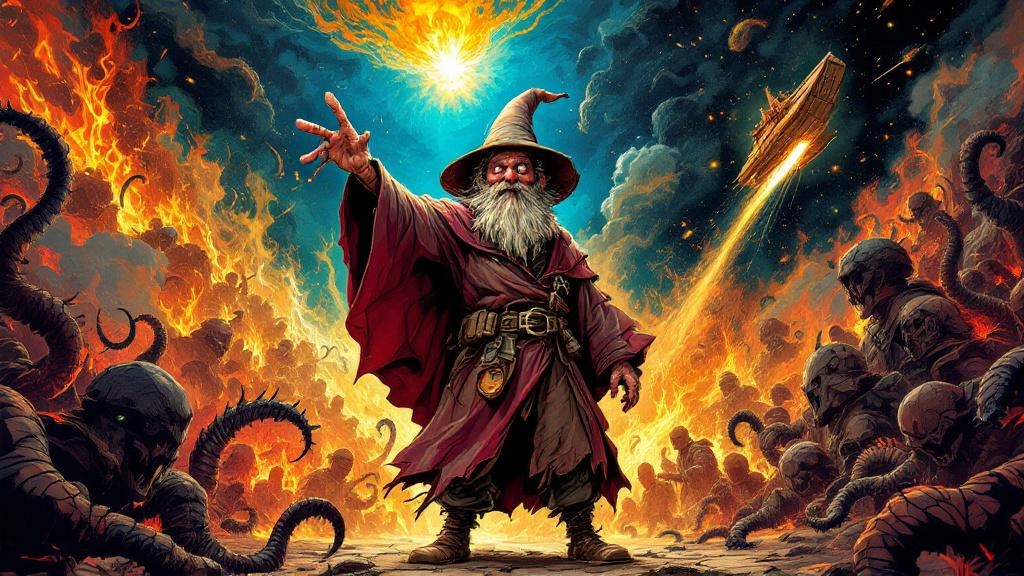
Rincewind has fallen off the world, escaped Hell, survived a war, and been launched into space. A countdown of the Discworld's most improbable survival moments.
From the Dungeon Dimensions to Space: Rincewind's Most Impossible Survivals
Rincewind should be dead. Not in the vague, theoretical sense that heavy drinkers or extreme sports enthusiasts "should" be dead. In the very specific, physics-defying, laws-of-narrative-causality-breaking sense that he has personally experienced things that should have ended him dozens of times over.
He's fallen off the edge of the world. He's been trapped in a dimension where the inhabitants want to eat reality itself. He's escaped from actual, literal Hell. He's survived a war in which both sides were trying to kill him. He's been stranded on a continent that hadn't finished being created yet. And he's been launched into space in a wooden vessel powered by swamp dragons.
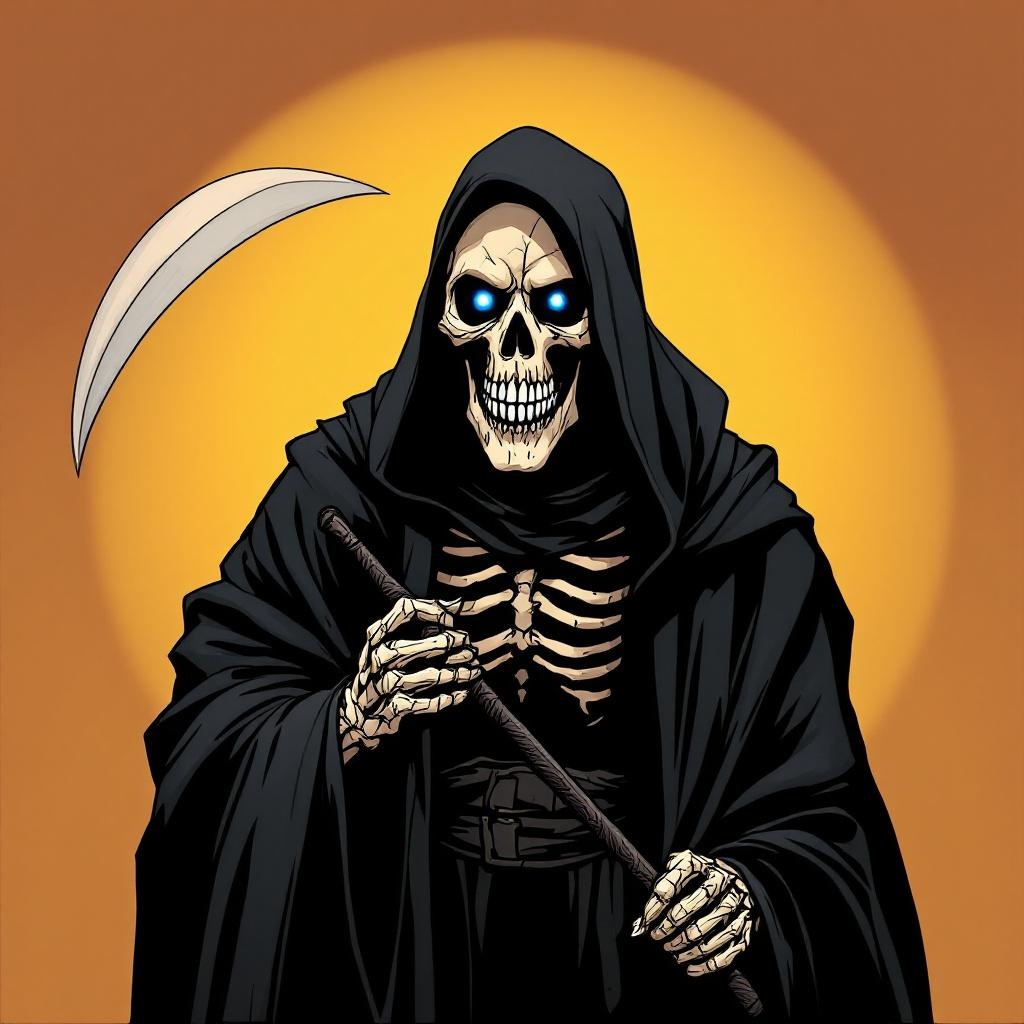
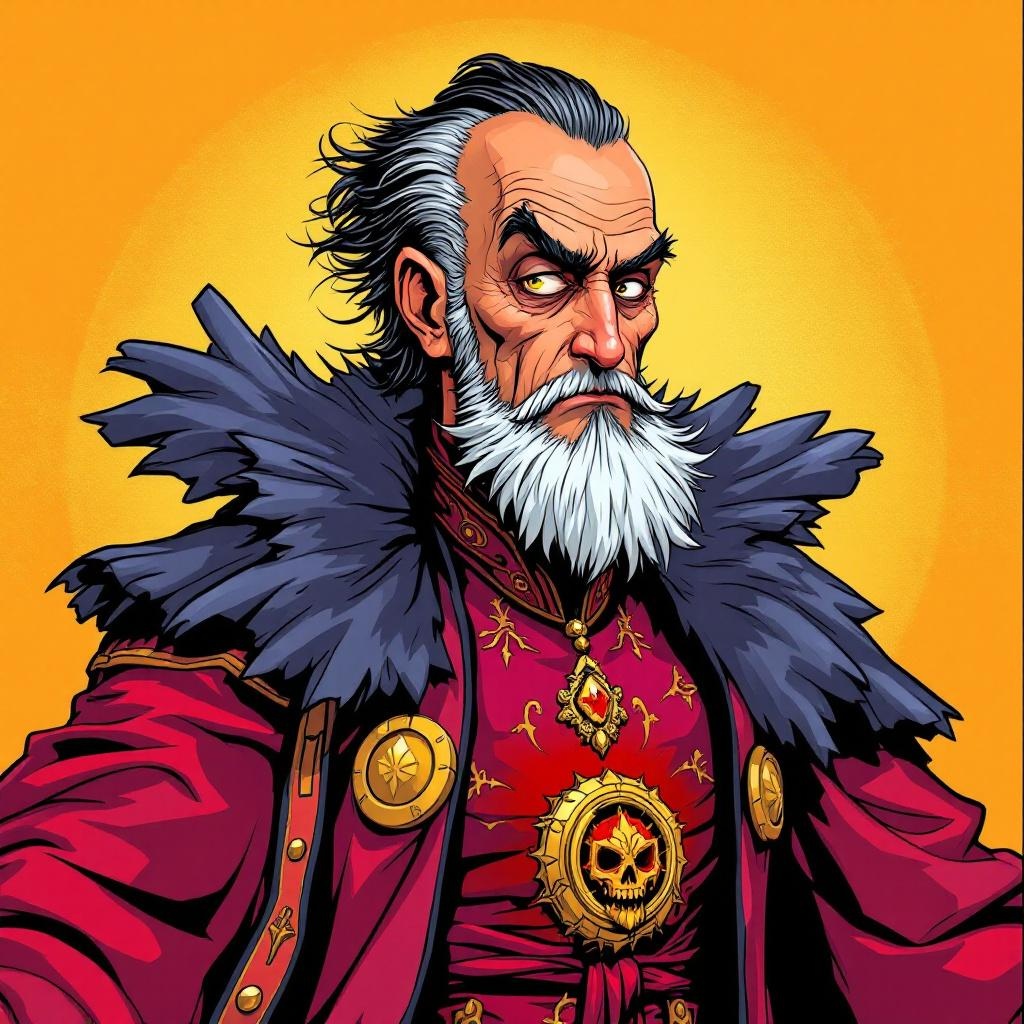
He survived all of it. Not through bravery, skill, or magical ability—Rincewind has essentially none of these things. He survived through panic, luck, and a survival instinct so powerful that Death himself keeps Rincewind's life-timer on a special shelf because he can't figure out how to read it.
Here's the catalogue of impossibility.
6. Falling Off the Edge of the World
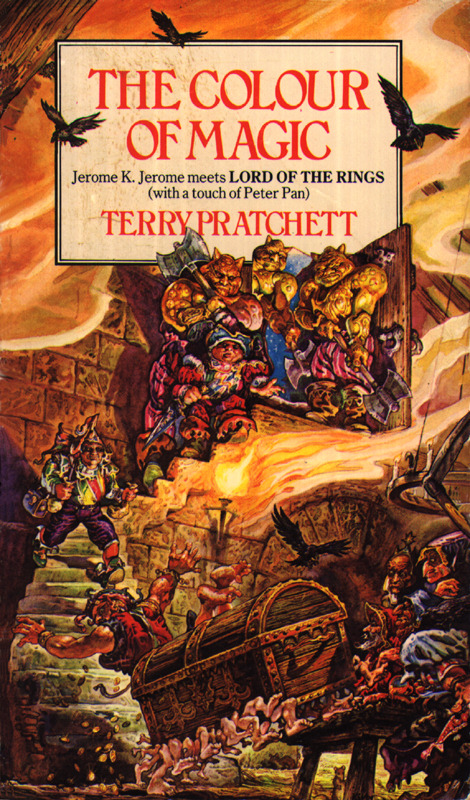
Book: The Colour of Magic Method of Almost-Death: Plummeting into infinite space Survival Strategy: The universe literally won't let him die
Let's start at the beginning. At the end of Rincewind's very first adventure, he and Twoflower fall off the Rim of the Disc. Not metaphorically. They go over the edge, past the Rimfall where the ocean pours into space, and into the void.
"Dead is only for once, but running away is for ever."
For any normal person, this is the end. There's no parachute, no safety net, no convenient updraft. Just the cold emptiness of space and a very long way down to nothing.
But Rincewind has the eighth spell of the Octavo—the Creator's own grimoire—lodged in his head since a teenage bet gone wrong. That spell has cosmic work to do. It needs to be spoken alongside its seven siblings to save the Disc from the approaching red star, and it can't do that if its host is a frozen corpse tumbling through space.
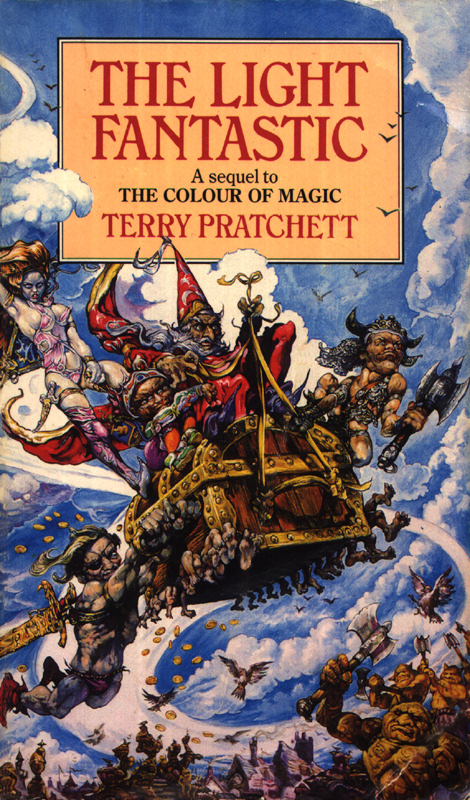
So reality intervenes. When The Light Fantastic opens, Rincewind is alive and in a tree at the very Edge, with no clear explanation for how he got there. The spell kept him alive because the story needed him alive.
It's the first time the universe saves Rincewind against his will. It won't be the last.
5. Trapped in the Dungeon Dimensions
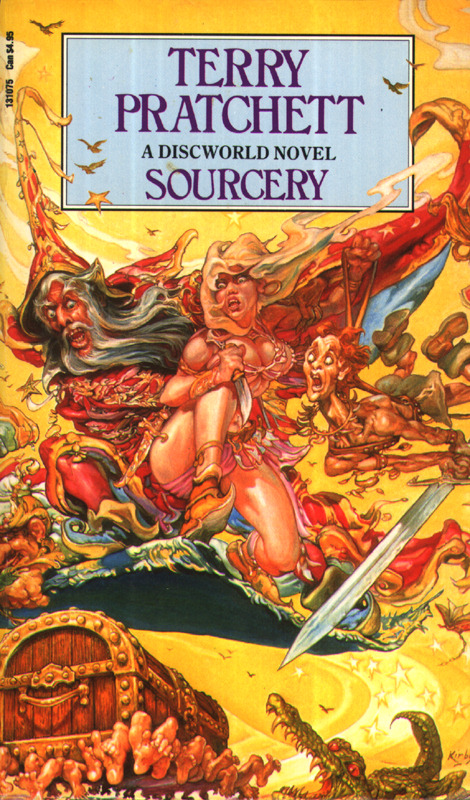
Book: Sourcery Method of Almost-Death: Imprisoned with Lovecraftian horrors Survival Strategy: Being too stubborn to be properly consumed
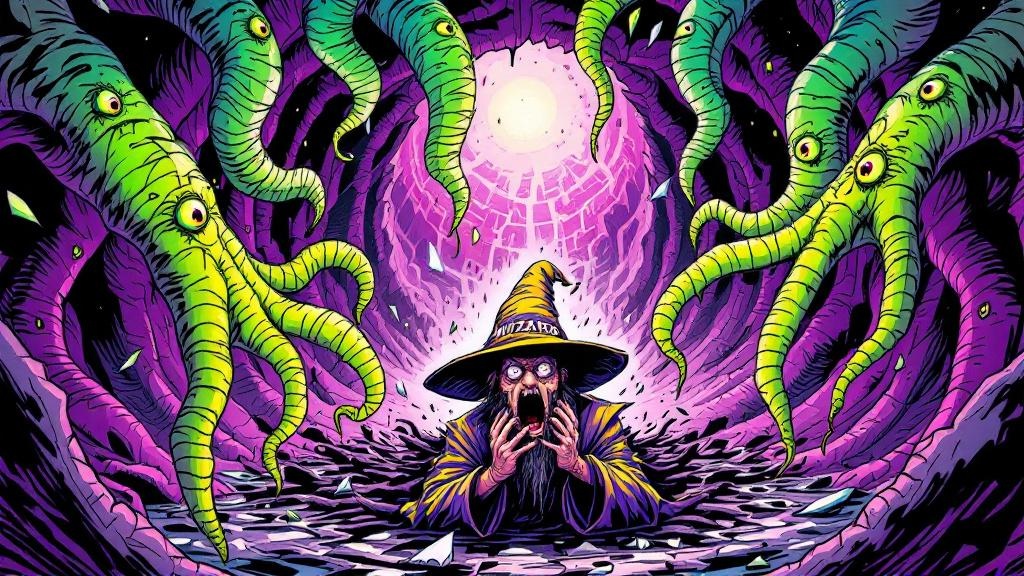
The Dungeon Dimensions are where the nightmares live. Not metaphorical nightmares—actual Things with too many tentacles and not enough respect for geometry. They exist in the gaps between dimensions, endlessly hungry, endlessly trying to break through into reality so they can devour it.
In Sourcery, Rincewind performs what remains his only deliberate act of heroism. He confronts the sourcerer Coin—a ten-year-old child being controlled by his dead father's soul—not to save the world, but to save the boy. When reality tears open and Things pour through, Rincewind stays behind to distract them while Coin escapes. The portal closes. Rincewind is trapped.
He spends years in there.
Think about that. Not hours. Not days. Years in a dimension of incomprehensible horror, with creatures that want to consume reality itself, armed with nothing but a pointy hat and a talent for screaming in forty-four languages.
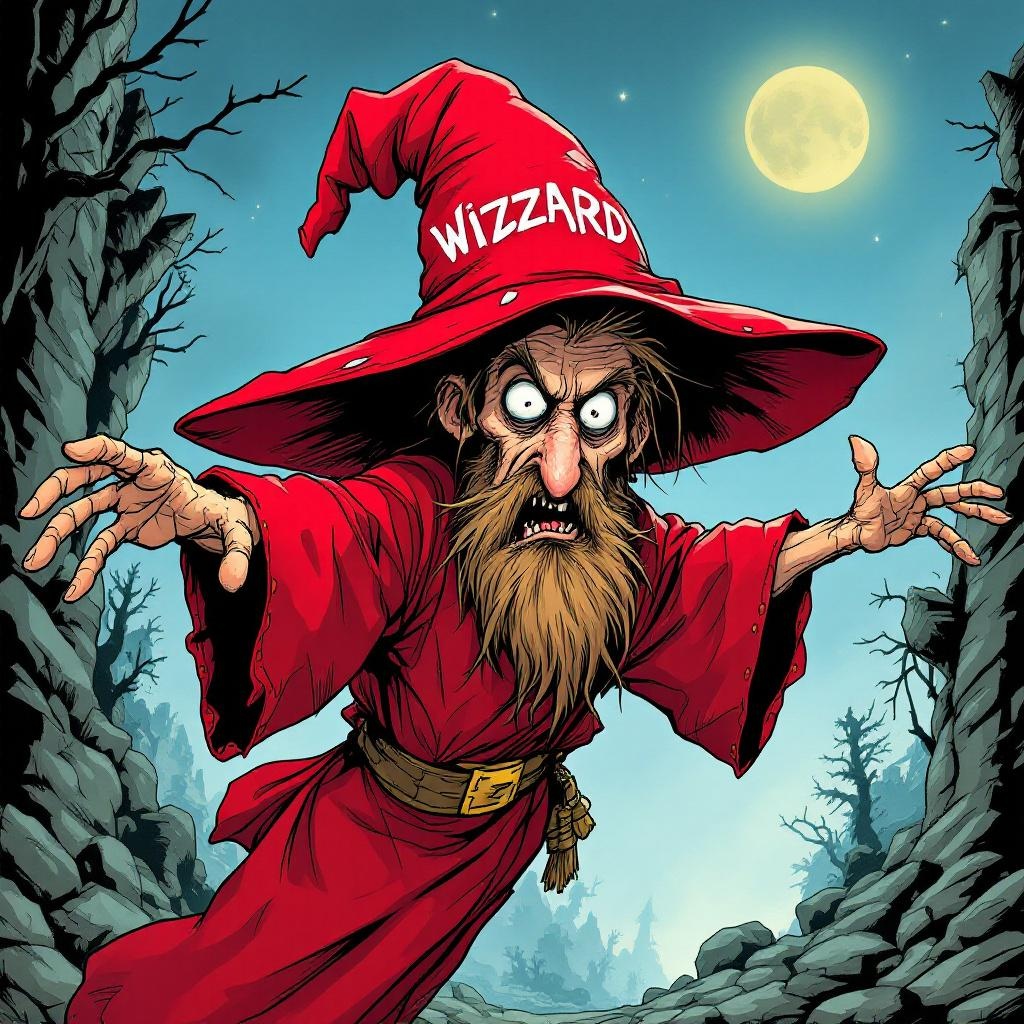
The Librarian at Unseen University places Rincewind's battered "Wizzard" hat on a pedestal in the Library. He trusts that a wizard will always come back for his hat. And eventually, through a chain of events involving a thirteen-year-old demonologist, Rincewind does.
4. Escaping Hell Through Paperwork
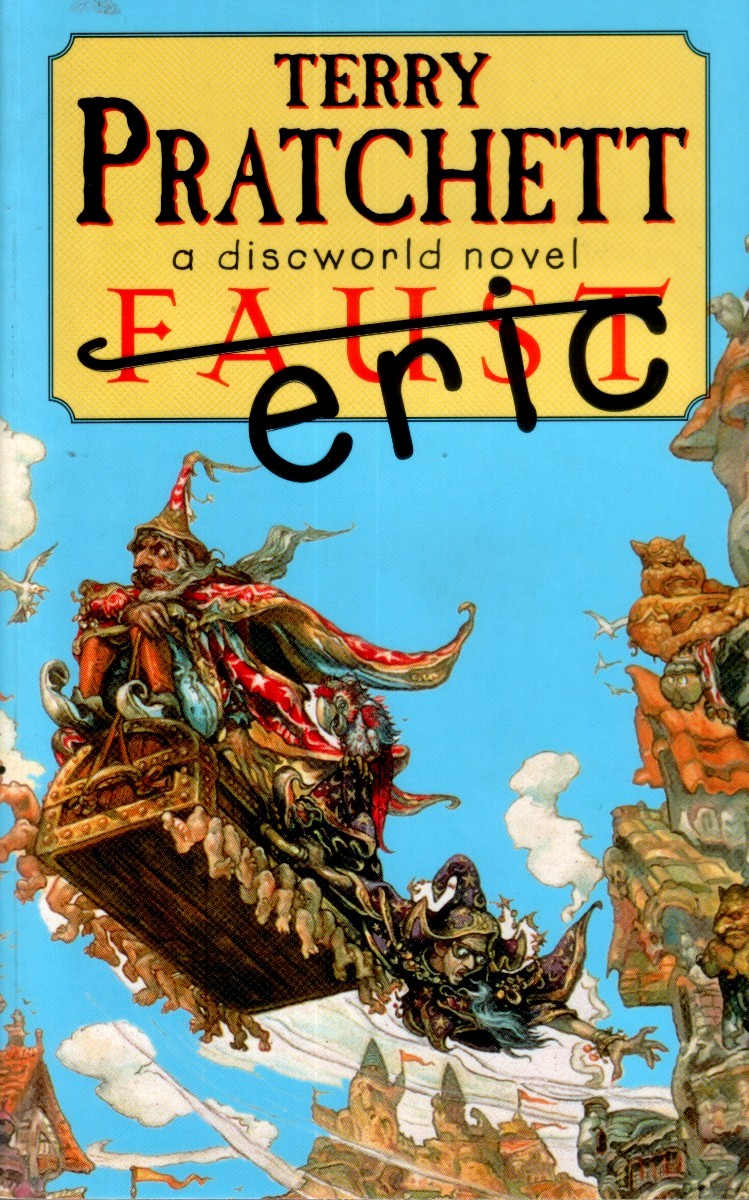
Book: Eric Method of Almost-Death: Being trapped in the actual underworld Survival Strategy: A Unseen University education, finally useful
After years in the Dungeon Dimensions, Rincewind's rescue comes from the least likely source: a teenager trying to summon a demon. Eric Thursley performs the ritual, and instead of getting a supernatural servant, he gets Rincewind—who falls out of the Dungeon Dimensions and into Eric's chalk circle looking confused and slightly singed.
"No, there aren't causes worth dying for! Because you've only got one life but you can pick up another five causes on any street corner!"— Rincewind
What follows is Pratchett's parody of the Faust legend, with Rincewind as the most useless wish-granter imaginable. Eric's three wishes—dominion over the world, the most beautiful woman, and eternal life—go catastrophically wrong. But the real survival test comes when they end up in Hell itself.
Here's the thing about Hell: the Demon King Astfgl has modernized it. Gone are the traditional pits of fire and brimstone. In their place: paperwork. Forms in triplicate. Committees. Mission statements. Performance reviews. The ultimate torture isn't physical—it's bureaucratic.
And Rincewind looks around and thinks: I know this place.
Years of navigating Unseen University's labyrinthine administration—the committees within committees, the forms that require other forms, the institutional inertia that makes actual demons look efficient—have prepared him for exactly this moment. His supposedly useless education becomes a skeleton key. He understands how bureaucracies work, how they break, and most importantly, how to confuse them.
They walk out. Through bureaucratic confusion, while a demon coup happens around them, Rincewind and Eric simply... leave. The road out is paved with good intentions—literally, each cobblestone has one written on it.
It's probably the most Pratchett survival of the lot. The system designed to trap people is defeated by someone who's spent his entire academic career trapped in a very similar system.
3. Surviving a War Where Everyone Wants You Dead
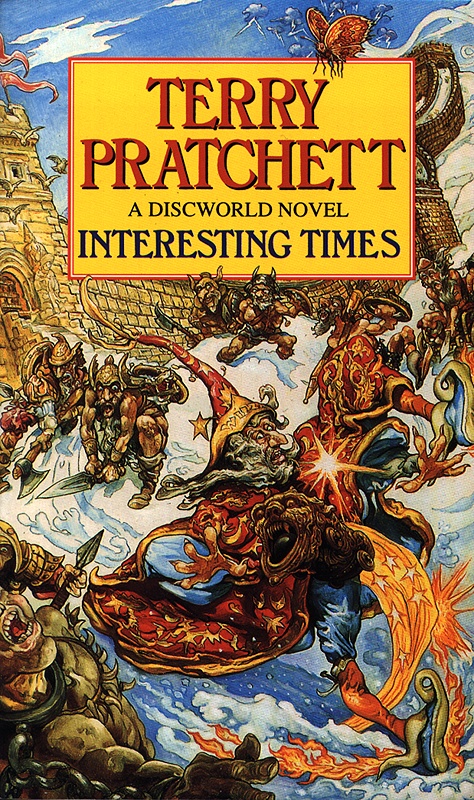
Book: Interesting Times Method of Almost-Death: Civil war with universal hostility Survival Strategy: Running directly into the solution
Rincewind is magically summoned to the Agatean Empire—Pratchett's parody of ancient China—which is in the middle of a civil war. The tyrannical Emperor is dying. Five feudal lords are fighting for control. A ragtag group of revolutionaries called the Red Army are putting up protest posters. And absolutely everyone, from the lords to the revolutionaries to random soldiers, wants Rincewind dead for various complicated political reasons he doesn't entirely understand.
His response, naturally, is to run.
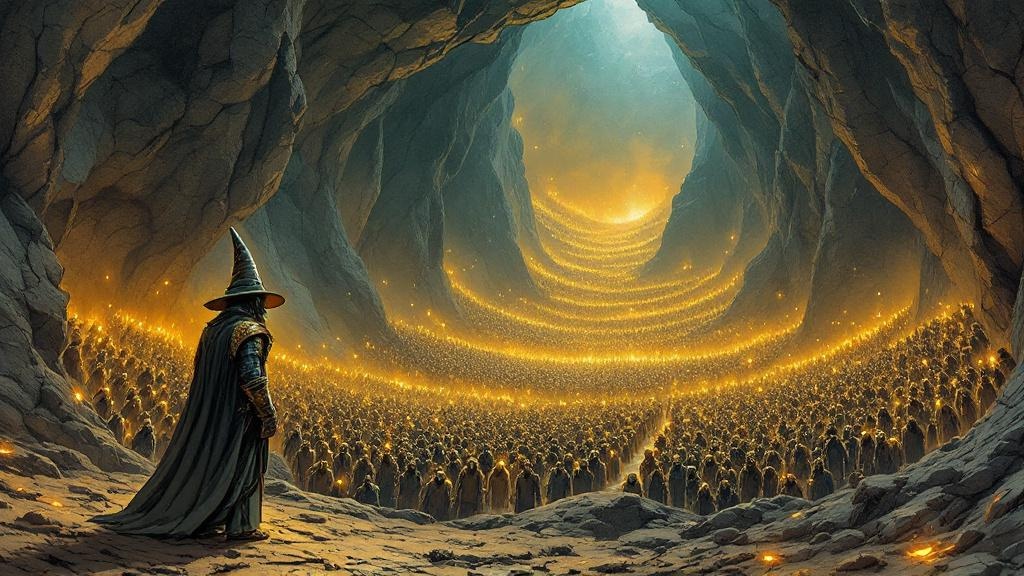
And this is where the universe does its thing. While fleeing from soldiers, Rincewind stumbles into an underground cavern containing the original Red Army—thousands of ancient terracotta warriors, enchanted and waiting. He accidentally dons a suit of magical armor that gives him command of the entire clay army, and while still desperately trying to escape, leads them into battle.
He doesn't mean to save the revolution. He doesn't mean to topple the feudal lords. He's trying to find the nearest exit. But the universe bounces him around like a pinball until he crashes into the jackpot.
This is also where he reunites with Twoflower, now older and more politically aware, whose naive travelogue from their first adventure together has accidentally inspired the revolution. "Interesting times" indeed.
2. Being the Chosen One of an Unfinished Continent
Book: The Last Continent Method of Almost-Death: Everything. Literally everything. Survival Strategy: Running away in a land where running away is the only correct response
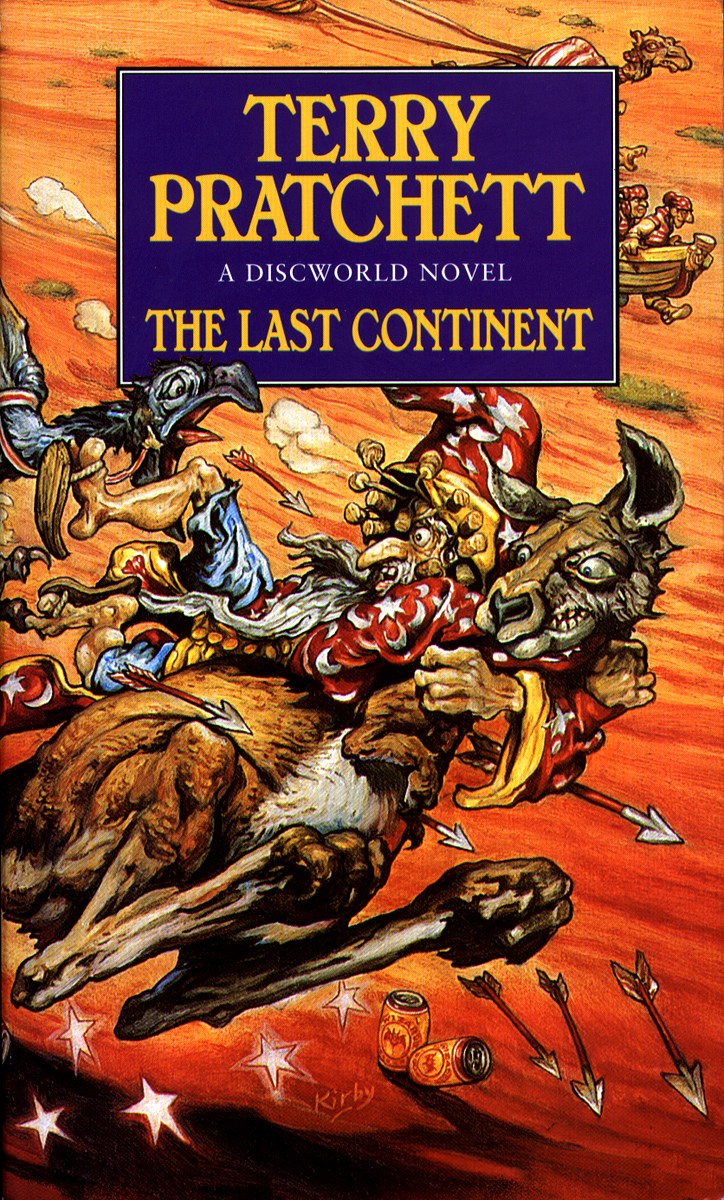
XXXX—the Last Continent, pronounced "four-ecks"—is Pratchett's love letter to Australia. It's a continent where everything is trying to kill you: the wildlife, the landscape, the weather, even the beer. The whole place hasn't finished being created, which means time and space don't work properly, the drought has lasted since the beginning, and reality keeps hiccupping.
It is, in other words, the most perfectly matched setting Rincewind has ever visited.
"People shot you instantly if they thought you were going to shoot them. But if you were unarmed, they often stopped to talk."— Rincewind, The Last Continent
Because here's the thing: on a continent where literally everything is lethal, Rincewind's philosophy of "see danger, run from danger" isn't cowardice. It's the only rational survival strategy. Every other character in the book keeps nearly dying because they approach XXXX like normal people. Rincewind survives because he approaches it the way he approaches everything—in a state of maximum paranoia.
He's helped along by Scrappy, a talking kangaroo who turns out to be the Trickster incarnate. Scrappy explains that Rincewind is fated to bring back the rain and complete the continent's creation. Rincewind is, predictably, horrified by this.
The resolution is pure Rincewind. He picks up a bullroarer—an indigenous ceremonial instrument—and idly fidgets with it. The thing starts spinning faster than it should, flying further than physics allows. When he lets go, it triggers the rain. He saves an entire continent and completes the act of creation by fidgeting.
Meanwhile, back in time, the wizards of Unseen University are accidentally creating the platypus by committee, because of course they are.
1. Going to Space in a Wooden Ship
Book: The Last Hero Method of Almost-Death: Everything about this is wrong Survival Strategy: Pure resignation
This is it. The big one. The survival that defies every law of physics, magic, and common sense.
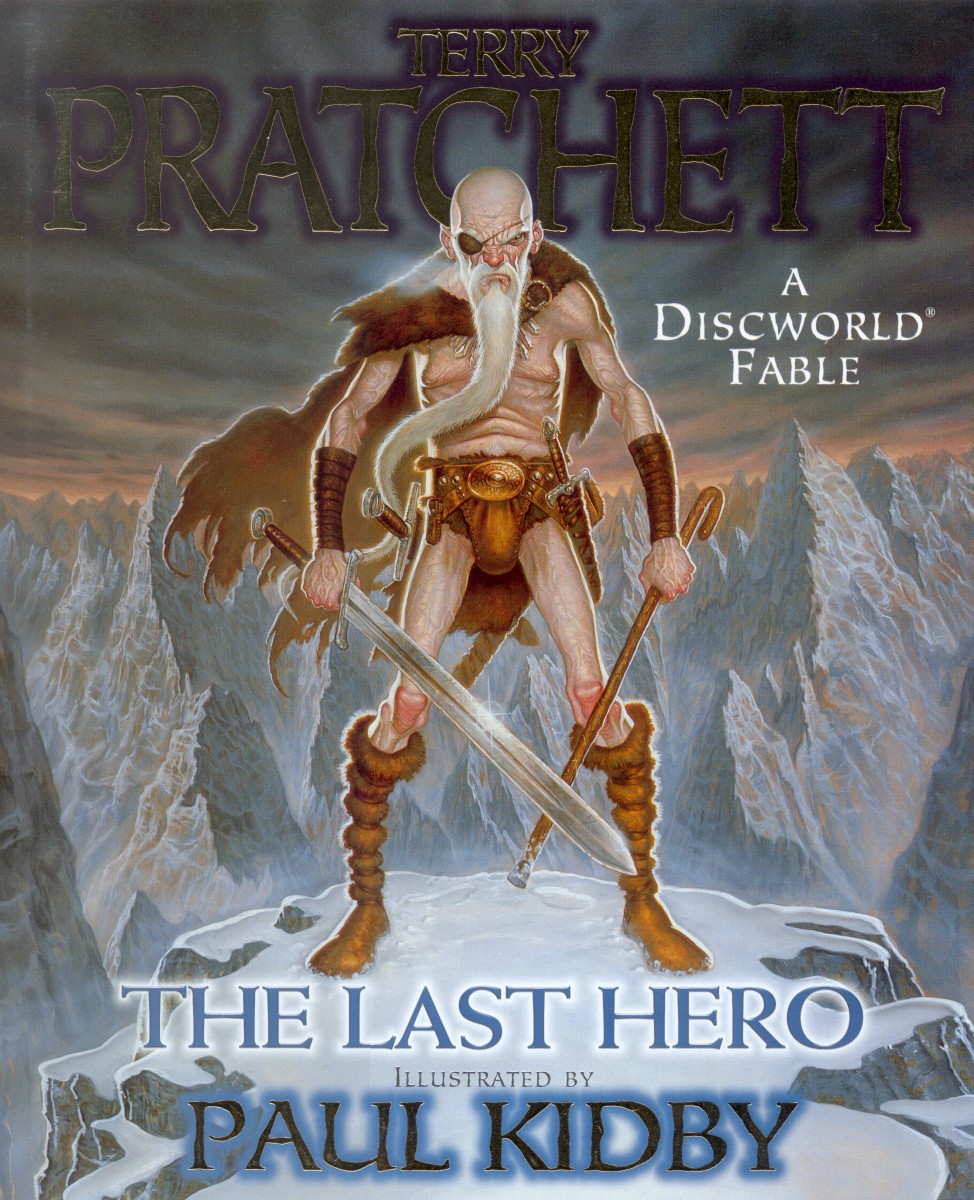
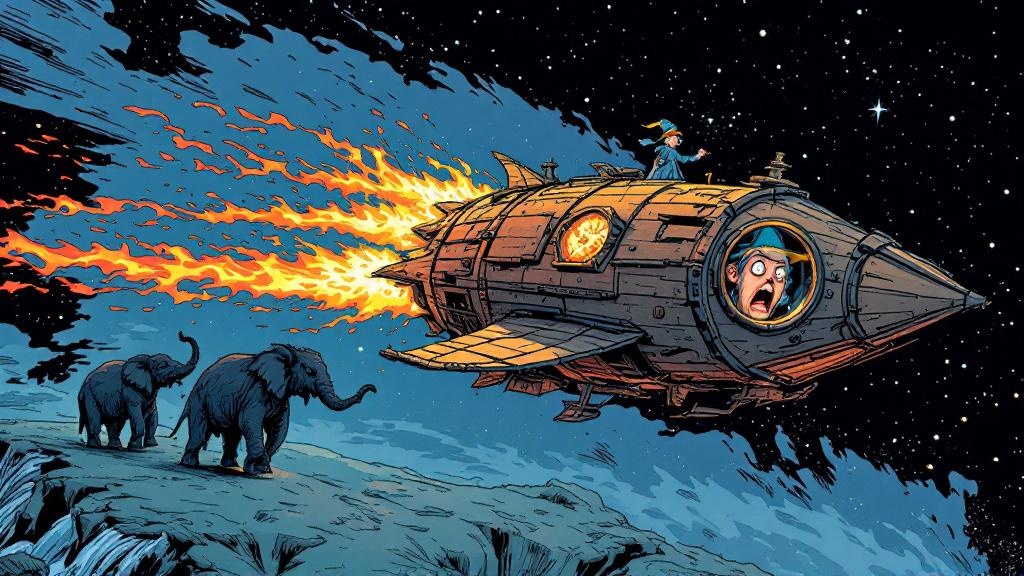
Cohen the Barbarian and his Silver Horde have decided to return fire to the gods—literally, by climbing Cori Celesti with a cartload of explosives. If they succeed, the Disc's magical field collapses and everyone dies. Someone has to stop them, and this requires flying to the mountain of the gods in a wooden vessel designed by Leonard of Quirm, powered by volatile swamp dragons.
The mission is essentially strapping yourself to a bomb and hoping it doesn't go off before you reach the other bomb.
Rincewind volunteers.
Not because he's brave. Not because he's found courage. Because he's finally understood the pattern. Eight books' worth of being conscripted by the universe has taught him that resistance is futile. If he doesn't volunteer, something will put him on that ship anyway—a magical summons, a collapsing floor, a series of improbable events ending with him in the pilot's seat wondering how this happened again.
So he shows up. And he proposes the mission motto: "Morituri Nolumus Mori"—"We who are about to die don't want to."
The Kite launches. They survive the launch (barely). They pass between the four elephants that hold up the Disc (terrifying). They land on the moon (improbable). They reach Cori Celesti (impossible). And Rincewind, the least magical wizard who ever lived, helps convince Cohen not to blow up the gods.
When the gods offer the survivors a reward, Leonard asks to paint the temple ceiling. Carrot asks for repairs to the ship. Rincewind—the man who has survived falling off the world, the Dungeon Dimensions, Hell, a civil war, an unfinished continent, and space travel—asks for a balloon.
A blue one.
The Running Tally
Here's what makes Rincewind's survival record truly remarkable: he doesn't get better at any of this.
Most characters in fiction grow. They learn from their experiences. They become braver, stronger, more capable. By the end of their arc, they can face the final challenge with hard-won confidence.
Rincewind is exactly as terrified in The Last Hero as he was in The Colour of Magic. Twenty-five years of publication, eight books of catastrophic adventure, and he hasn't gained a single hit point. He is, at every moment, a deeply ordinary man in deeply extraordinary circumstances, surviving through the only tools he has: legs that run fast, a mouth that screams loud, and a universe that apparently needs him alive.
"It takes guts to run away, you know. Lots of people would be as cowardly as me if they were brave enough."
Death has a theory about this. He thinks the Discworld might need an Eternal Coward the way it needs an Eternal Champion—a cosmic archetype, a necessary opposite, the anti-hero with a thousand retreating backs. It would explain the impossible life-timer. It would explain why every attempt to kill Rincewind bounces off the fabric of reality like a stone off armored plating.
But here's what Death's theory doesn't account for: Sourcery. The one time Rincewind stayed. The one time he didn't run. The one time he looked at a frightened child and decided that some things matter more than survival.
Maybe the Eternal Coward theory is right. Maybe the universe does need Rincewind alive. But it needed him alive in the Dungeon Dimensions too, and he chose to go there anyway.
That's not luck. That's not cosmic function. That's a man who runs from everything except the things that actually matter.

For Rincewind's fully articulated philosophy of survival through retreat, read Rincewind's Philosophy of Running Away. For the one exception to the running rule, see A Half-Brick in a Sock: His Only Deliberate Heroism. And for Death's cosmic theory about why none of this should be possible, read The Eternal Coward.