Rincewind and Twoflower: The Discworld's Most Unlikely Friendship

How Rincewind went from trying to rob Discworld's first tourist to breaking him out of prison. The evolution of fantasy's most reluctant friendship.
Rincewind and Twoflower: The Discworld's Most Unlikely Friendship
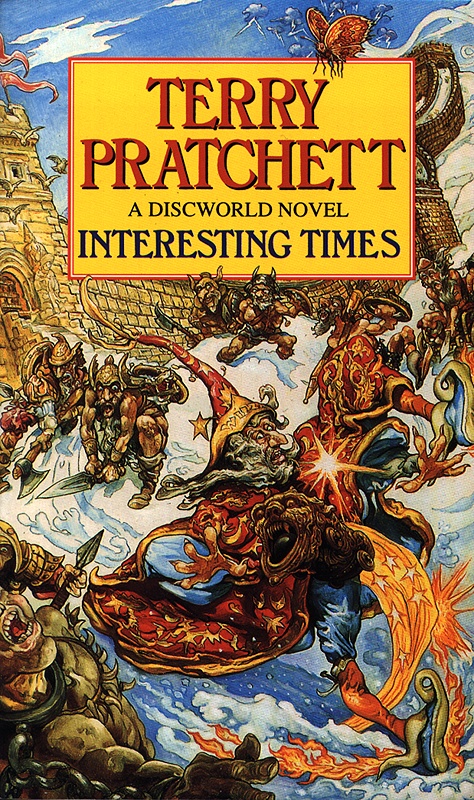
When we first meet Rincewind and Twoflower together, Rincewind is trying to steal the tourist's money and skip town. By Interesting Times, fifteen books and eight real-world years later, he's breaking Twoflower out of a dungeon in the Agatean Empire.
Nobody planned this. Least of all Rincewind.
Their relationship is one of Discworld's quiet triumphs—a friendship that neither character would call a friendship, built on mismatched temperaments, near-constant mortal danger, and a shared talent for being in exactly the wrong place at the wrong time. It's also, somehow, one of the most emotionally satisfying arcs in the entire series.
The Coward and the Tourist
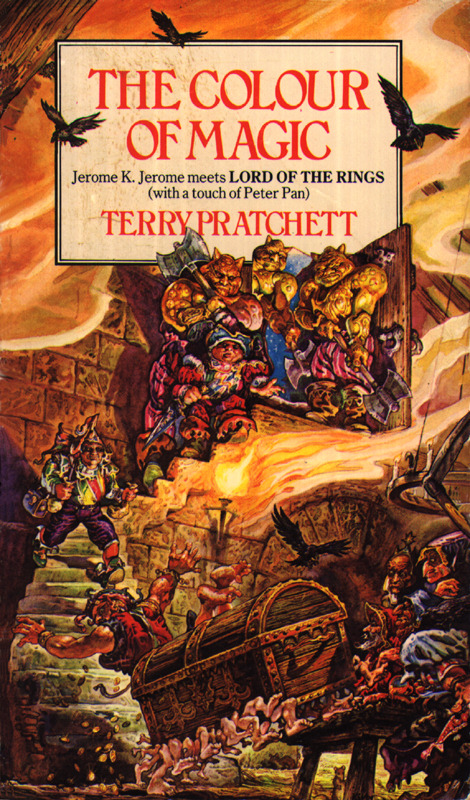
The setup is pure comedy. In The Colour of Magic, Lord Vetinari forces Rincewind to act as guide for the Disc's first tourist—a cheerful insurance actuary from the Counterweight Continent who has come to Ankh-Morpork because he's read about it in books and thinks it sounds wonderful.
"Disliking him would be like kicking a puppy."
Rincewind's initial assessment is not generous. Twoflower is "obviously insane." He photographs things that are trying to kill him. He tips generously in a city where generosity gets you mugged. He looks at a bar fight and sees local colour.
But even in those early pages, something shifts. Rincewind "rather liked him. Disliking him would be like kicking a puppy." It's grudging. It's reluctant. It's exactly how Rincewind would stumble into caring about someone—accidentally, while trying not to.
Their dynamic is the oldest comedy double act in the book: the cynic and the optimist, the coward and the innocent, the man who sees danger everywhere and the man who doesn't see it at all. Pratchett knew this formula. What makes it work is that he refuses to let it stay formulaic.
Rose-Tinted Everything
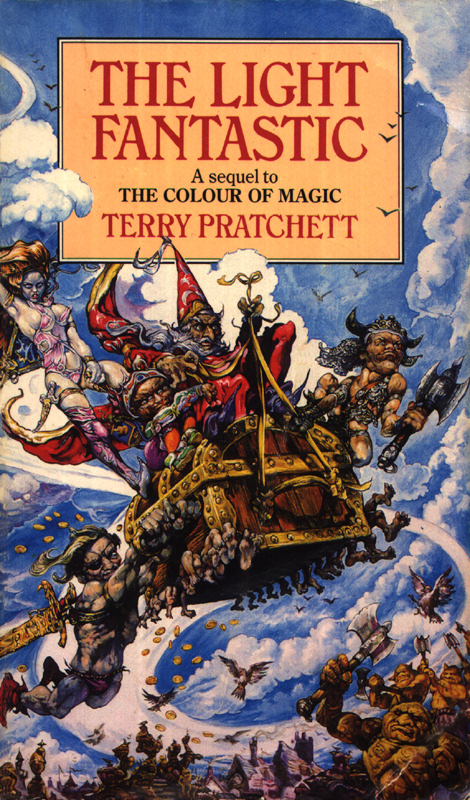
The Light Fantastic is where the relationship deepens. With the world ending—a massive red star bearing down on the Disc—Rincewind and Twoflower are thrown together again, this time without the Patrician's threat to keep them paired. They stay together because, by now, that's just what they do.

It's during this book that Rincewind has his most honest moment of reflection about Twoflower. He thinks about how Twoflower doesn't just look at the world through rose-tinted spectacles—"he looked at it through a rose-tinted brain, too, and heard it through rose-tinted ears." Where a poet would stare at a daffodil and write something beautiful, Twoflower would wander off to find a book on botany.
Then comes the line that matters: "He just looks at things, but nothing he looks at is ever the same again. Including me, I suspect."
That final clause—"Including me, I suspect"—is quietly devastating. Rincewind is admitting, in his sideways, reluctant fashion, that Twoflower has changed him. Not by teaching him to be brave. Not by showing him the beauty of the world. But simply by being someone who sees things differently and, through sheer stubborn optimism, makes Rincewind see them differently too.
The Parting That Hits Harder Than It Should
At the end of The Light Fantastic, the world is saved. The spells have been spoken. Rincewind can finally learn magic again (theoretically, at least—he never quite manages it). And Twoflower announces he's going home.
"He found himself feeling sorry that Twoflower was leaving, and that was him really realizing he was going to miss the tourist."
This shouldn't be a big moment. Twoflower was never supposed to be permanent. He was a tourist—visiting was always the point. But Rincewind had been making plans. He'd assumed Twoflower would stay at Unseen University, that their accidental partnership would just continue.
Instead, Twoflower leaves. And Rincewind is surprised to discover that he minds.
Fans on the Terry Pratchett Forums have called this parting "more affecting than the end of Lord of the Rings"—a comparison that sounds absurd until you've read it. The power comes from its understatement. There's no dramatic farewell speech. No tearful embrace. Rincewind simply realizes he's sad, and the realization catches him off guard.
Before he goes, Twoflower gives Rincewind The Luggage.
The Luggage: A Friendship Made Sapient Pearwood
If you want to understand what Twoflower means to Rincewind, look at what he leaves behind.
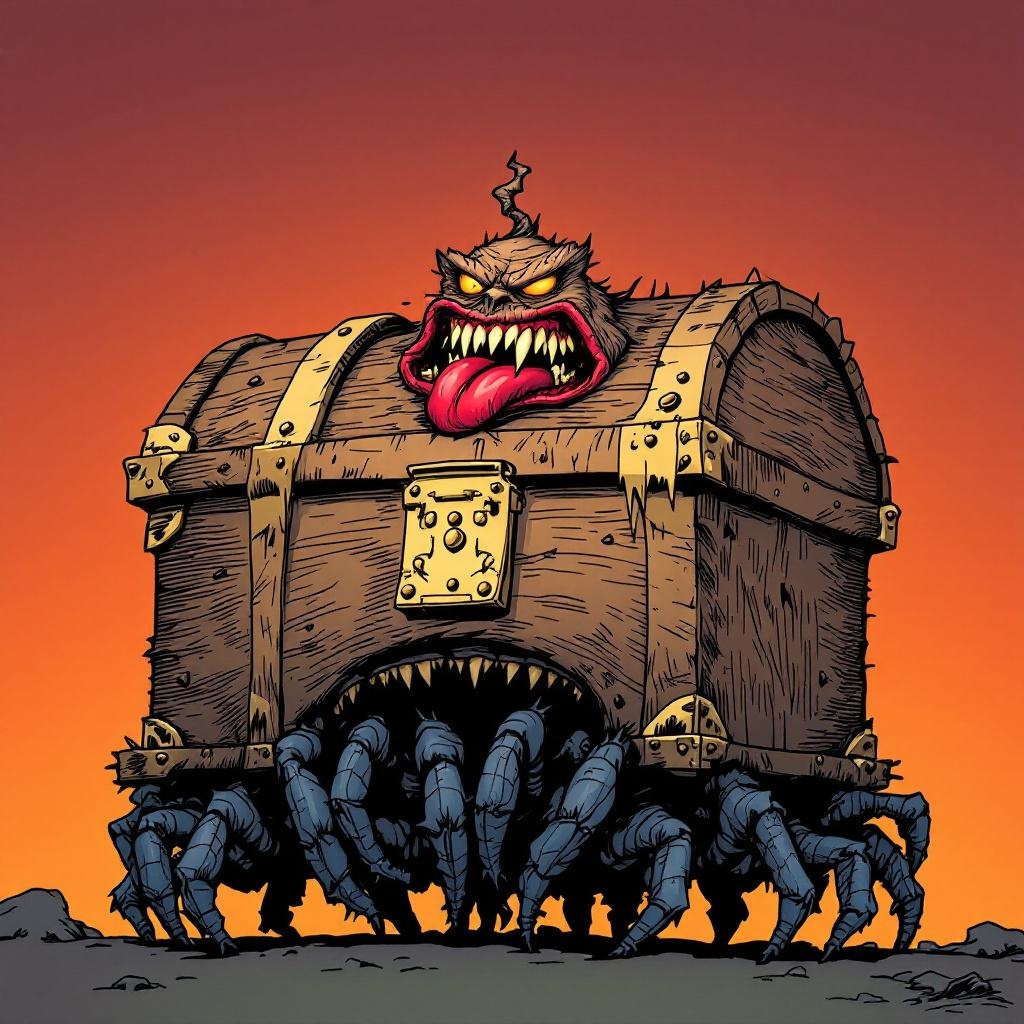
The Luggage is a chest made of sapient pearwood—a rare, magical material that makes it sentient, loyal to its owner, and murderously protective. It has hundreds of tiny legs. It can eat people. It follows its master across continents, through dimensions, and occasionally through time itself.
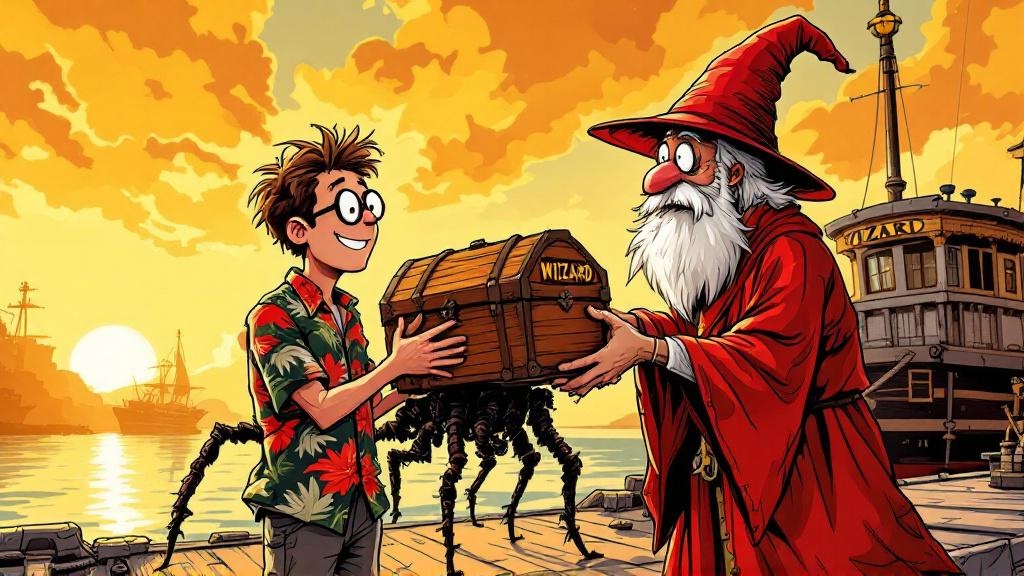
Twoflower gives this to Rincewind. Think about what that means.
Twoflower knows Rincewind's primary survival strategy is running away. He knows the wizard has no magical ability, no combat skills, no allies willing to risk their necks for him. So he leaves behind his most faithful companion—a thing that will protect Rincewind with lethal force, whether Rincewind wants protecting or not.
It's an act of care disguised as a practical gift. And it works. The Luggage follows Rincewind through Sourcery, Faust Eric, Interesting Times, and every subsequent adventure. It's there in the Dungeon Dimensions. It's there on the Counterweight Continent. It's there in space.
A piece of Twoflower's world, following Rincewind everywhere. Long after the tourist has gone home, his gift keeps showing up, keeps biting things, keeps making sure the worst wizard in the world doesn't die.
When Rincewind finally visits the Counterweight Continent in Interesting Times, he discovers that sapient pearwood luggage is common there—many travelers have their own faithful trunks. The Luggage isn't unique. But the act of giving it away is. In Twoflower's culture, this is like giving someone your dog. Your very large, very angry, very loyal dog.
Fifteen Books Later
Then comes Interesting Times, and everything pays off.
Rincewind is magically transported to the Agatean Empire against his will (naturally). He's thrown into a dungeon cell. And from the cell next door comes a voice he hasn't heard in fifteen novels.
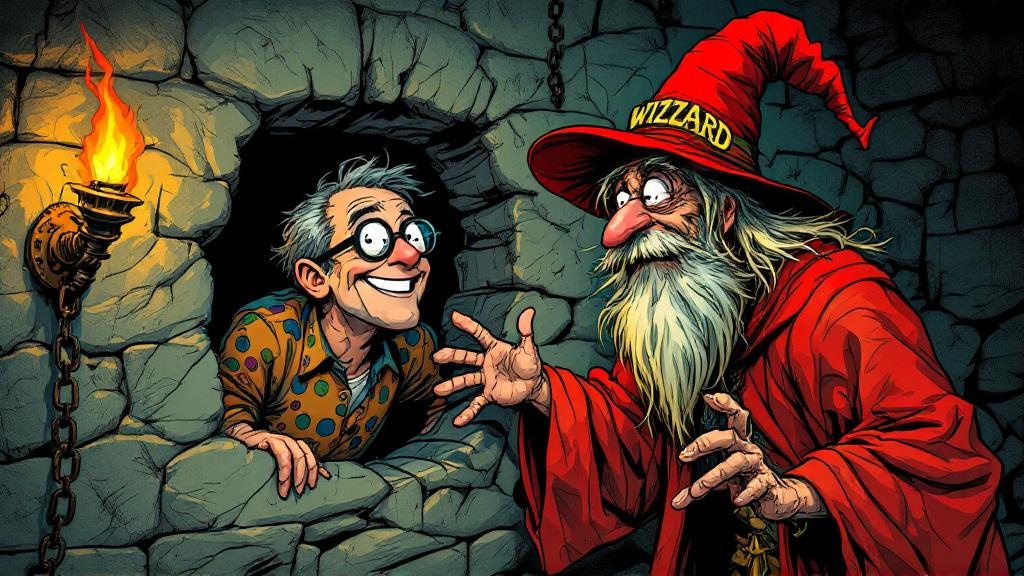
Twoflower knocks out a section of wall to tell Rincewind he's not allowed to talk to him. Because of course he does—he's following the rules literally while breaking them completely. Same old Twoflower.
"Same old Rincewind," Twoflower says when they meet face to face. "You always were so pessimistic about everything, but it always worked out all right in the end."
Rincewind would dispute this. Strongly. But the reunion scene works because it's so easy. There's no awkwardness, no "it's been so long." They fall back into their dynamic instantly—Twoflower cheerfully oblivious, Rincewind despairingly aware of exactly how much danger they're in.
"The important thing is that someone should stand up to you. Whatever happens to them afterwards."
But Twoflower has changed. His innocent travelogue about Ankh-Morpork—"What I Did on My Holidays"—has accidentally inspired a revolution. His daughters, Pretty Butterfly and Lotus Blossom, lead the rebel Red Army. And when Twoflower confronts the villain Lord Hong, who killed his wife, he says something that reframes his entire character: "The important thing is that someone should stand up to you. Whatever happens to them afterwards."
That's not naivety. That's courage. It always was.
The Optimist Was Right All Along
Here's the thing about Rincewind and Twoflower that Pratchett never states directly but builds across three books and fifteen years of writing: the optimist was right.
Rincewind's worldview says everything is dangerous, everyone is out to get you, and the sensible response is to run. Twoflower's worldview says the world is fascinating, people are basically interesting, and everything will probably work out.
By Interesting Times, Twoflower's naive travelogue has sparked a revolution. His daughters are freedom fighters. He stands up to a murderer without flinching. And he ends the book as Grand Vizier of the Agatean Empire—the most innocent man on the Disc, running a country.
Rincewind survives. He always survives. But Twoflower thrives.
The cynic keeps his head down and gets through life. The optimist changes the world. Pratchett doesn't belabor this point—he's far too subtle for that—but it's there in the structure of the story, in the arc from tourist to revolutionary to statesman.
And Rincewind, who spent two books complaining about this annoying tourist, has been carrying a piece of him everywhere for fifteen novels. The Luggage isn't just luggage. It's proof that Twoflower was right about Rincewind, too—that underneath the cowardice and the cynicism, there's someone worth protecting.
Why This Friendship Works
Most fictional friendships are built on shared values, mutual respect, or complementary skills. Rincewind and Twoflower share almost nothing. One is a cynical survivor; the other is a relentless optimist. One runs from everything; the other walks toward it with a camera.
What makes them work is simpler than chemistry. It's exposure.
They spend enough time together—running from trolls, falling off edges, dodging dragons—that Rincewind stops being able to pretend Twoflower is just an annoying obligation. You can maintain emotional distance from someone for a day. Maybe a week. But two books' worth of near-death experiences? At some point, the guard comes down.
Rincewind never says "you're my friend." He'd rather eat his own hat (which says "Wizzard" on it, so that's quite a commitment). But he travels across the Disc to the Counterweight Continent, fights in a revolution he doesn't believe in, and helps Twoflower's daughters because... well, because they're Twoflower's daughters. He'd never admit that's why. But it is.
The literary critic's reading—that Twoflower represents the reader, the enthusiastic tourist in Pratchett's world, while Rincewind is the reluctant guide—makes their friendship even more resonant. If Twoflower is us, then Rincewind's gradual, grudging affection for him is Pratchett's message about what happens when you let someone else's enthusiasm past your defenses.



Read Them Together
The beauty of this friendship is that it bookends the Rincewind subseries. Start with The Colour of Magic and The Light Fantastic to see the relationship form. Then skip ahead to Interesting Times to see what time and distance do to it.
You'll find that Pratchett built something remarkable without ever making a fuss about it. No dramatic declarations. No tearful monologues. Just a coward who kept a murderous suitcase because a tourist gave it to him, and a tourist who started a revolution because a coward once showed him the world.
Some friendships are built on grand gestures. This one was built on shared panic, reluctant affection, and a chest that bites people.
It's enough.
For more on Rincewind's survival philosophy, read about his religion of running away. To see his one moment of true heroism, explore how he saves the world by trying not to.