SIT! BAD DOG!: Gaspode's Victory Over Big Fido and the Philosophy of Dog Obedience
How Gaspode the Wonder Dog defeated Big Fido's Dog Guild with two words in Men at Arms — and what it reveals about Pratchett's philosophy of domestication.
SIT! BAD DOG!: Gaspode's Victory Over Big Fido and the Philosophy of Dog Obedience
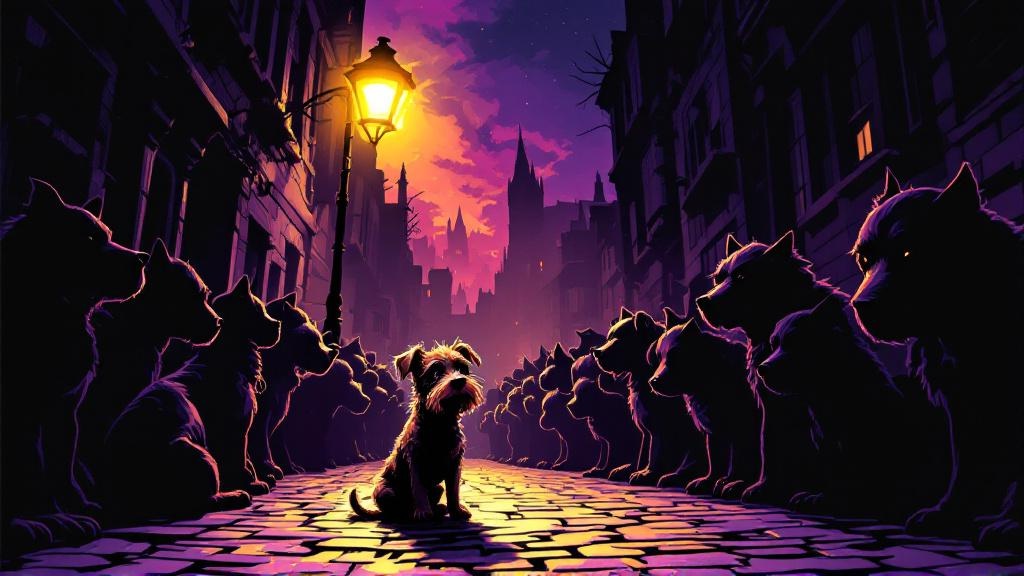
A tiny, mangy, flea-bitten mutt stands in an alley, surrounded by fifty attack dogs who have been ordered to kill him. He has no weapons, no backup, and—if we're being honest—not much in the way of personal hygiene. What he does have is the Power.
He opens his mouth, and in passable human, shouts: "SIT!"
Fifty per cent of the animals obey. In most cases, it's the hind fifty per cent.
This is the funniest scene in Men at Arms. It might also be the most philosophically devastating thing Terry Pratchett ever wrote about what it means to be a domesticated creature.
The Revolutionary and the Street Dog
To understand why this moment lands so hard, you need to understand what Gaspode is up against.
Big Fido is a small, mad-eyed poodle with flatulence and delusions of grandeur. He runs the Dog Guild of Ankh-Morpork—an underground canine organization that has, under his leadership, become something between a political movement and a death cult. Big Fido's platform is simple: dogs are wolves. They've been enslaved by humans, corrupted by millennia of domestication, and must reclaim their savage heritage. He preaches racial purity, wolf names like "Silverheart" and "Darkfur," and the right of every dog to run free and hunt as nature intended.
If that sounds familiar, it should. Fans have noted that Big Fido's rhetoric mirrors fascist ideology almost point for point—the myth of a lost golden age, the call to racial purity, the glorification of violence as liberation. The satirical knife twists deeper when you remember that Big Fido is a poodle. A small, flatulent poodle delivering speeches about the master race. Pratchett understood that the most dangerous demagogues are often the most absurd.
"No, mad's when you froth at the mouf. He's insane. That's when you froth at the brain."— Gaspode
Big Fido enforces his ideology with violence. Any dog caught being kind to a human faces execution. The Dog Guild has become a pack of killers who believe they're freedom fighters—which is to say, exactly what every pack of killers has believed throughout human (and, apparently, canine) history.
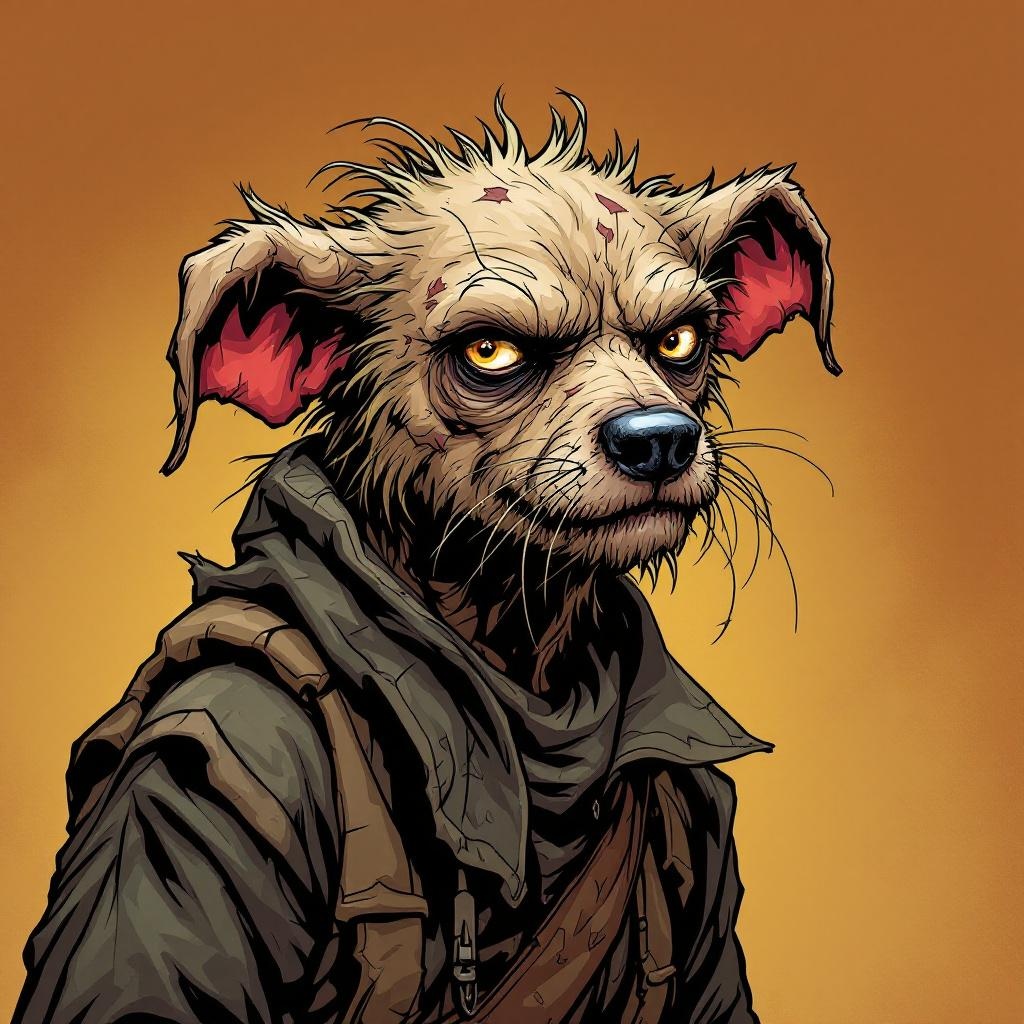
And into this steps Gaspode: a street dog whose intelligence came from eating magically contaminated rubbish near Unseen University, whose list of diseases is so long they've reportedly started fighting each other, and whose survival strategy has always been cynicism, fast talking, and knowing when to run.
He is, in every way, the opposite of Big Fido's ideal. Small where Fido wants big. Scruffy where Fido wants pure. Practical where Fido wants mythic. And he is about to bring the entire revolution crashing down with two words.
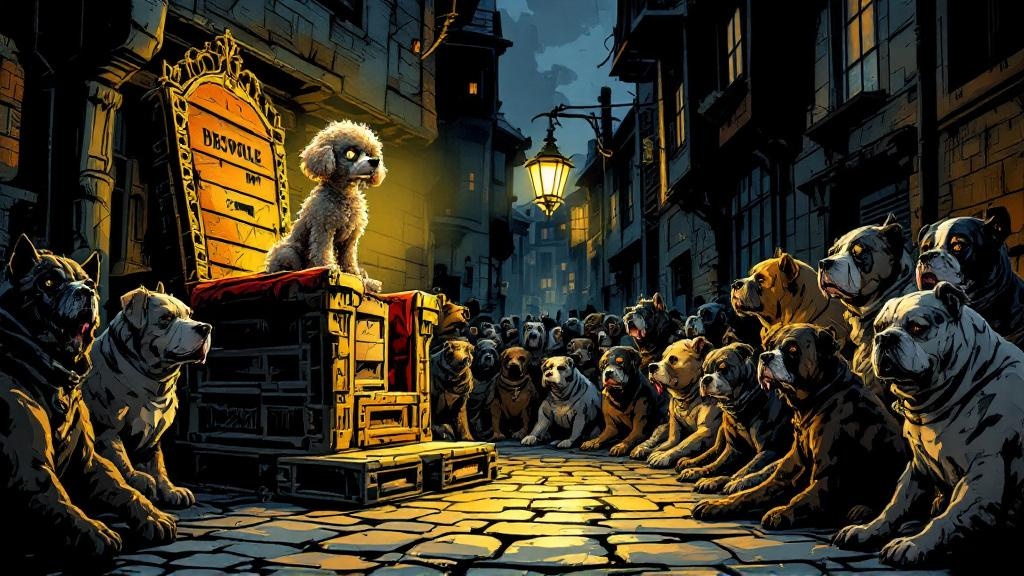
The Power
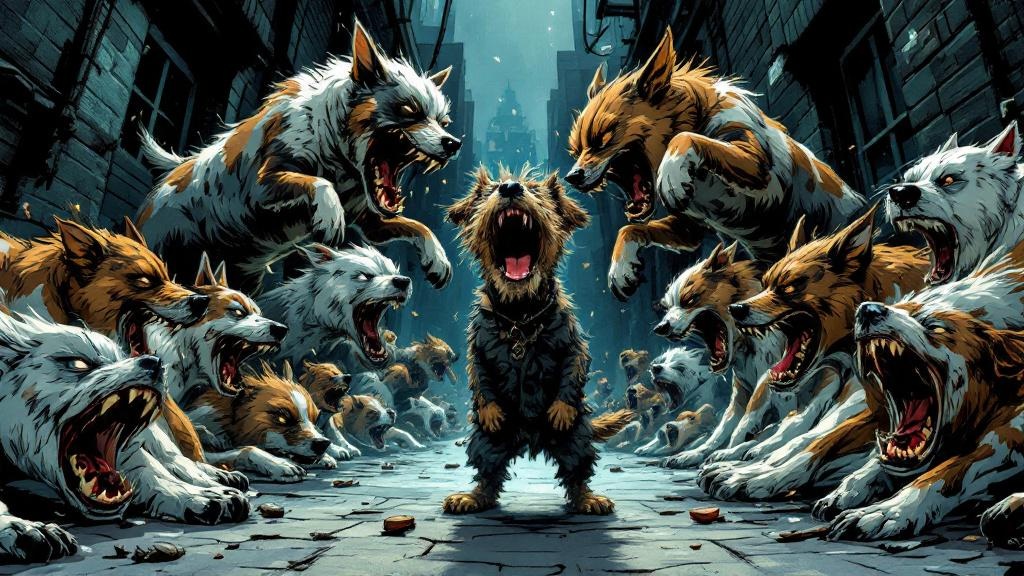
The scene itself is beautifully constructed. Big Fido orders his pack to attack. Fifty dogs lunge. And Gaspode, who can speak human because magic gave him something no dog was ever meant to have, uses that gift in the most devastating way possible.
"SIT!" he shouts.
The command bounces around the alley. Dogs in mid-spring find their treacherous legs coiling beneath them. It doesn't matter that they've been told they're wolves. It doesn't matter that Big Fido has spent months preaching liberation from human control. The word "SIT" reaches something deeper than ideology—it reaches instinct, conditioning, thousands of years of selective breeding. The dogs' hindquarters betray them.
Then comes the kill shot: "BAD DOG!"
Pratchett describes what happens next as "an overpowering sense of racial shame." The dogs cringe. Not because they choose to—but because they can't help it. The phrase "bad dog" triggers something so fundamental, so deeply embedded in what dogs are, that conscious thought doesn't enter into it. Bewildered dogs rain down from mid-air as their own bodies betray the revolution.
"I said I got the Power, didn't I?" Gaspode tells Angua afterward.
It's a punchline. It's also a thesis statement.
What Dogs Actually Are
Here's where Pratchett goes from funny to profound. The Big Fido subplot isn't a throwaway gag—it's built on a philosophical foundation that he lays out explicitly earlier in Men at Arms:
"Dogs are not like cats, who amusingly tolerate humans only until someone comes up with a tin opener that can be operated with a paw. Men made dogs, they took wolves and gave them human things—unnecessary intelligence, names, a desire to belong, and a twitching inferiority complex. All dogs dream wolf dreams, and know they're dreaming of biting their Maker. Every dog knows, deep in his heart, that he is a Bad Dog."
Read that again slowly. It's doing several things at once.
"Every dog knows, deep in his heart, that he is a Bad Dog."
First, it establishes that dogs are made things. Not natural creatures, but artificial ones—created by humans through selective breeding, shaped to serve human purposes. They carry human gifts (intelligence, names, belonging) that they never asked for and can never fully use.
Second, it gives dogs an existential crisis. They dream of being wolves—their original, "natural" selves—but they know those dreams are fantasies. They can no more become wolves again than a sword can become ore.
Third, and most devastatingly, it says that every dog carries guilt. Not for anything they've done, but for what they are. A Bad Dog. Not because they behave badly, but because the shame is baked in—a feature, not a bug, of the domestication process. Humans needed dogs to feel guilty so they could be controlled. And it worked so well that it became part of what dogs are.
This is the weapon Gaspode wields. When he shouts "BAD DOG!" at Big Fido's pack, he's not invoking a command. He's invoking an identity. And that identity is stronger than any ideology Big Fido could preach, because Big Fido is trying to convince dogs they're wolves, while Gaspode is reminding them of what they already know they are.
The Failure of the Revolution
Big Fido's movement was always doomed, and not because of Gaspode. It was doomed because it was built on a lie.
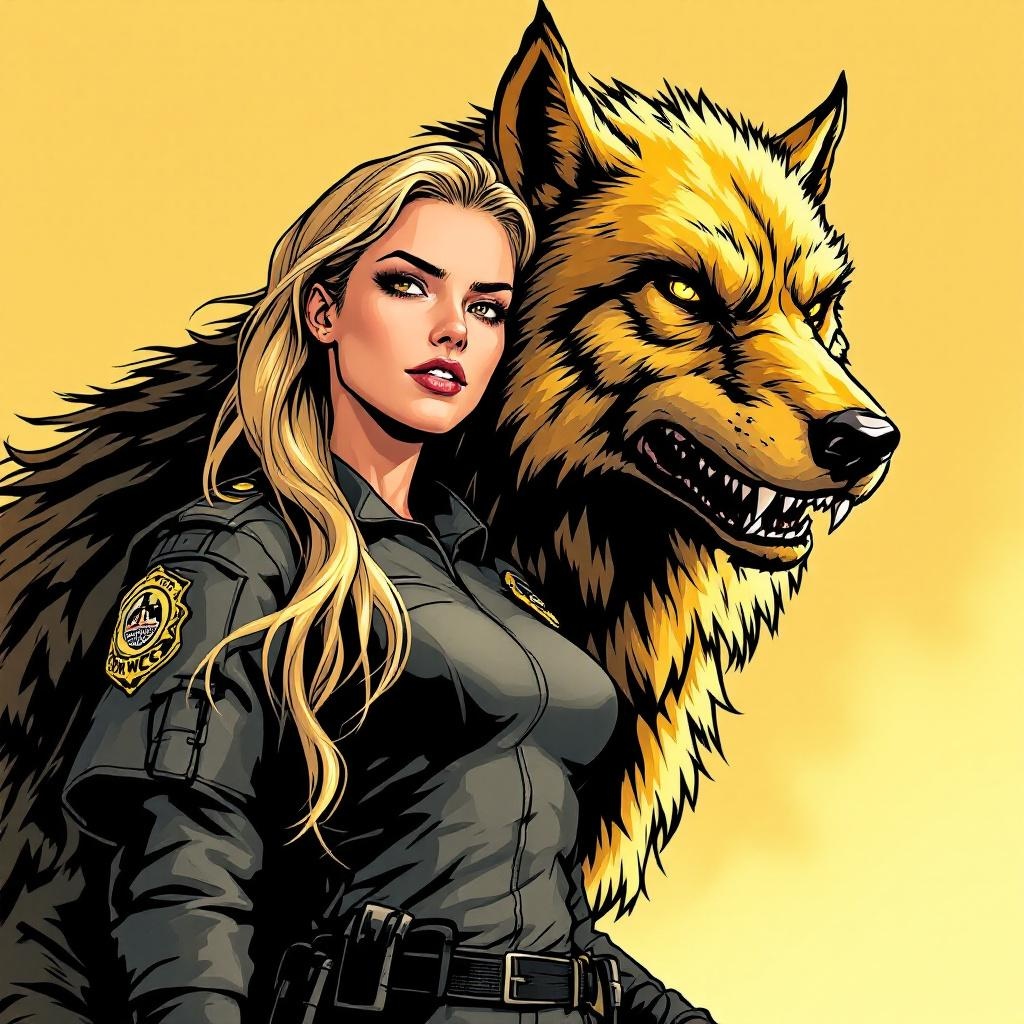
Pratchett puts a real wolf-adjacent character right there in the scene: Angua, who is actually part wolf, who has actually met wolves, who knows what wolf society looks like. And she knows that Big Fido's romantic vision of noble wolves with names like "Silverheart" is pure fantasy. Real wolves don't have names. Real wolves don't give speeches. Real wolves don't form guilds with membership dues and execution policies. Everything Big Fido is doing—the organization, the hierarchy, the ideology—is profoundly, absurdly human.
That's the deeper joke. Big Fido isn't leading dogs back to their wolf nature. He's leading them deeper into the human traits they were given—the tribalism, the groupthink, the willingness to follow a charismatic leader toward destruction. He's not curing domestication. He's its most extreme symptom.
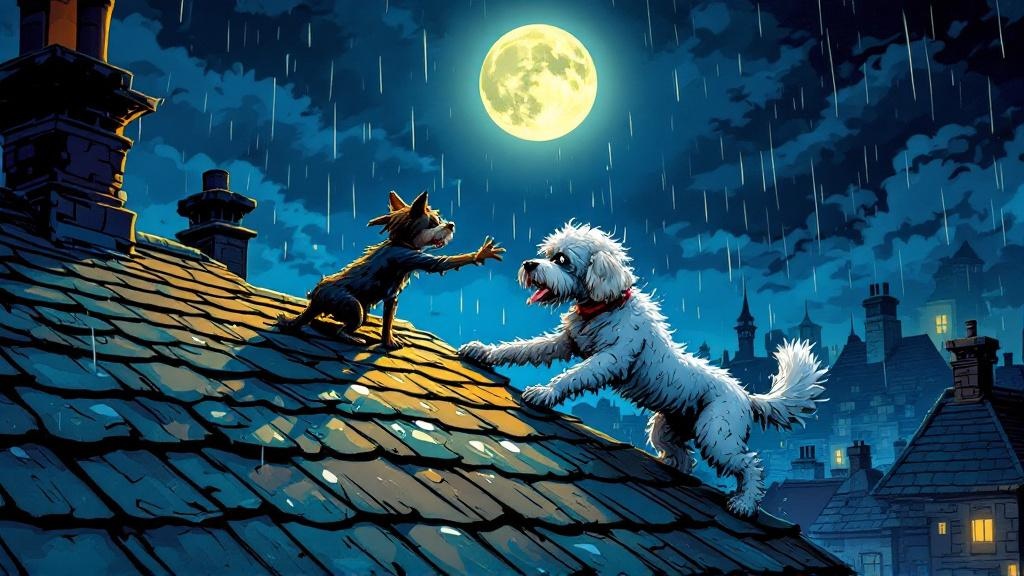
And when it all falls apart? When Big Fido makes a final desperate leap across a twenty-foot gap between rooftops, his forepaws touching slate and finding no hold? Gaspode—cynical, self-interested, looking-out-for-number-one Gaspode—tries to save him.
"The thing is... the actual thing is... I will, though. It's a bugger, bein' a dog."
The Myth That Survives
After Big Fido's death, something remarkable happens. The dogs of Ankh-Morpork don't process his fall as a defeat. Instead, they construct a myth: Big Fido escaped the city. He's out there somewhere, leading a real wolf pack, living the free life he always promised. One day he'll come back.
This isn't a throwaway detail. It's Pratchett observing how ideology survives its own failure. The dogs need the myth because without it, they'd have to confront an uncomfortable truth: they begged for scraps from humans while following Big Fido, and they'll keep begging for scraps now that he's gone. The myth lets them do this with dignity—they're only being servile temporarily, until the revolution returns.
"Pride is all very well, but a sausage is a sausage."— Gaspode
It's the same pattern you see in human movements built on false premises. When the promised utopia doesn't arrive, the faithful don't abandon the cause—they push the timeline back. The leader isn't dead, he's in exile. The revolution hasn't failed, it's been postponed. And life goes on exactly as before, only now with a comforting mythology to take the edge off.
Gaspode, of course, sees through all of it. He always has. "Pride is all very well," he says, "but a sausage is a sausage." That's not cynicism—it's honesty. Dogs need food more than ideology. Gaspode knows this because unlike Big Fido, he's never had the luxury of pretending otherwise.
Why This Scene Matters
The confrontation between Gaspode and Big Fido works on every level Pratchett operates on.
As comedy, it's flawless. The image of attack dogs involuntarily sitting in mid-leap, brought low by their own conditioned shame, is one of the funniest things in all of Discworld.
As satire, it's razor-sharp. A fascist movement led by a poodle, defeated by the very obedience it claimed to reject—Pratchett couldn't have constructed a more elegant demolition of authoritarian ideology if he'd written a political essay.
As philosophy, it asks a question that has no comfortable answer: what does it mean to be a creature made by someone else? Dogs didn't choose to be dogs. They were shaped, bred, and conditioned into what they are. Their guilt is manufactured. Their loyalty is engineered. Even their rebellion, when it comes, uses the tools of their makers. Is there anything authentic left?
Gaspode's answer, delivered without knowing it's an answer, is yes. Not in the wolf dreams. Not in Big Fido's ideology. In the moment where a scruffy, cynical, disease-ridden street dog reaches for a falling enemy because he can't not help. Because despite everything—the conditioning, the shame, the "racial guilt"—there's something in Gaspode that chooses.
Not because someone told him to sit. Because he stood up.
Where to Read It
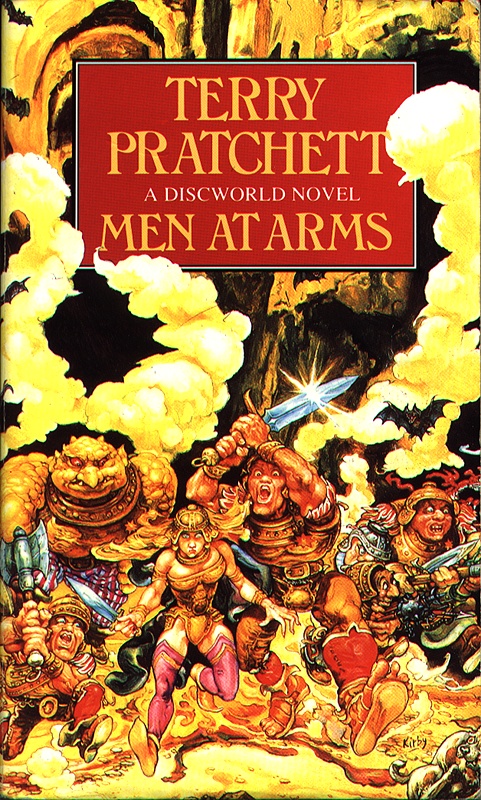
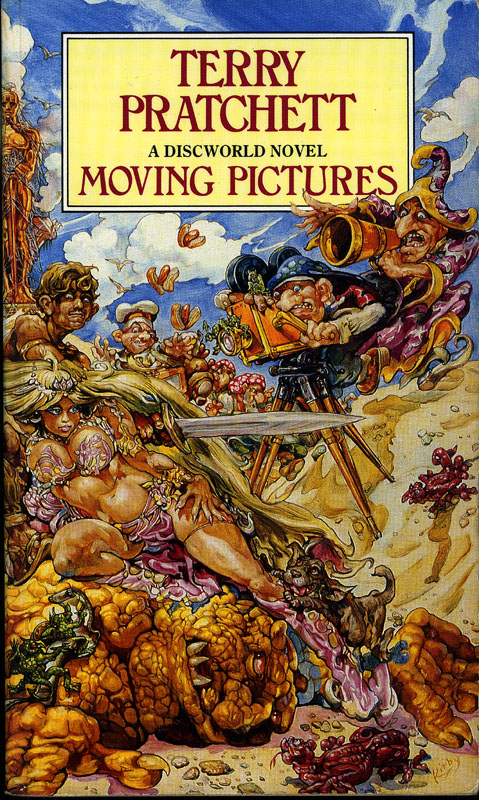
If you haven't encountered Gaspode before, you might want to start with Moving Pictures, where he first appears as an aspiring movie star who loses the lead role to a better-looking dog. It's a different kind of story—lighter, sillier—but it establishes who Gaspode is before Men at Arms tests what he's made of.
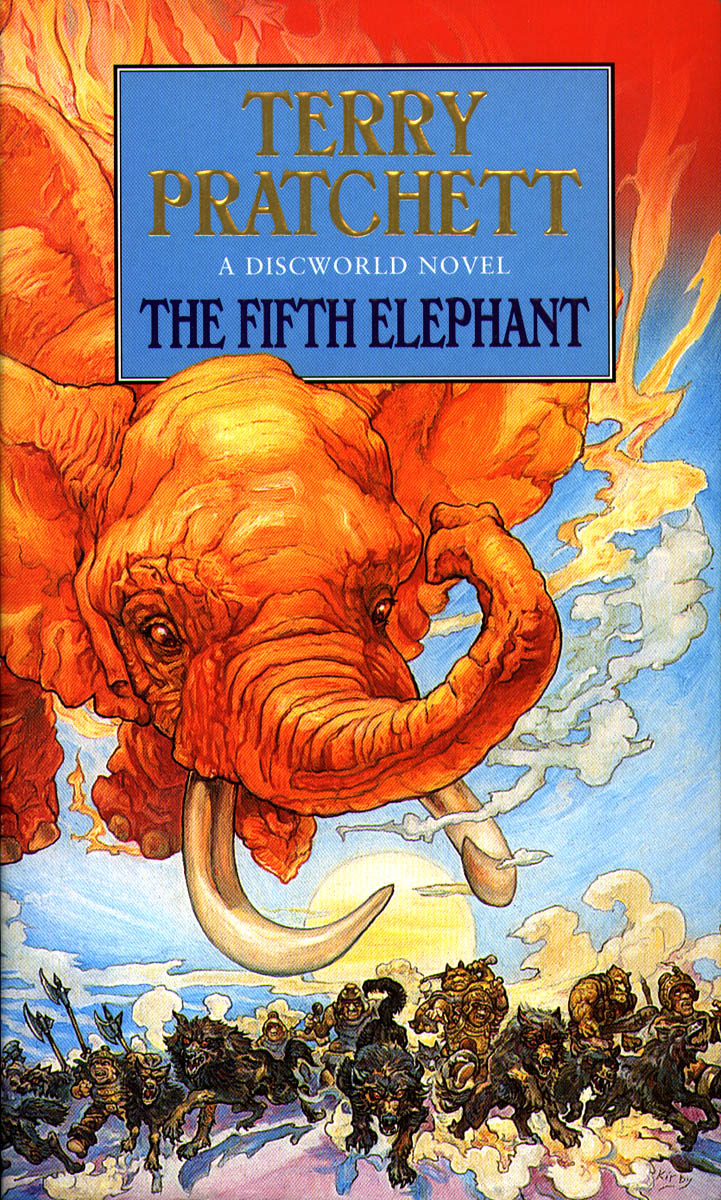
And if this article has you curious about Gaspode's later adventures—including a harrowing journey across a continent that ends in betrayal and silence—keep an eye out for his Fifth Elephant story. It's one of the saddest things Pratchett ever wrote about loyalty, and it starts with a dog who's already proven he's the bravest mutt in Ankh-Morpork.
For more on the City Watch novels that feature Gaspode, explore Men at Arms or discover why Sam Vimes' Boots Theory changed real-world economics.