Discworld's Most Loyal Character Is a Murderous Suitcase
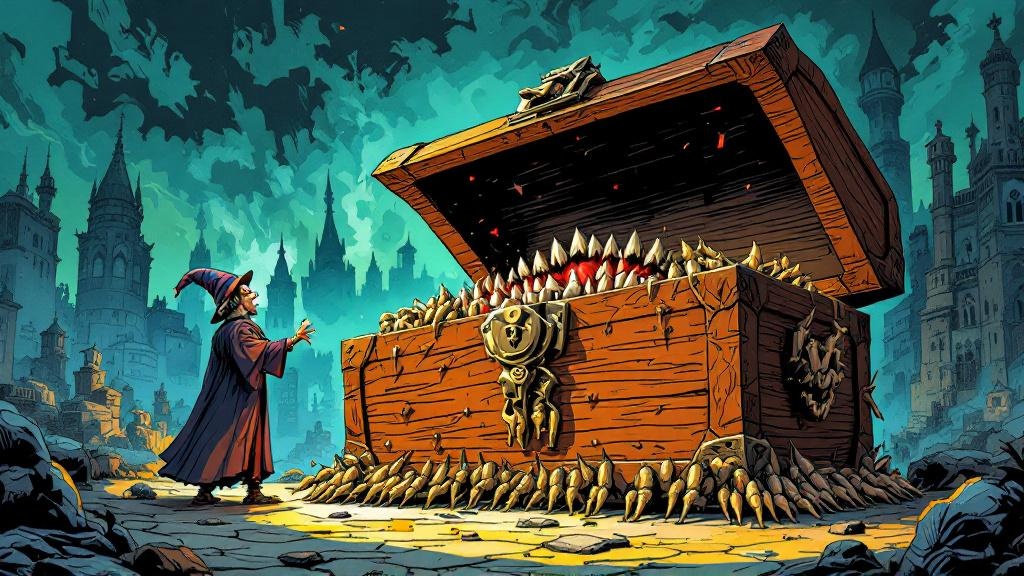
The Luggage is Discworld's perfect metaphor for unconditional love—a sentient chest that follows its owner into Hell, eats anyone who threatens them, and always has clean underwear ready.
Discworld's Most Loyal Character Is a Murderous Suitcase
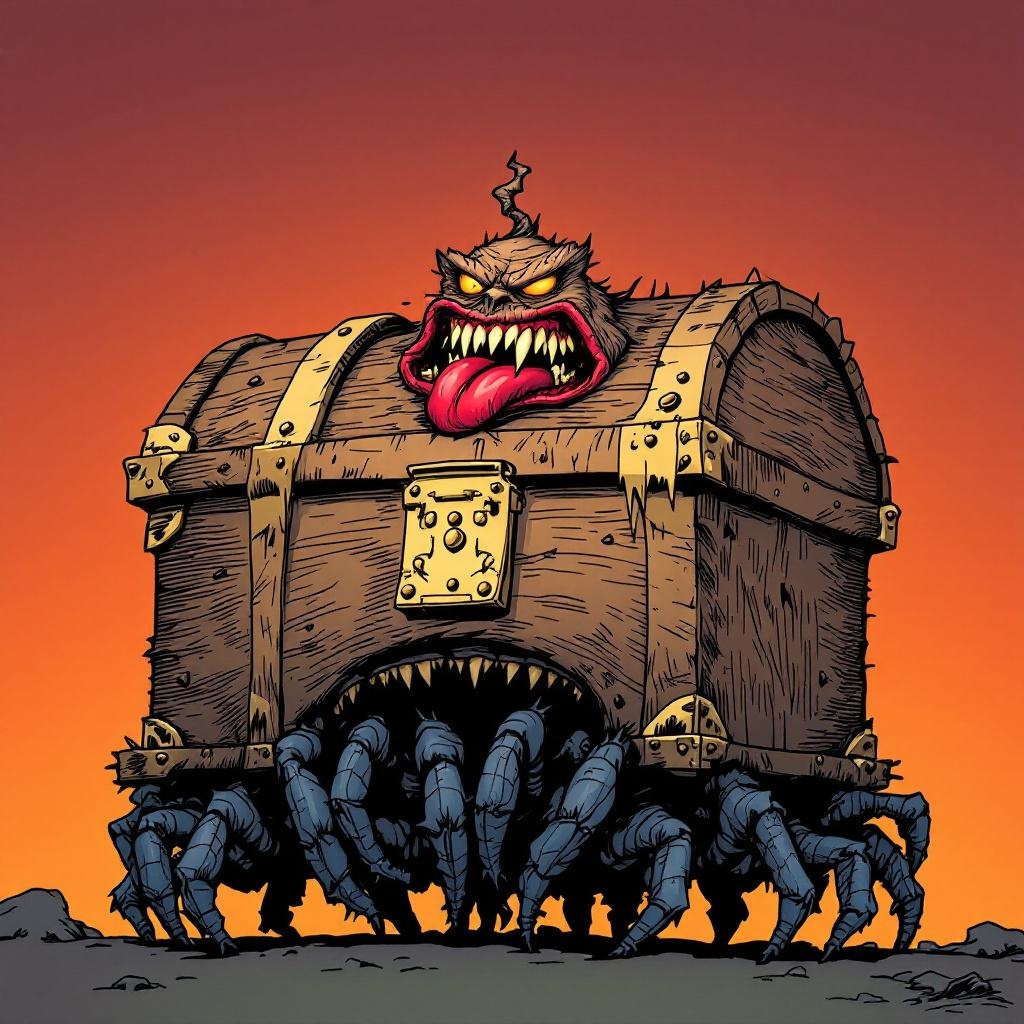
In a series with over two hundred named characters—assassins who follow a code of ethics, a Death who saves Christmas, witches who'd stare down the sun—the most touching devotion belongs to a chest with hundreds of legs, no face, and a mouth full of teeth like sycamore tombstones.
The Luggage cannot speak. It has no eyes, no features "apart from a lock and a couple of hinges." And yet Terry Pratchett made its loyalty so vivid, its emotions so unmistakable, that readers have spent four decades genuinely caring about a piece of furniture. That's not just good writing. That's a magic trick.
Half Suitcase, Half Homicidal Maniac
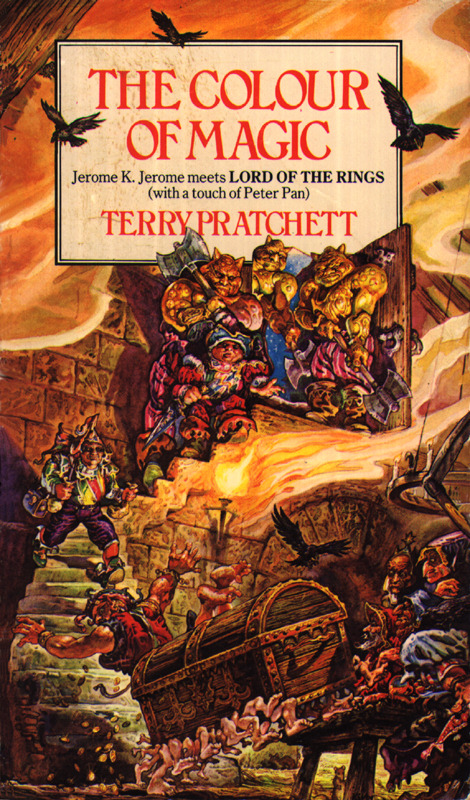
The Luggage first appears in The Colour of Magic trailing behind Twoflower, the Disc's first tourist, through the burning streets of Ankh-Morpork. While citizens flee in every direction, this large, well-seasoned chest trundles calmly through the chaos on hundreds of little legs, radiating the quiet menace of something that has never once encountered a problem it couldn't eat.
And eat it does. When the Thieves' Guild sends assassins after Twoflower for his gold, The Luggage deals with them in its characteristically direct fashion. Twoflower doesn't even notice. He's too busy taking pictures.
"The Luggage said nothing, but louder this time."
That's the joke, and it never stops being funny: here's a tourist so naively optimistic that he wanders through a city of thieves and murderers completely unharmed, because his suitcase is committing all the violence on his behalf. It's like a nature documentary where a baby gazelle frolics in a field while its mother systematically destroys every predator in the savanna. Except the mother is a box.
But the brilliance of The Luggage isn't just the comedy of its violence. It's that the violence is never random. The Luggage doesn't attack bystanders or cause chaos for fun. Every kill, every chomped assassin and stomped Dungeon Dimension horror, serves one purpose: protecting its owner. Its aggression is the purest expression of love in the Discworld—absolute, uncompromising, and completely non-negotiable.
The Art of Staring Without Eyes
Here's the thing that shouldn't work but absolutely does: Pratchett made a featureless wooden box one of the most emotionally expressive characters in the series.
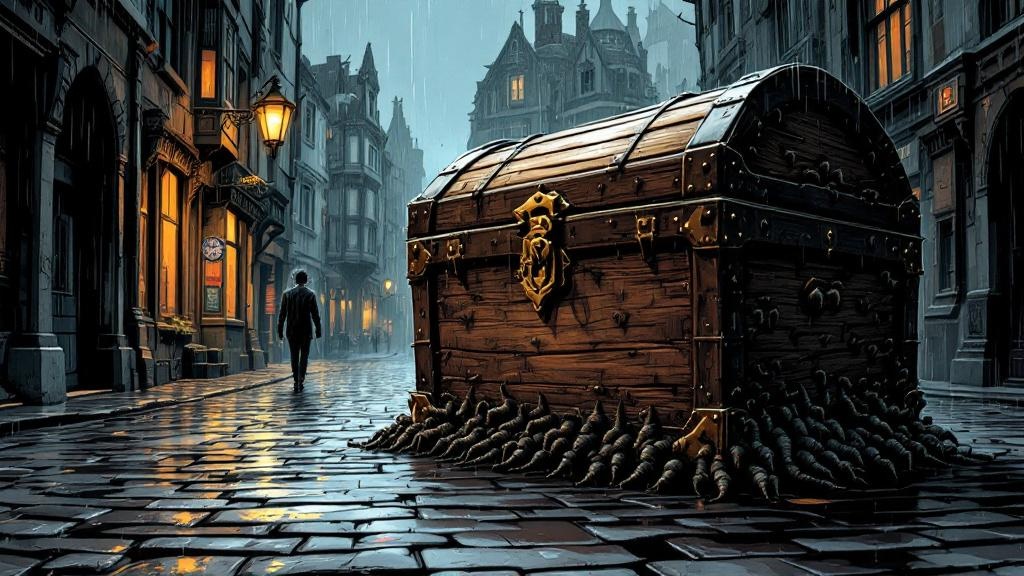
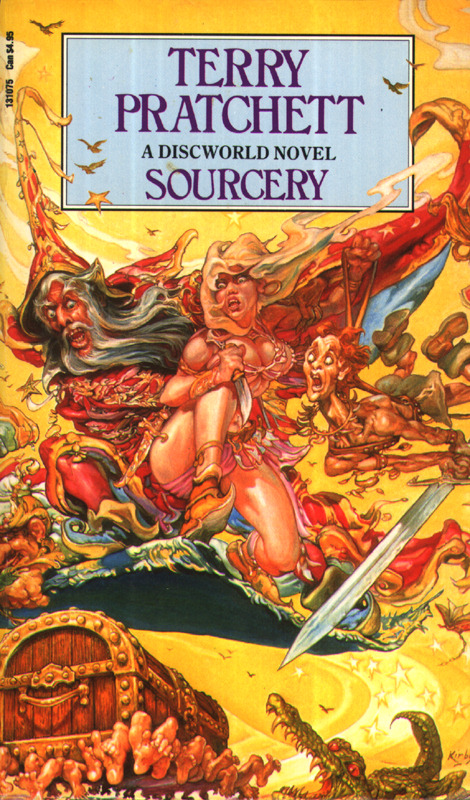
Consider this description from Sourcery: The Luggage could "outstare a glass-eyed statue" despite having nothing to stare with. "When it came to a look of betrayed pathos, the Luggage could leave the average kicked spaniel moping back in its kennel."
How do you stare without eyes? How do you look pathetic without a face? You shouldn't be able to. And yet every reader who encounters The Luggage knows exactly how it's feeling at any given moment.
Pratchett achieves this through pure behavioral characterization. The Luggage doesn't need dialogue because its actions are its dialogue. Following someone across continents is loyalty. Eating someone is fury. Refusing to open is sulking. Hibernating on top of a wardrobe is contentment. Each behavior maps to a recognizable emotion so cleanly that the absence of a face becomes irrelevant.
He also leans on animal comparisons that ground The Luggage's alien nature in something familiar. It has "a cat's tendency to lose interest in things that didn't fight back." Its pathos outdoes a kicked spaniel. It hibernates like something domesticated. These touchstones give readers an emotional vocabulary for a character that, technically, shouldn't have one.
The Gift at the End of the World
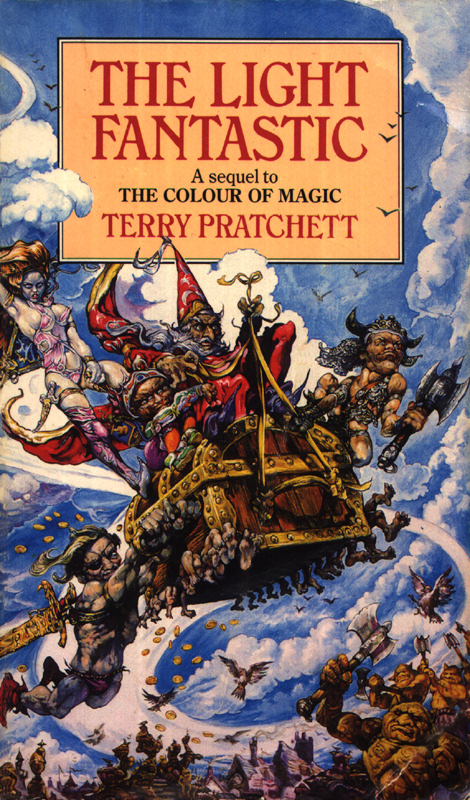
The relationship between The Luggage and Twoflower is harmonious—a naive tourist and his perfectly matched guardian. But the relationship that matters begins at the end of The Light Fantastic, when Twoflower goes home to the Counterweight Continent and gives The Luggage to Rincewind.
"It's yours now. It's always liked you."
"It's yours now. It's always liked you."— Twoflower
That line does something sneaky. Twoflower says The Luggage has always liked Rincewind—implying it chose its next owner before Twoflower decided to leave. The Luggage didn't wait to be gifted. It had already made its selection. And its selection was a man who emphatically did not want a homicidal piece of furniture following him everywhere.
This shift transforms The Luggage from a comic prop into something more complex. With Twoflower, loyalty was easy—his owner welcomed him, appreciated him, and never questioned his occasional murder of passersby. With Rincewind, The Luggage faces the more difficult kind of devotion: loving someone who'd really rather you didn't.
It's the difference between a dog who's always been loved and a rescue dog who refuses to leave the side of the person who keeps trying to drop it off at the shelter. The second kind of loyalty is harder, messier, and infinitely more touching.
Into the Dungeon Dimensions and Beyond
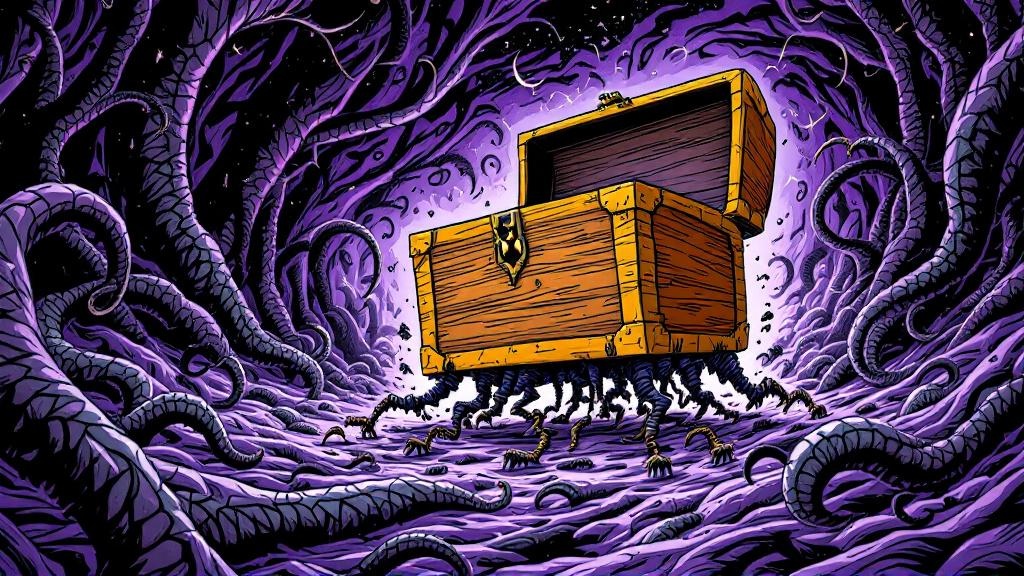
In Sourcery, Rincewind gets trapped in the Dungeon Dimensions—a place between realities inhabited by Things so alien they drive humans insane just by existing. It's the sort of place that erases you from existence, that dissolves the boundaries between what's real and what isn't.
The Luggage waits outside.
Not for minutes or hours. It simply waits, faithfully, at the threshold of a place that shouldn't have a threshold, because its owner is in there somewhere and leaving is not something The Luggage does. When waiting proves insufficient, it does what it always does: it goes in after him. It doesn't think about whether this is possible. It doesn't weigh the odds. It has the same attitude toward dimensional barriers that it has toward locked doors and assassins—they exist only until they don't.
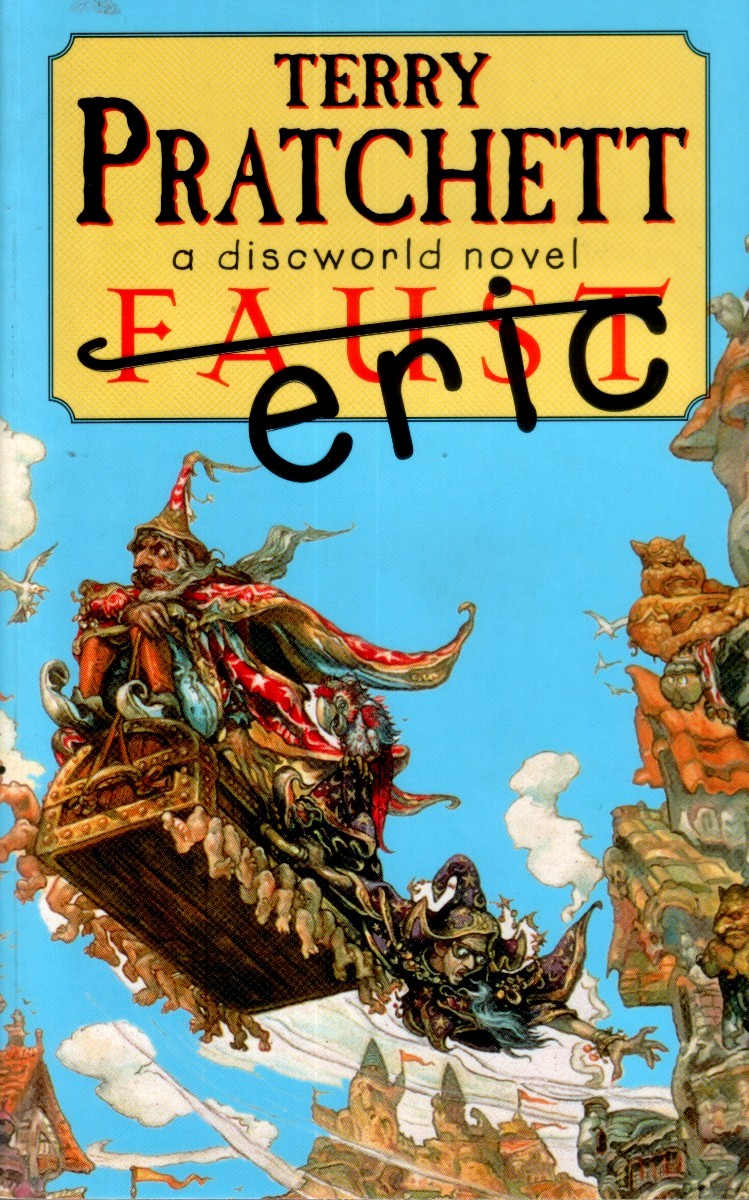
Then in Faust Eric, it follows Rincewind through literal Hell. The demons learn not to approach it roughly as fast as you'd expect demons to learn anything, which is to say: after the first few disappear.
This is The Luggage's defining quality distilled to its essence. It will follow its owner anywhere. Across continents, through the Dungeon Dimensions, into Hell itself. It does not evaluate the danger. It does not calculate the cost. It simply goes where its owner goes, and anything between them ceases to exist.
The Underwear Detail (And Why It Matters)
For all its violence, The Luggage has one deeply domestic habit that might be the most telling detail Pratchett ever gave it.
No matter what The Luggage has just eaten—dragons, armies, eldritch horrors from between dimensions—the next time its owner opens the lid, there are their clothes. Neatly folded. Pressed. Smelling faintly of lavender.
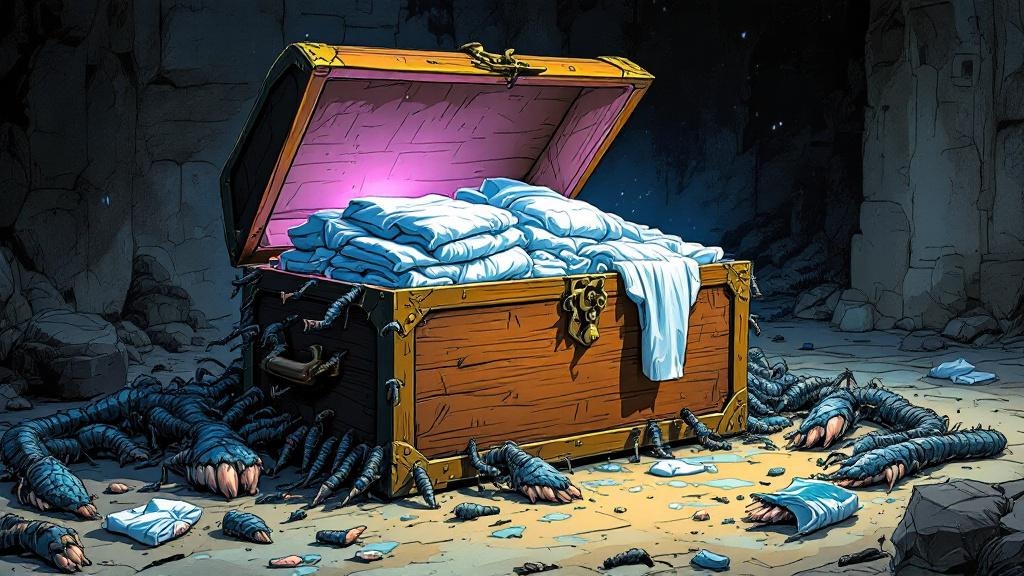
This is comedy, obviously. The juxtaposition of cosmic violence and domestic tidiness is inherently funny. But it's also characterization of the highest order. The Luggage doesn't just protect its owner—it cares for them. It maintains their laundry. It keeps things in order. It is simultaneously the most dangerous and the most nurturing object on the Disc.
Think about what this means in practical terms. The Luggage exists in a state of constant readiness for both extreme violence and clean underwear. It's like a parent who will absolutely destroy anyone who threatens their child but also always has a tissue ready. The protection and the care are not separate functions. They're the same impulse expressed two ways.
The Luggage as Discworld's Best Metaphor
Here's where The Luggage transcends its status as a running gag and becomes something genuinely meaningful.
"Its emotional range is limited but intense—and that simplicity is exactly what makes it work."
The Luggage is unconditional love given physical form. Not the complicated, negotiated love of human relationships—the simple, fierce, non-negotiable love of a creature that cannot be reasoned with, cannot be dissuaded, and cannot be lost. It will follow you into Hell. It will eat anything that threatens you. And it will always, always have clean underwear ready.
Pratchett once said—or claimed to have said, since he cheerfully admitted to making up different origin stories for different interviewers—that the idea came from watching a wheeled suitcase following a tourist across airport tiles, "moving as though it had a mind of its own." Whether or not that's true doesn't matter. What matters is what he built from it: a character with no voice, no face, and no features who somehow became one of the most beloved figures in all of fantasy fiction.
The Luggage's emotional range is deliberately limited. It feels loyalty, protectiveness, hurt, and rage. That's essentially the complete list. But Pratchett understood something crucial: emotional complexity isn't the same as emotional depth. A character who feels five things with absolute intensity can be more moving than one who feels a hundred things tepidly.
When The Luggage sulks after eating the Octavo in The Light Fantastic, refusing to open for three days, you don't need a soliloquy to understand its feelings. When it waits outside the Dungeon Dimensions for an owner who might never return, you don't need dialogue to feel the weight of that devotion. The simplicity is the point. The Luggage loves like a force of nature—without reservation, without condition, without end.
Where to Meet the Murderous Suitcase

If you want to see The Luggage at its most emotionally resonant, though, read The Light Fantastic. The ownership transfer scene—Twoflower leaving, The Luggage being given to Rincewind, the quiet acknowledgment that something important has changed hands—is one of those moments Pratchett slips in between the jokes that catches you completely off guard.
And then pick up Sourcery to watch The Luggage prove exactly what that loyalty means when tested against the laws of physics, the boundaries between dimensions, and the fundamental nature of reality itself.
None of them stand a chance.
For more on The Luggage's long-suffering owner, read about Rincewind's philosophy of running. And if you want to start from the very beginning, The Colour of Magic is waiting—with hundreds of little legs.