How a Spilled Inkwell Made Ponder Stibbons a Wizard
Ponder Stibbons became Unseen University's most competent wizard by accident—spilled ink, a stolen exam, and one question. Here's the full absurd story.
How a Spilled Inkwell Made Ponder Stibbons a Wizard
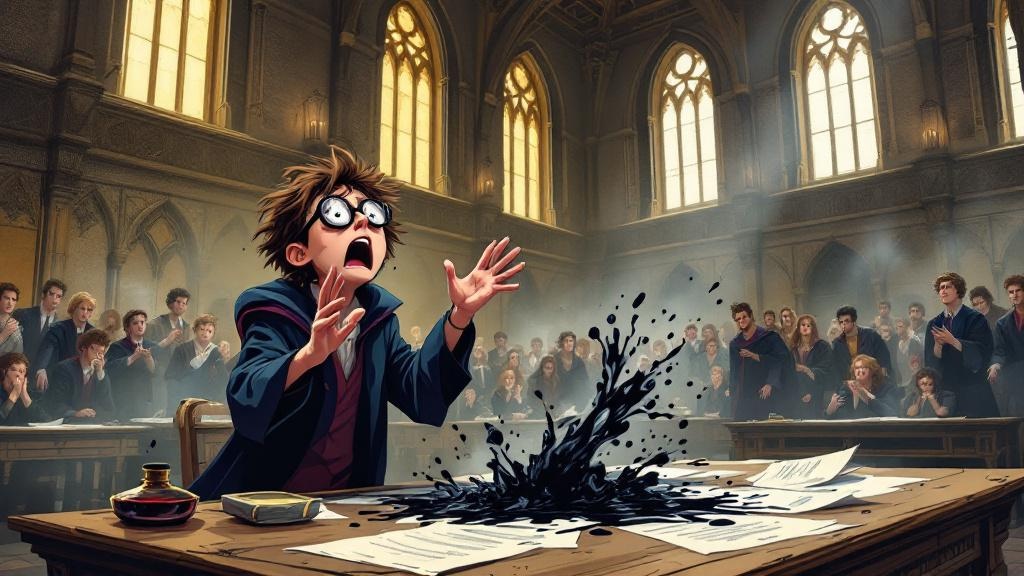
Here is the full list of qualifications that made Ponder Stibbons a member of Unseen University's faculty: he knocked over an inkwell.
That's it. That's the entire origin story. One nervous student, one clumsy elbow, one spilled bottle of ink, and Discworld's most hardworking wizard stumbled into a career he never applied for.
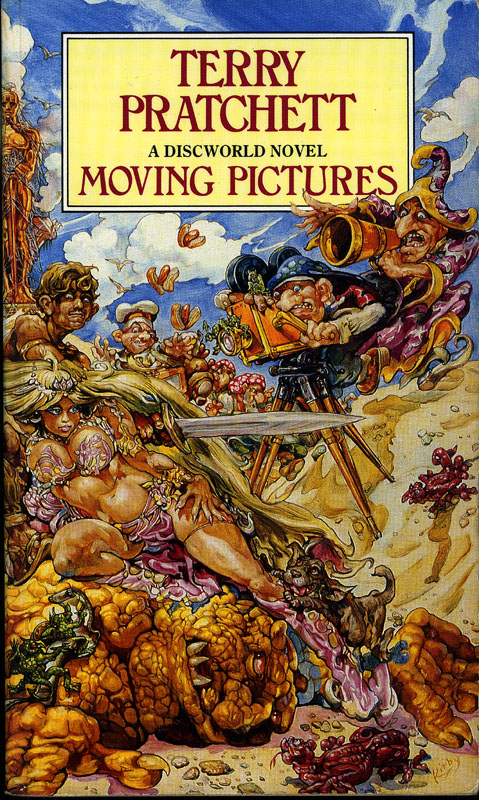
The story behind it—from Moving Pictures—is one of Pratchett's most perfectly constructed absurdities. It involves a trust fund, a one-question exam, a student who studied harder to avoid work than most people study to do it, and an institution so tangled in its own bureaucracy that it accidentally hired its best employee. If you've ever gotten a job you weren't qualified for, or watched someone fail upward, or wondered how the person actually keeping the lights on ended up there in the first place—this one's for you.
The Laziest Man in History
To understand how Ponder became a wizard, you first have to understand the man whose exam he accidentally stole.
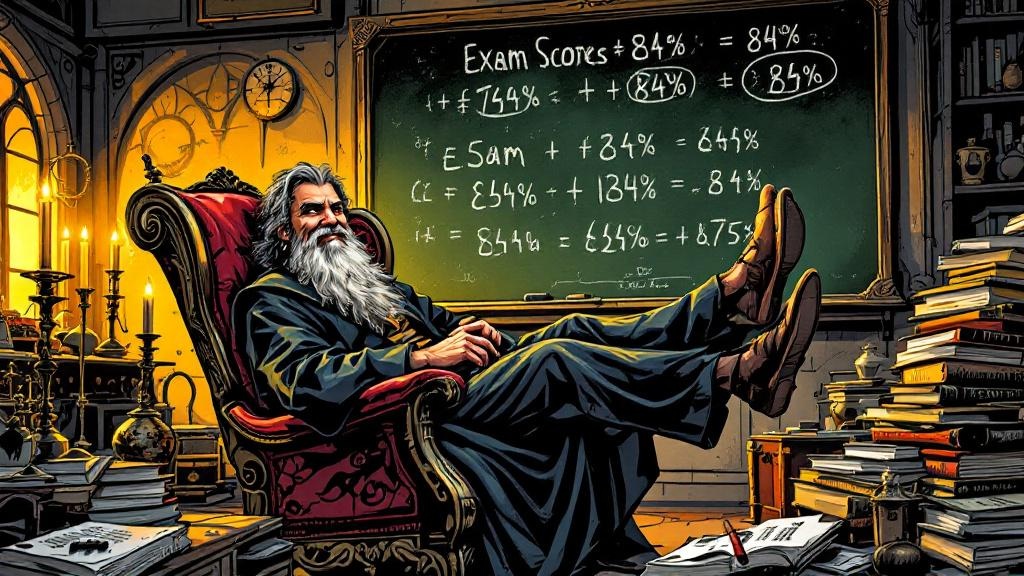
Victor Tugelbend was, by Pratchett's description, "the laziest person in the history of the world. Not simply, ordinarily lazy. Ordinary laziness was merely the absence of effort. Victor had passed through there a long time ago, had gone straight through commonplace idleness and out the other side. He put more effort into avoiding work than most people put into hard labour."
Victor had a scheme. His uncle's trust fund paid his tuition at Unseen University, but only as long as he scored above 80% on every exam. The catch? The passing mark to actually become a wizard was 88%. So Victor studied obsessively—not to succeed, but to score exactly 84% on every single exam. High enough to keep the money flowing, low enough to never graduate and have to do anything with his life.
"He put more effort into avoiding work than most people put into hard labour."
Think about that for a moment. To consistently score exactly 84%, you need to know the material perfectly. You need to know which questions to get right and which to deliberately get wrong, in exactly the right proportions. Victor Tugelbend was almost certainly one of the most knowledgeable students at Unseen University. He just used all that knowledge to remain a student forever.
It only failed him three times. Once he accidentally passed by scoring above 88%, but he argued his grade down. Then he overcorrected with an 82% and an 83%. The system held. Year after year, Victor Tugelbend sat in his comfortable room, collected his uncle's money, and devoted his considerable intellect to doing absolutely nothing.
The Bursar's Trap
The Bursar noticed.
It's never entirely clear how long Victor's scheme had been running, but eventually someone in the University administration looked at the pattern—84%, 84%, 84%, year after year—and got angry enough to do something about it.
The Bursar's solution was elegant in its cruelty. He cut Victor's final exam down to a single question:
"What is your name?"
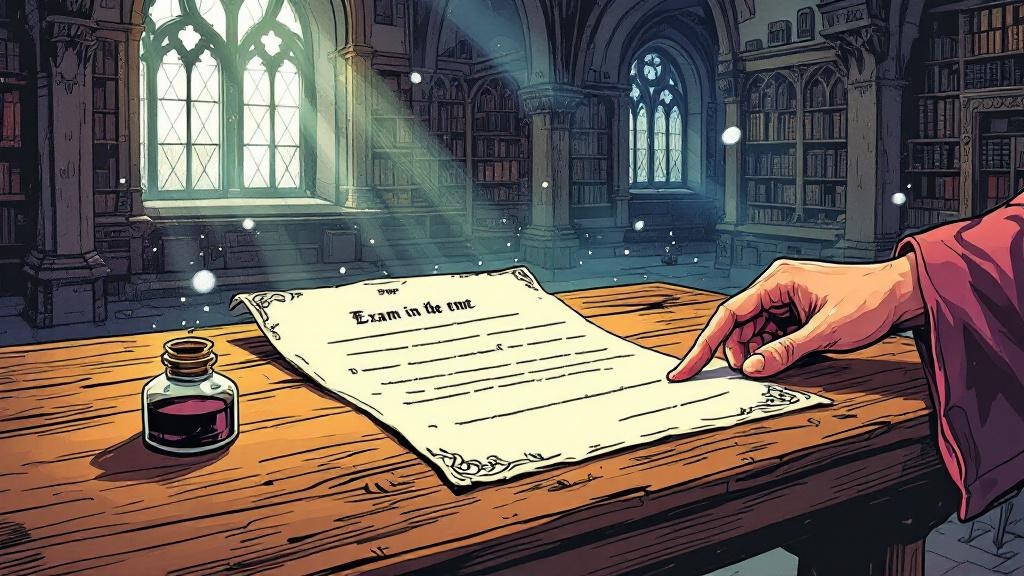
It was a perfect trap. Victor couldn't score 84% on a single question—you either answer it or you don't. If he wrote his name, he'd score 100% and pass, becoming a wizard and losing his funding. If he left it blank, he'd score 0% and lose his funding anyway. The Bursar had designed an exam that made Victor's entire strategy impossible.
There was just one problem. Victor never showed up.
By the time the exam rolled around, Victor had left for Holy Wood, drawn by the magic of the moving pictures that drive the plot of the novel. His seat sat empty. His carefully laid plans, his years of strategic mediocrity, his uncle's trust fund—all of it rendered irrelevant because he wandered off to become a film star.
The Inkwell
And then there was Ponder.
Ponder Stibbons was everything Victor wasn't: earnest, nervous, and genuinely trying his best. He sat down for his own exam, opened his inkwell, and—through the kind of clumsiness that changes lives—knocked it across his paper.
"The answer to question One is: Ponder Stibbons. Which is what my name is."
The examiner let him move to the next desk. Victor's desk. Where Victor's exam sat waiting, with its single devastating question.
Ponder, confused by the brevity of the paper but too nervous to question it, answered the question. "The answer to question One is: Ponder Stibbons. Which is what my name is." Then he sat there for the rest of the exam period, desperately trying to pad out his answer because it felt wrong to finish so quickly, adding increasingly anxious elaborations on the fact that his name was, indeed, Ponder Stibbons.
He scored 100%. The highest mark in Unseen University history.
And just like that, the trap designed to catch the laziest student in the world instead launched the career of the hardest-working wizard the University had ever seen.
The Most Discworld Origin Story Possible
There's something deeply Pratchettian about Ponder's accident. It's not random—it's the kind of chaos that reveals how systems actually work.
The Bursar built a perfect trap. It would have worked flawlessly on its intended target. But institutions don't operate on intentions. They operate on paperwork. The exam didn't care who sat at Victor's desk. It didn't check names. It just existed, a bureaucratic mechanism doing exactly what bureaucratic mechanisms do: processing whoever happens to be in front of them.

The irony stacks beautifully. Victor studied harder than anyone to avoid becoming a wizard. Ponder became one without trying. Victor's elaborate system required years of careful calibration. Ponder's career required one clumsy elbow. The student who knew everything chose to do nothing with it. The student who spilled ink on his own exam ended up running the University.
And here's the layer that makes it quintessential Pratchett: the system worked better by accident than it ever did on purpose. Unseen University's formal admissions process had been producing centuries of wizards whose primary skills were eating large dinners and falling asleep in armchairs. Its accidental admissions process—one spilled inkwell, one misplaced exam—produced the only faculty member who would ever actually get things done.
From 100% to Twelve Positions
What makes Ponder's origin story more than just a funny anecdote is what he does with it.
In Lords and Ladies, just a few books after his accidental graduation, Ponder is already on the faculty as Reader in Invisible Writings, trying to explain parallel universes to Archchancellor Ridcully and watching in despair as his careful scientific analogies are cheerfully mangled. By Soul Music, he's building Hex, Discworld's first computer. By Hogfather, he's the de facto IT manager of an institution that doesn't understand what IT is.
And by Unseen Academicals, he holds twelve separate positions at the University—Head of Inadvisably Applied Magic, Praelector, Reader in Invisible Writings, Master of The Traditions, Camerlengo, and seven others—giving him twelve votes on the University Council. A majority all by himself. Nobody noticed because all the reports went to Ponder himself.
""You're Ponder Stibbons, right? The only one who does any work in the university?""— Moist von Lipwig
When Moist von Lipwig meets him in Making Money and says, "You're Ponder Stibbons, right? The only one who does any work in the university?", Ponder goes red and protests that he simply "pulls his weight, like any other member of the faculty." But Pratchett adds, with surgical precision, that "a slight tone to his voice suggested that perhaps the other faculty members had far too much weight and not enough pull."
The student who got 100% by writing his own name ended up being the only person keeping an entire institution functional. Not because he was ambitious. Not because he schemed. Because he kept showing up, kept doing the work, and kept being the person who noticed that things needed doing.
The Competence Trap
Every large organization has a Ponder Stibbons—someone who ended up doing everything because they were the only one willing to do anything.
It's not a compliment. It's a trap.
Ponder doesn't accumulate twelve positions because the University recognizes his talent. He accumulates them because jobs that need doing eventually drift toward the person who does jobs. Nobody assigns them formally. Nobody votes on it. The work just... arrives on his desk, because his desk is the only one where things don't pile up and get ignored.
Pratchett understood something fundamental about institutions: competence is not rewarded; it's exploited. The senior wizards at Unseen University don't promote Ponder because he's good at things. They ignore the fact that he's doing everything because acknowledging it would mean either helping or feeling guilty about not helping. Both options require effort. So they let Ponder handle it and go back to lunch.
The comedy is that Ponder's entire career started with an accident, but his rise to power was inevitable. Put a competent person in any institution and they'll end up running it—not because they want to, but because nobody else will. The inkwell just determined which institution.
Why It Matters That It Was an Accident
Pratchett could have given Ponder a conventional origin. A brilliant student who passed his exams through sheer intellect. A political operator who maneuvered his way onto the faculty. A prodigy discovered by a mentor.
Instead, he gave him an inkwell.
And that choice tells you everything about what Ponder represents. He's not a chosen one. He's not destined for greatness. He's a nervous kid who spilled some ink and ended up in the wrong seat at the wrong time—and then, because that's who he is, he did the work anyway.
There's something profoundly democratic about that. In a genre full of prophecies and bloodlines and magical destinies, Ponder Stibbons became important because he was competent and present. No secret heritage. No ancient prophecy. Just a willingness to show up and answer whatever question was in front of him, even if it was only "What is your name?"
The answer, as it turned out, was enough.



The Name on the Paper
There's one more layer to this story that's easy to miss.
The exam asked: "What is your name?" And Ponder, in his earnest, anxious way, answered it. Fully. Completely. Without irony or strategy or any attempt to game the system.
Victor would have agonized over that question. Could he score 84% on a name? Could he misspell it slightly? Get the middle initial wrong? Victor's entire approach to life was about controlling outcomes, manipulating systems, finding the exact angle that let him slide through without commitment.
Ponder just wrote his name.
Sometimes that's all it takes. Not genius. Not ambition. Not a perfectly calibrated strategy for avoiding effort. Just showing up, answering honestly, and being willing to do whatever comes next—even if "whatever comes next" turns out to be running the entire University because nobody else can be bothered.
For more on what Ponder does with his accidental career, read The Scientist Among Wizards. To see his greatest creation in action, look out for the upcoming piece on Hex and the Fluffy Teddy Bear.