The Way of Mrs. Cosmopilite: How Terry Pratchett Made Motherly Clichés Into Sacred Wisdom
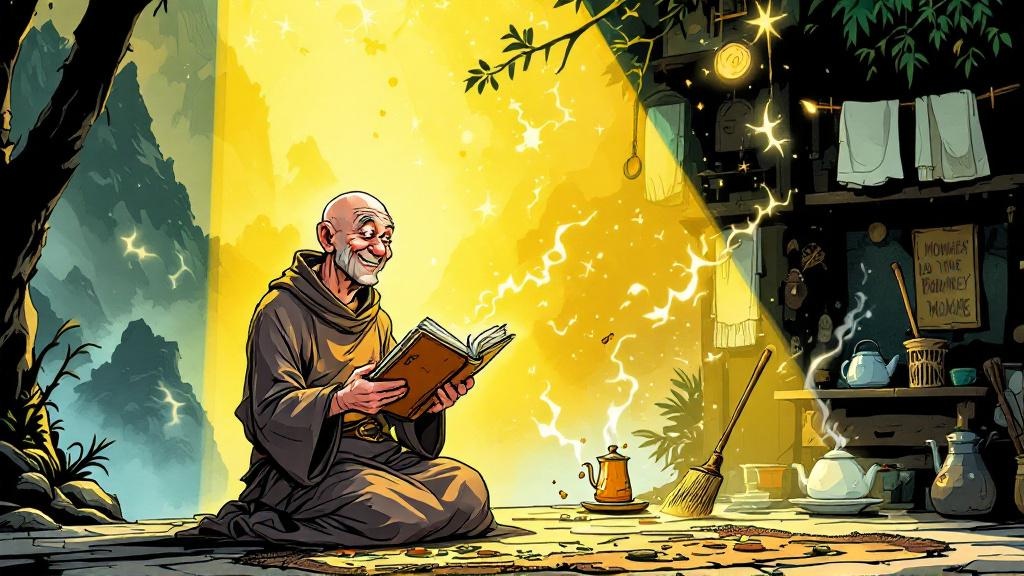
Lu-Tze follows the Way of Mrs. Cosmopilite—an Ankh-Morpork landlady's common-sense sayings treated as sacred text. It's Pratchett's funniest and most sincere philosophy.
The Way of Mrs. Cosmopilite: How Terry Pratchett Made Motherly Clichés Into Sacred Wisdom
Somewhere in Ankh-Morpork, there's a landlady who runs a boarding house and occasionally a haberdashery shop. She's practical, no-nonsense, and firmly of the opinion that you should always wear clean underwear because you never know if you'll be knocked down by a cart.
She is also, much against her wishes, a religious icon.
This is because Lu-Tze—the most dangerous monk in the history of the Discworld, an 800-year-old sweeper who can fight time itself—built his entire philosophy around her common-sense sayings. He wrote them down in a little notebook. He quotes them to confused senior monks. He has converted an entire generation of young acolytes to follow her Way.
Mrs. Cosmopilite would like them all to stop following her to the shops, please.

The Monk Who Couldn't Follow the Rules
To understand why Lu-Tze ended up building a philosophy around his landlady's nagging, you need to understand where he came from.
Lu-Tze is a History Monk—one of the order based at the Monastery of Oi-Dong in the high Ramtops, tasked with maintaining the flow of time across the Disc. The monastery follows the Way of Wen the Eternally Surprised, a rigorous philosophical discipline built over millennia of study and contemplation.
Lu-Tze couldn't do it.
He tried. The books are clear on that. But the formal discipline of the Way of Wen simply didn't stick. He couldn't achieve enlightenment through meditation and mantras and carefully arranged rocks. The monastery's path to wisdom was designed for a specific kind of mind, and Lu-Tze's wasn't it.
So they sent him out into the world. And he ended up in Ankh-Morpork, lodging with Mrs. Marietta Cosmopilite—a woman who had never meditated on anything more cosmic than whether the milk had gone off, and whose approach to life's great mysteries was "Well, I'll go to the foot of our stairs."
"The most dangerous man on the Disc built his entire philosophy around a landlady who would like him to wipe his feet before coming in."
And somehow, under her roof, Lu-Tze found what millennia of monastic training couldn't give him. Not enlightenment in any mystical sense. Something better: a framework for actually dealing with reality.
The Sacred Texts of a Boarding House
Here's where the joke starts. And here's where the joke becomes something more.
Lu-Tze recorded Mrs. Cosmopilite's sayings in a notebook. At least 72 of them, organized as numbered koans—the Discworld equivalent of Buddhist sutras. He quotes them with the same reverence other monks use for the words of Wen the Eternally Surprised.
"Is it not written," Lu-Tze will announce to bewildered colleagues, "that there is a time and a place for everything?"
The monks don't dare ask where it's written. Lu-Tze's reputation makes that inadvisable.
Consider some of the sacred texts:
"It won't get better if you pick at it." This is Koan-level wisdom about acceptance, about knowing when intervention makes things worse. Any therapist would charge you a hundred dollars for this advice. Mrs. Cosmopilite probably said it about a scab.
"There is a time and a place for everything." Coming from a time monk, this one takes on layers. Lu-Tze manipulates the fabric of temporal reality for a living. And his guiding principle on when to act is what your nan says when you're playing football indoors.
"Do unto otters as you would have them do unto you." This is Koan 97. Lu-Tze admits he's not sure he got this one right. The deliberate garbling is perfect—it suggests that the sacred texts aren't quite reliable, that the transmission process has introduced errors, just like every real religious tradition in history.
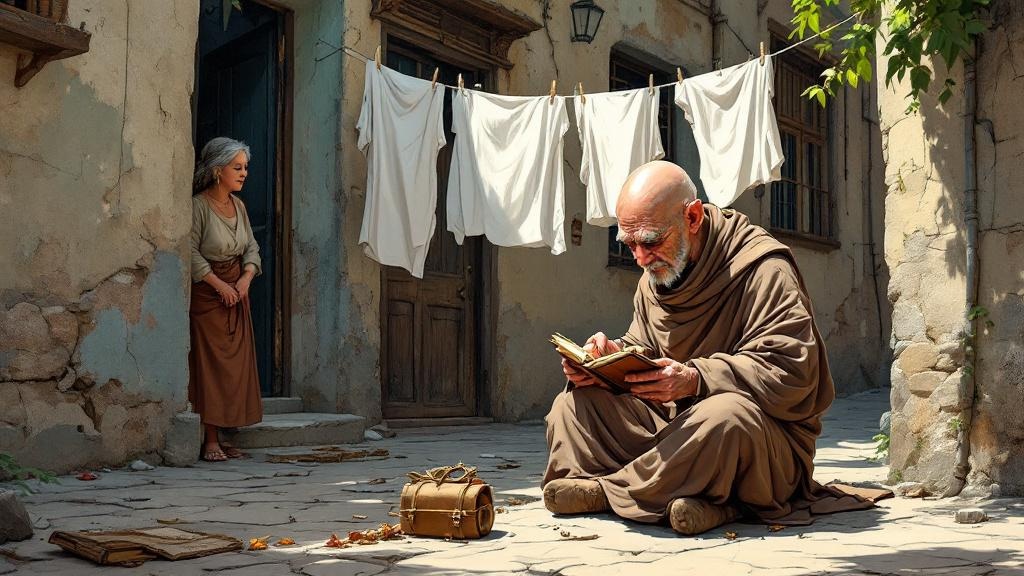
"I have only one pair of hands." A statement about human limitation that doubles as a meditation on presence. You can only do what you can do. Mrs. Cosmopilite said it while juggling laundry and cooking. Lu-Tze applies it to the maintenance of history itself.
"You should always wear clean underwear because you never know if you will be knocked down by a cart." The ultimate motherly cliché. Also, when you think about it, a genuine expression of one of philosophy's core ideas: memento mori. You could die at any moment. Be prepared. Be worthy of inspection.
The joke writes itself. But Pratchett wasn't just writing a joke.
The Punchline That Isn't a Punchline
Here's the thing about the Way of Mrs. Cosmopilite that sneaks up on you: it works.
Lu-Tze isn't the monastery's greatest failure. He's its greatest success. He's 800 years old, he can manipulate time with his bare hands, he changed the course of history because he disagreed with how it was written, and he defeated the incarnation of Time itself in single combat. He is, by any measure, the most accomplished History Monk who has ever lived.
And he did it all following the wisdom of a woman who thinks "Because" is a complete sentence.
"The Way of Mrs. Cosmopilite works. Not despite being common sense—because it is."
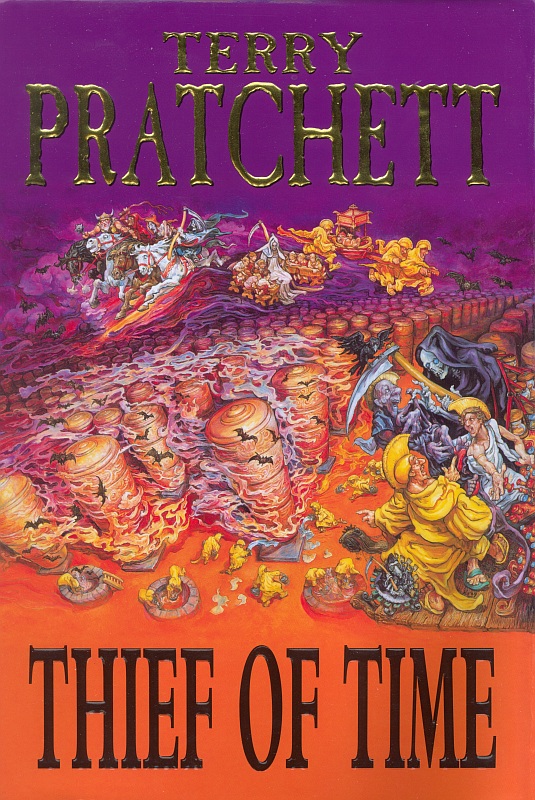
In Thief of Time, Lu-Tze takes his apprentice Lobsang Ludd on a mission to save reality. Along the way, he encounters every kind of challenge—temporal anomalies, Auditor-avatars wearing human bodies like ill-fitting suits, martial artists who think they're better than a sweeper. And at every turn, the Way of Mrs. Cosmopilite provides the answer.
When to act? "There is a time and a place for everything." When facing overwhelming odds? "I have only one pair of hands"—do what you can. When confronting the unknowable horror of the Auditors? "It won't get better if you pick at it"—sometimes the only strategy is to stop overthinking and deal with what's in front of you.
Pratchett is making a point here that goes well beyond comedy. The Way of Mrs. Cosmopilite works because common sense works. The accumulated practical wisdom of ordinary people who've spent their lives actually dealing with problems is more useful than the abstract philosophizing of monks who've spent centuries contemplating their navels on a mountaintop.
Wisdom Looks Bigger From Far Away
Pratchett put it more directly elsewhere: "It's a strange thing about determined seekers-after-wisdom that, no matter where they happen to be, they'll always seek wisdom which is a long way off. Wisdom is one of the few things that looks bigger the further away it is."
This is the core of the Mrs. Cosmopilite joke—and it cuts both ways.
The monks of Oi-Dong live in the Ramtops, studying ancient texts and practicing rigorous discipline. Meanwhile, impressionable young people in Ankh-Morpork follow the path of distant religious teachers with exotic names like Rinpo and Gompa. Everyone's chasing wisdom from somewhere else.
So what happens when young monks from Oi-Dong actually follow the Way of Mrs. Cosmopilite? They go to Ankh-Morpork. They put on orange robes. They follow Mrs. Cosmopilite to the shops. They lurk outside her haberdashery, scribbling down her observations about the weather.
She hits them with a broom.
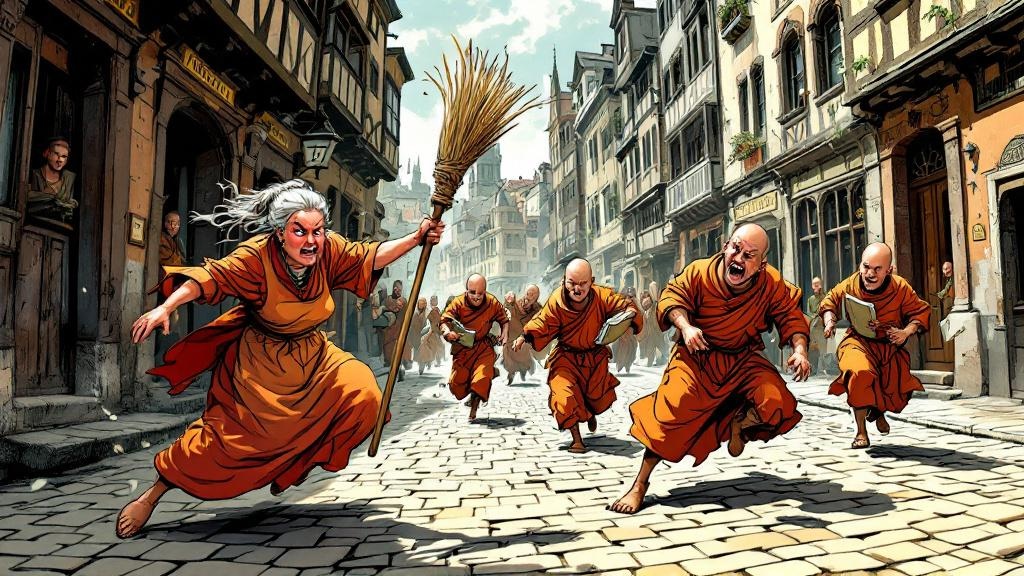
This is magnificent. The young monks have taken Lu-Tze's wisdom and turned it into exactly the same kind of distant-wisdom-seeking that the Way was supposed to cure. They've made Mrs. Cosmopilite exotic. They've turned "Wrap up warm or you'll catch your death" into scripture. They've missed the point by doing exactly the right thing for the wrong reasons.
And Mrs. Cosmopilite, the unwilling prophet, responds the way any sensible person would when religious acolytes start stalking them: with a broom and strong language. She's even developed her own martial art from it—"Shout at Them, Hit Them With a Broom."
The Serious Part
Underneath all the comedy, Pratchett is making one of his most sincere arguments.
Mrs. Cosmopilite survived Ankh-Morpork. She ran a boarding house in a city that is essentially a medieval London crossed with a sewage works crossed with organized crime. She raised children, managed tenants, kept a business running, and navigated life without the benefit of magical time-manipulation powers or centuries of monastic study.
That means she's wiser than monks on mountaintops. Not because her individual sayings are profound—though some accidentally are—but because her wisdom is tested. It survived contact with reality. "It won't get better if you pick at it" isn't philosophy. It's the conclusion of a woman who has watched a thousand problems get worse because people couldn't leave them alone.
Lu-Tze understood this. The Way of Wen the Eternally Surprised is beautiful and rigorous and completely disconnected from the experience of actually living a life. The Way of Mrs. Cosmopilite is banal and obvious and it works when you need it to.
That's Pratchett's argument about wisdom in a nutshell. The stuff that sounds profound usually isn't. The stuff that sounds like your mum nagging you usually is.
Is He Serious, Though?
The brilliant ambiguity of Lu-Tze's devotion to Mrs. Cosmopilite is that Pratchett never quite tells you how seriously to take it.
Is Lu-Tze genuinely enlightened by his landlady's common sense? Or is the Way of Mrs. Cosmopilite just an elaborate troll, a way of winding up senior monks who've spent centuries pursuing formal enlightenment? Is he making fun of them, or is the joke on us for assuming motherly wisdom can't be sacred?
The answer, as with most things Pratchett, is yes.
"The joke is that common sense is sacred wisdom. The deeper joke is that it actually is."
Lu-Tze genuinely follows the Way. He genuinely quotes Mrs. Cosmopilite in moments of crisis. He genuinely finds useful guidance in "If you want a thing done properly you've got to do it yourself." But he also clearly enjoys the discomfort it causes. He relishes announcing "Is it not written...?" and watching senior monks squirm because they dare not ask where.
The ambiguity is the point. Pratchett loved destroying the boundary between joke and philosophy, between satire and sincerity. The Way of Mrs. Cosmopilite is his most sustained example. It's simultaneously a parody of Eastern mysticism, a celebration of working-class wisdom, a commentary on how religions form, and a genuinely useful philosophical framework.
All at once. And still funny.
How Religions Actually Start
There's a deeper layer here that's easy to miss.
Lu-Tze recorded Mrs. Cosmopilite's sayings. His followers copied them. Young monks now study them as sacred texts. Mrs. Cosmopilite herself didn't ask for any of this and actively resists it.
Sound familiar?
Pratchett is quietly showing you how every religion in history actually started. Someone says something sensible. Someone else writes it down. A third person decides it's sacred. A fourth person follows the path to the source. And the original speaker—if they're still alive—usually wants nothing to do with any of it.
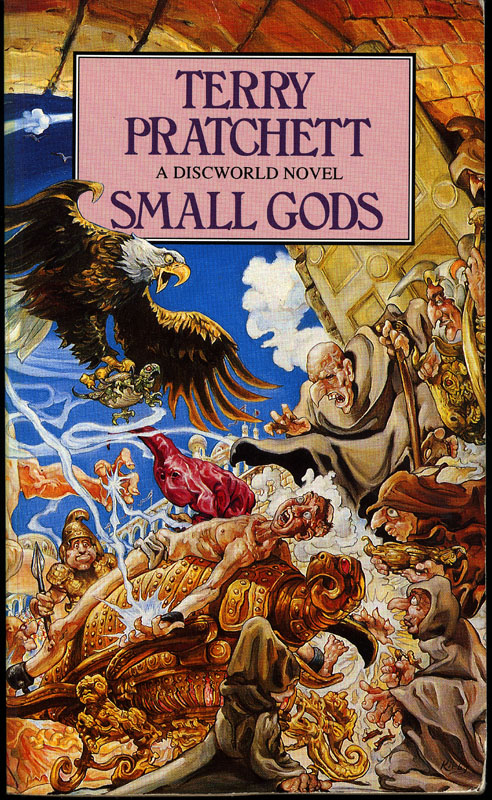
In Small Gods, Pratchett explored this process through Brutha and the Great God Om, showing how genuine belief gets crushed under institutional religion. The Way of Mrs. Cosmopilite is the comic mirror of that tragedy. Same process, smaller scale, and the prophet fights back with a broom.





What Your Nan Knew That the Philosophers Didn't
The ultimate achievement of the Way of Mrs. Cosmopilite is that it makes you reconsider every piece of practical advice you've ever dismissed.
"A penny saved is a penny earned." That's financial wisdom compressed into eight words. "You can't tell a book by its cover." That's Lu-Tze's entire survival strategy—the sweeper nobody notices who happens to be the most powerful monk alive. "When you have got to go, you have got to go." That's a statement about inevitability that any Stoic philosopher would recognize.
Mrs. Cosmopilite didn't invent these sayings. They're the accumulated wisdom of generations of ordinary people—parents, grandparents, landladies, shopkeepers—who learned through trial and error what works and what doesn't. They survived because they're true. Not profound-sounding, not elegant, not dressed up in the language of mysticism. Just true.
Lu-Tze's genius was recognizing this. His comedy was treating it with the reverence usually reserved for ancient scripture. And Pratchett's genius was making you laugh at the absurdity while quietly agreeing with the premise.





The Bottom Line
The Way of Mrs. Cosmopilite is Terry Pratchett's most perfectly layered joke. On the surface, it's absurd—a legendary martial artist quoting his landlady as sacred scripture. One level down, it's satire about how we fetishize distant wisdom while ignoring the practical knowledge right in front of us. And at its core, it's something Pratchett clearly believed: the most useful truths are the simplest ones.
"It won't get better if you pick at it." "There is a time and a place for everything." "I have only one pair of hands."
Your mum was right. Lu-Tze just had the good sense to write it down.
Want to see what happens when Lu-Tze puts his philosophy into action? Read about Rule One and the martial art of Deja-fu, or discover how he casually rewrote history in Small Gods.