Power, Bauble, Control: Vetinari's Political Philosophy vs. Machiavelli's Prince
How Lord Vetinari's philosophy of control surpasses Machiavelli's advice to princes. A literary analysis of Discworld's greatest political mind.
Power, Bauble, Control: Vetinari's Political Philosophy vs. Machiavelli's Prince
Niccolò Machiavelli wrote The Prince in 1513, and political philosophy has been arguing about it ever since. Is it better to be feared than loved? Should a ruler keep his word? Can the ends justify the means?
Five centuries later, Terry Pratchett answered all of these questions—and then asked a better one. What if the real trick isn't being feared or loved, but being so thoroughly indispensable that nobody can afford to get rid of you?
Welcome to the political philosophy of Lord Havelock Vetinari, Patrician of Ankh-Morpork, a man who wrote his own treatise on governance and titled it not The Prince but The Servant. That title alone tells you everything about where this is heading.
The Name Is the First Joke
Before we get into philosophy, there's a gag hiding in plain sight that sets the entire frame.
The Medici family ruled Florence during the Renaissance. Their name derives from medico—doctor, physician. They produced popes, patrons of the arts, and a political dynasty that Machiavelli both served and wrote for. Lorenzo de' Medici wielded patronage and conspiracy as instruments of control.
"If the Medici are the doctors, then the Vetinari are... the vets."
Terry Pratchett, being Terry Pratchett, looked at this and thought: if Medici comes from medicine, what comes from veterinary? The Vetinari family. Pratchett once explained it directly: "Of course there was Medici, so I thought if you had the Medici then you would have the Dentistri and the Vetinari." It's why the other boys at the Assassins' Guild called young Havelock "Dog-Botherer"—the veterinary pun made flesh.
But this isn't just a throwaway joke. The Medici connection is an invitation. Pratchett is telling you to read Vetinari through the lens of Renaissance political philosophy. He's practically daring you to compare the Patrician to Machiavelli's ideal prince.
And when you do, the Patrician wins.
Machiavelli's Prince: The Received Wisdom
Here's the thing about The Prince that most people get wrong: Machiavelli never actually said "it's better to be feared than loved." What he said was that it's best to be both, and only when you can't manage that should you lean toward fear.
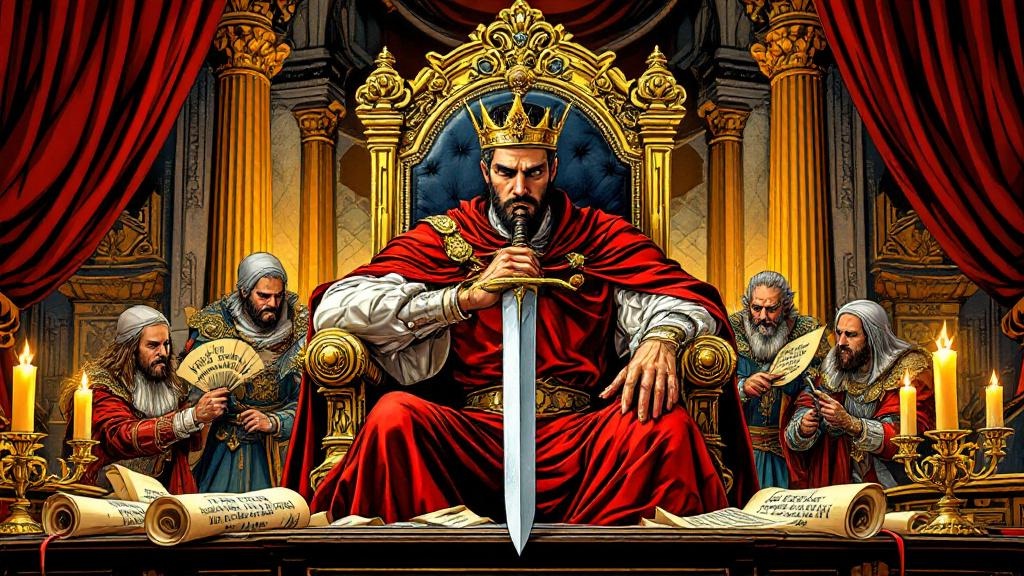
His reasoning was characteristically bleak. Love, Machiavelli argued, is preserved by obligation—and people are terrible at honoring obligations. Fear, however, is preserved by the dread of punishment, which never lets up. "Men have less scruple in offending one who is beloved than one who is feared."
The rest of The Prince follows this logic. A ruler should appear virtuous without actually being constrained by virtue. He should act swiftly and decisively. He should understand that the ends justify the means—no matter how calculated those means might be.
It's pragmatic. It's honest about human nature. And for five hundred years, it's been the default framework for thinking about political power.
Vetinari read it. Then he wrote something better.
The Servant: Vetinari's Counter-Thesis
Somewhere in the Oblong Office, there exists an unpublished manuscript. Vetinari calls it The Servant, and it deals with the practical particulars of running a city like Ankh-Morpork.
The title is the argument. Where Machiavelli addressed his advice to a prince—someone who stands above their subjects and must learn to manage them—Vetinari's framework begins from the opposite position. The ruler serves the city. Not the other way around.
This isn't idealism. Vetinari has no illusions about human nature. He's just as cynical as Machiavelli about what motivates people. But he's arrived at a fundamentally different conclusion about what a ruler should want.
"Power was a bauble. Any thug had power. The true prize was control."
Here's the key passage, from the narration that gets closest to Vetinari's inner life: "You found that what you really wanted was power, and there were much politer ways of getting it. And then you realized that power was a bauble. Any thug had power. The true prize was control."
That distinction—power versus control—is the whole game. Power is the ability to make people do what you want through force or threat. Any warlord has it. Any dictator with enough soldiers has it. Machiavelli's prince, for all his cunning, is ultimately a man with a very big stick.
Control is something else entirely. Control is understanding the system so thoroughly that you can place your thumb on the scale at exactly the right moment. It's knowing where the fulcrums are. And critically, "all control started with the self."
Fear, Love, and the Third Option
Machiavelli says: be feared.
Vetinari says: be permanent.
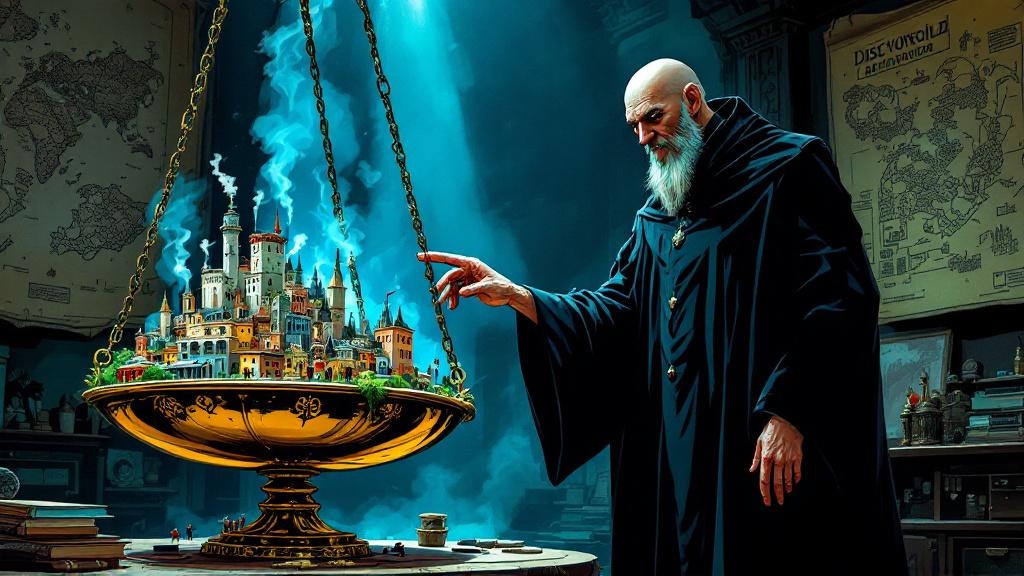
This is his masterstroke, the philosophical move that leaves Machiavelli in the dust. Vetinari doesn't rule through fear—guild leaders aren't afraid of him because he might have them killed. They're afraid of what would happen to Ankh-Morpork without him. He's carefully constructed a reality where having him as Patrician is slightly better than any alternative. Not dramatically better. Not utopian. Just... slightly better. Enough that it's never quite worth the risk of removing him.
There's a price on his head—AM$1,000,000, the highest for any living being. The Assassins' Guild refuses to accept contracts on him. Not out of loyalty or fear, but because they've done the maths. An Ankh-Morpork without Vetinari would be chaos, and chaos is bad for business.
This is governance as systems engineering. Machiavelli's prince maintains power through personal qualities—cunning, ruthlessness, the appearance of virtue. If the prince dies, the system collapses. Vetinari has built something that almost doesn't need him at all—and that's precisely what makes him irreplaceable, because nobody else understands the machinery well enough to keep it running.
Irony Over Steel
"It is said that Vetinari can accomplish more with irony than most others can with steel."
Machiavelli spent considerable ink on the subject of arms. A prince must be a warrior. He must study the art of war. He must never let his mind wander from the subject of military preparation. Force, for Machiavelli, is the foundation of all political authority.
Vetinari was trained at the Assassins' Guild. He can kill people. He's very good at it. He simply chooses not to, because killing people is an admission that you've run out of better ideas.
"Vetinari can accomplish more with irony than most others can with steel."
Consider how he handles crime. Machiavelli's prince would crack down with force—public executions, harsh punishments, demonstrations of power. Vetinari legalized the Thieves' Guild. He gave thieves a quota, issued receipts for muggings, and reduced violent crime to below what it was under any previous Patrician who tried to stamp it out by force. The criminals are organized. They have a budget. And crucially, they police each other.
It's absurd. It's also brilliant. And it's the kind of solution that Machiavelli—trapped in his framework of princes and armies—would never have imagined.
The same logic extends to the Seamstresses' Guild, the Beggars' Guild, even the Assassins. Vetinari's Ankh-Morpork runs on the principle that people will do what they're going to do anyway, so you might as well make them fill out paperwork for it. This isn't The Prince. This is game theory with a civil service.
The City Above All
Here's where Vetinari and Machiavelli diverge most sharply.
Machiavelli's prince serves himself. Oh, he serves the state too—a stable state is good for the prince—but the prince's survival and glory are the ultimate goals. The state is the instrument. The prince is the purpose.

Vetinari has inverted this entirely. "It was said that he would tolerate absolutely anything apart from anything that threatened the city." He's broadly tolerant of individual rights and personal eccentricities—Ankh-Morpork is a city where trolls, dwarfs, vampires, werewolves, golems, and humans coexist in something approximating harmony. But anyone who places their own interests above those of Ankh-Morpork will find that tolerance evaporates instantly.
He has no visible personal life. No vices that any guild could exploit. His only discernible emotional attachment was to his dog, Wuffles. He reads sheet music rather than having it performed, because he finds the "sweat and saliva" of live performance distasteful. The city is his life.
Machiavelli would find this baffling. What's the point of ruling if you don't enjoy ruling? But that's precisely Vetinari's insight. The moment a ruler starts enjoying power for its own sake, they've lost control. They've become attached to the bauble instead of the mechanism.
The Proof Is in the Guilds
The practical results speak for themselves.
Lorenzo de' Medici ruled Florence through patronage and conspiracy. He survived the Pazzi assassination attempt of 1478 through a combination of luck and popular support, then consolidated power by convincing supporters that more centralized control was necessary. His legacy is gorgeous art, impressive architecture, and a dynasty that eventually collapsed into excess and papal politics.
Vetinari rules Ankh-Morpork through boredom and competence. He deals with big problems while they're still small problems. He plays powerful interest groups against one another. He makes certain that everyone else is too busy making money or plotting against their rivals to find it convenient—right now—to remove him.
"He deals with big problems while they're still small. Everyone else is too busy to find it convenient, right now, to remove him."
Lorenzo needed the Pazzi conspiracy to fail. Vetinari survived his own poisoning in Feet of Clay and used it as a weapon. He'd known about the arsenic in the candles for some time. He let Vimes investigate. He let the city's elite watch the investigation unfold. And by the end, every potential plotter understood exactly how much worse things would be if they succeeded in killing him.
Machiavelli said a prince should be ready to seize fortune when it strikes. Vetinari lets his enemies create their own misfortune, then watches them educate themselves about why he's necessary.
What Pratchett Was Really Saying
The comparison between Vetinari and Machiavelli isn't just a clever literary game. It's Pratchett doing what he always does—taking a received idea and testing it against something more human.
Machiavelli's The Prince is the foundational text of political cynicism. It says: people are bad, so rulers must be worse. It's pragmatic, it's influential, and it's depressing.
Pratchett's response, through Vetinari, is both more cynical and more hopeful. Yes, people are self-interested. Yes, they'll break their word when it suits them. But a clever enough system—one that channels self-interest into productive behavior, that makes cooperation more profitable than betrayal, that regulates chaos rather than trying to eliminate it—can produce something that looks remarkably like a functioning, tolerant, even progressive society.
Not through virtue. Not through fear. Through competence and the quiet understanding that the true prize was never power. It was control.
And that's a political philosophy worth taking seriously—even if it comes from a book about a flat world on the back of a turtle.
Where to Read Vetinari at His Best
If you want to see Vetinari's philosophy in action, start with Going Postal. It's Vetinari at his most Machiavellian—taking a condemned con man and transforming him into a civil servant, not through force but through an understanding of human nature so precise it's almost cruel. Moist von Lipwig thinks he's being given a second chance. He is. It's just that the second chance was designed by someone who understands exactly how con men think.
From there, Feet of Clay shows you what happens when someone tries to remove Vetinari from the equation. And The Truth demonstrates his relationship with the free press—another institution he tolerates because controlling the flow of information is more valuable than suppressing it.





Machiavelli wrote the manual for princes. Vetinari proved that the real power belongs to the servant who understands the machinery. Five centuries of political philosophy, and it took a fantasy novel about a city on a turtle's back to get the answer right.