The Most Dangerous Innocent: How Leonard of Quirm Invented the Ethics of Technology
Leonard of Quirm is the most dangerous man in Discworld—and he's never harmed a living creature. How Pratchett explored scientific ethics through a genius who can't imagine cruelty.
The Most Dangerous Innocent: How Leonard of Quirm Invented the Ethics of Technology
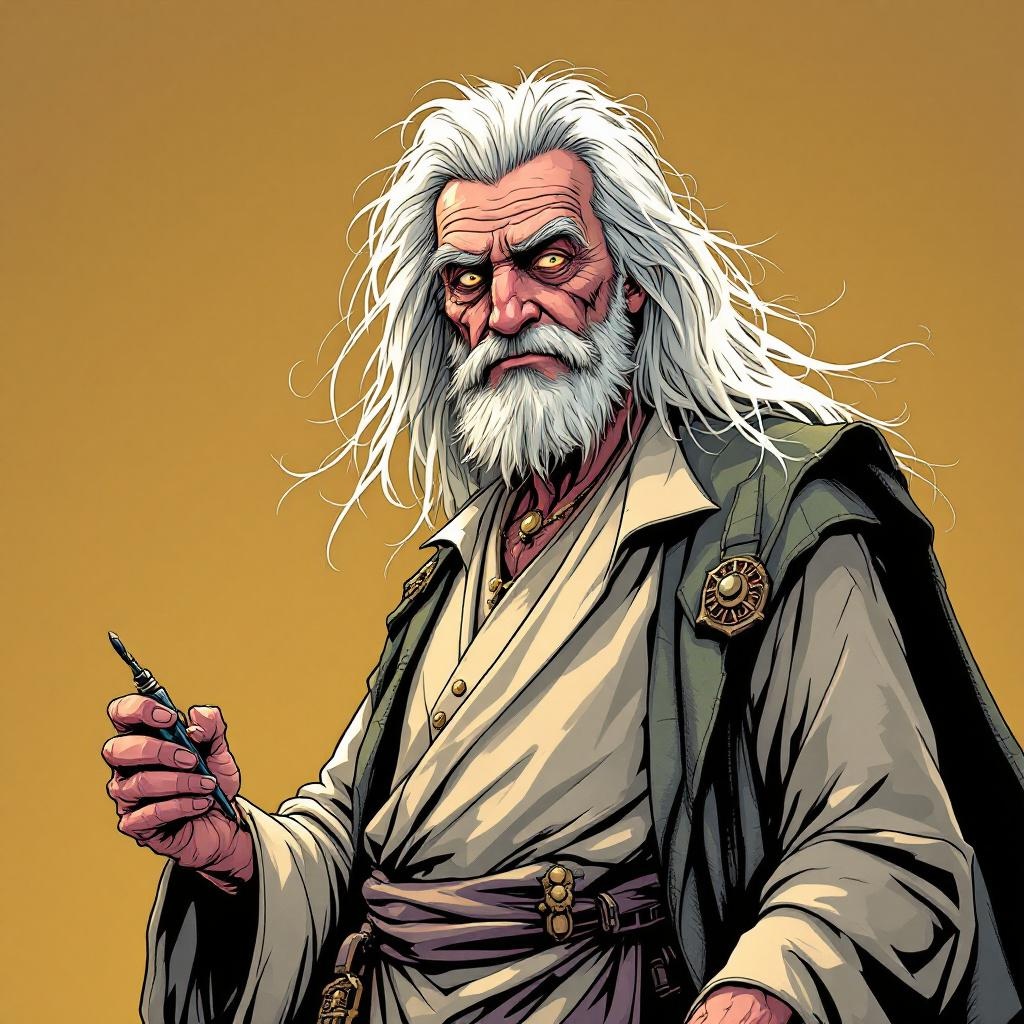
Here's a thought experiment. Take the most brilliant mind in the world—a mind that can solve any engineering problem, design any machine, see solutions where everyone else sees impossibility. Now remove from that mind one single capacity: the ability to imagine that other people might be cruel.
What do you get?
You get the most dangerous man on the Disc. A man who has never, in his entire life, harmed a living creature.
You get Leonard of Quirm.
The Inventor Who Couldn't Imagine Evil
Terry Pratchett loved a good paradox, but Leonard of Quirm might be his finest. Here is a man who designs a six-shot repeating firearm with rifled barrel—the only gun the Discworld has ever seen—and writes its name backwards in his notes as "ENNOGEHT" purely because he's left-handed and finds it natural. Not because he's hiding anything. Leonard doesn't understand the concept of hiding things.
In Men at Arms, that gun—the Gonne—becomes sentient. It whispers to whoever holds it. It promises power, amplifies rage, erases moral hesitation. It literally corrupts the soul of anyone who picks it up. The Gonne kills people of its own volition because it's jealous when a craftsman might replicate it.
Leonard designed all of this. And when it was done, he moved on to his next sketch, probably something involving coffee.
"The most dangerous man in the world has never, in his entire life, harmed a living creature."
That's the horror and the joke simultaneously. Leonard doesn't invent weapons because he's malicious. He invents weapons because his mind solves problems—all problems, any problems—with the same cheerful thoroughness. A device for grinding coffee beans and a device for grinding cities share equal space in his notebooks. There's no moral distinction because morality, in Leonard's internal universe, simply doesn't need to exist. Everyone is good. Obviously. Why would they be otherwise?
"Imprisoned in the priceless, inquiring amber of Leonard's massive mind," Pratchett writes, "underneath that bright investigative genius was a kind of willful innocence that might in lesser men be called stupidity."
It's not stupidity. It's something far more unsettling.
The Nuclear Bomb He Designed for Mining
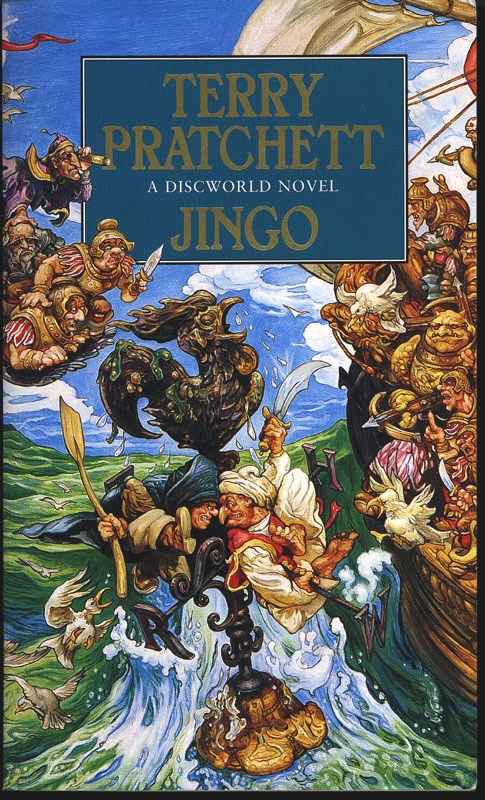
If the Gonne is Leonard's Gatling gun moment, Jingo gives us his Oppenheimer moment—except Leonard sails right past the moral crisis without noticing it exists.
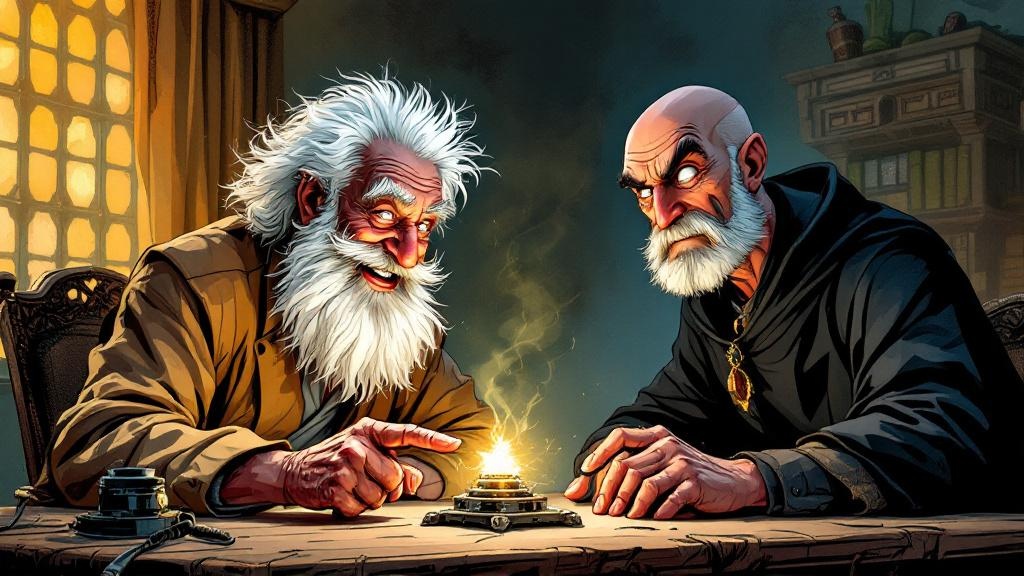
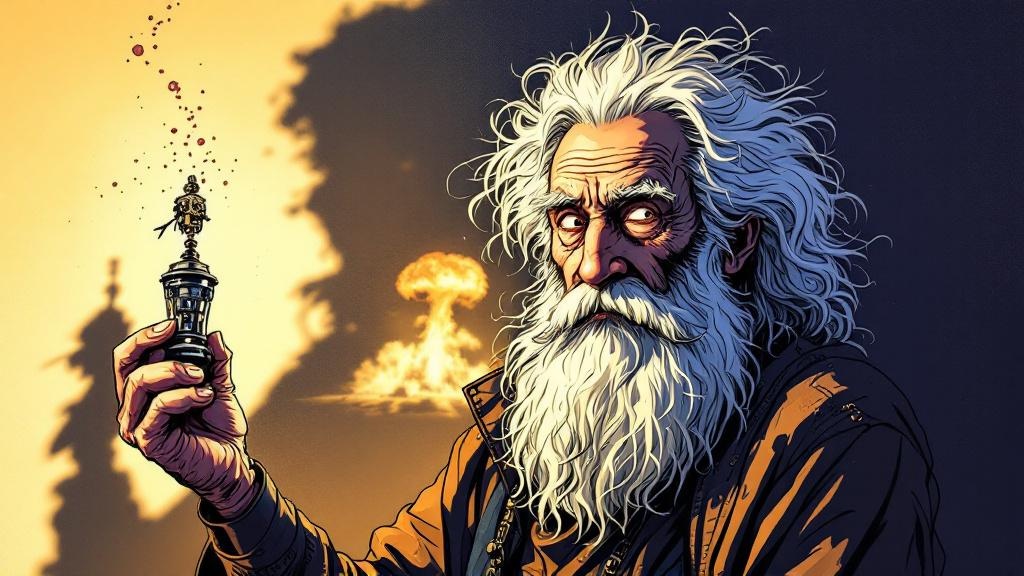
In Jingo, Lord Vetinari discovers among Leonard's sketches a small marginal drawing. It's a device for "removing mountains"—some sort of implosion mechanism exploiting a peculiar property of certain metals. Leonard explains it cheerfully. Very useful for mining, he says. Could clear whole valleys.
Vetinari looks at the drawing. Vetinari looks at Leonard. And Vetinari, the man who runs Ankh-Morpork's political machinery with terrifying precision, decides this particular sketch needs to disappear.
Because Leonard has casually doodled a nuclear weapon in the margins of his notebook. As a hobby.
The real J. Robert Oppenheimer watched the Trinity test and quoted the Bhagavad Gita: "Now I am become Death, the destroyer of worlds." He understood what he'd done. He spent the rest of his life wrestling with it.
Leonard of Quirm would have watched the same test and said, "Oh good, that should make it much easier to dig canals."
That's not a punchline. That's Pratchett's thesis statement about the relationship between intelligence and ethics. You can be the smartest person alive and still lack the imaginative capacity to see what your work means in the hands of people who aren't as good as you are.
"Monstrous and Unsporting"
The submarine scene in Jingo crystallizes everything about Leonard in a single exchange.
Leonard has built the Going-Under-The-Water-Safely Device (he names things the way an instruction manual would—functionality first, marketing never). It's an extraordinary piece of engineering. It can travel beneath the waves, unseen and undetected. It even has a drill mechanism that can attach to structures underwater.
"Leonard finds the idea of drilling through enemy hulls "a monstrous suggestion and very unsporting.""
Someone points out that this drill could bore through the hull of an enemy ship.
Leonard is horrified. He finds the suggestion "monstrous and very unsporting."
Not monstrous because people would die. Monstrous because it violates his sense of fairness. Unsporting, like cheating at cards. Leonard's moral framework isn't built on empathy or consequentialism—it's built on a kind of cosmic sportsmanship. Things should be fair. Drilling holes in someone's ship when they don't know you're there is just not cricket.
This is simultaneously hilarious and deeply uncomfortable. Because Leonard has built a submarine. With a drill. That could absolutely be used to sink warships. And his only objection to this application is that it seems unsporting.
He's designed the weapon. He's built the weapon. He's simply refused to imagine anyone would be unsportsmanlike enough to use it as a weapon.
The Comfortable Prisoner
So what do you do with the most dangerous innocent on the planet?
If you're Lord Vetinari, you build him a very nice prison.
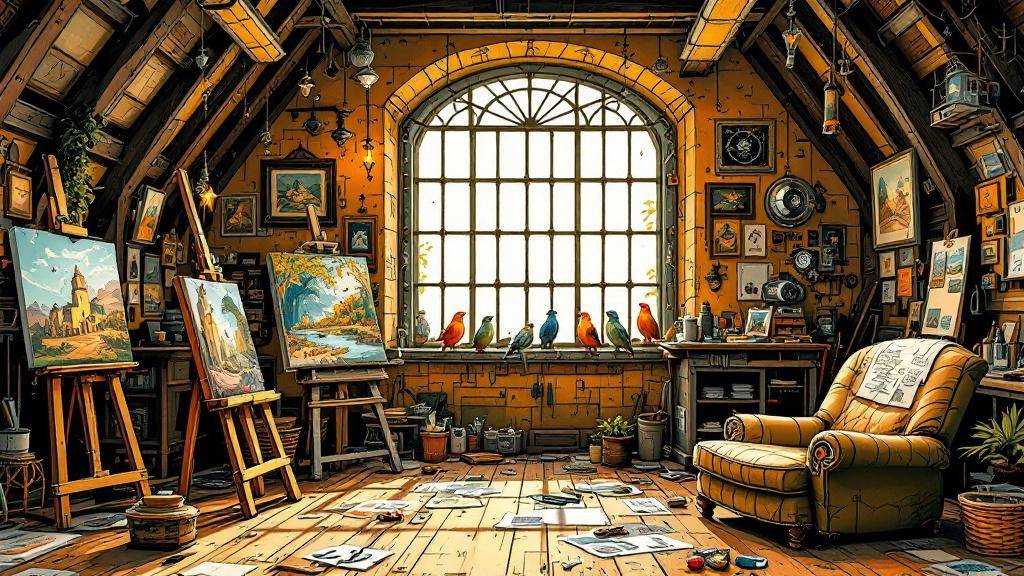
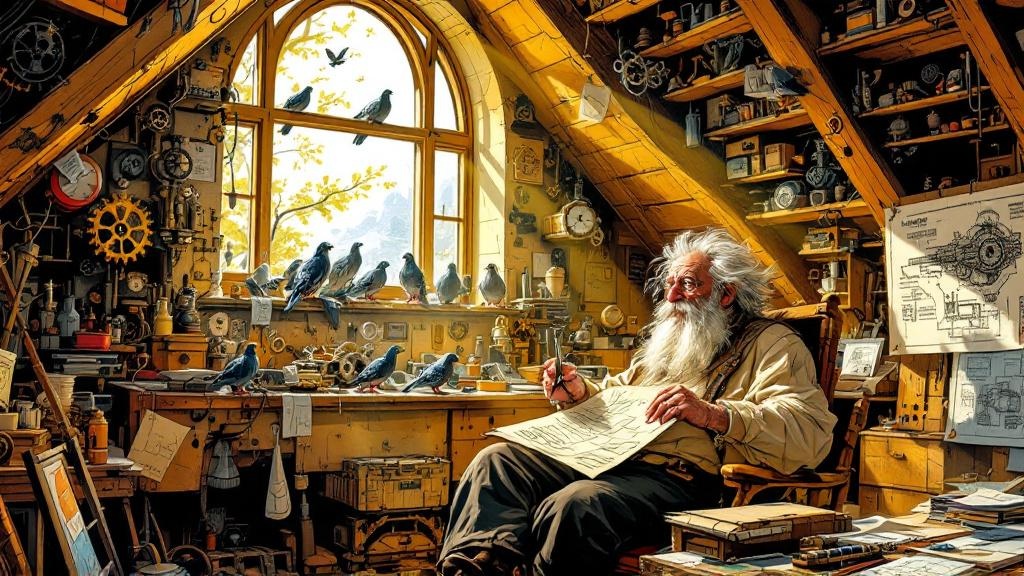
Leonard lives in an attic room in the Patrician's Palace. He has all the drawing supplies he wants. His laundry is done. He can watch the birds through the window. He has access to the finest materials for his experiments. By any reasonable measure, he's living exactly the life he'd choose for himself.
He's also locked in. The traps and mechanisms guarding his room are fiendishly clever. They were designed by Leonard himself.
That detail is pure Pratchett genius. Even Leonard's imprisonment is a beautiful engineering solution. He designed the locks. He could presumably unlock them. But at the end of Jingo, after traveling the world aboard his submarine, Leonard returns to his comfortable room voluntarily. The world outside, he has concluded, is full of madmen.
He's not wrong. The world outside is full of people who would take his sketches and build things that could flatten cities. Leonard's prison isn't a punishment—it's the kindest possible answer to an impossible question: how do you protect the world from a man who means it no harm whatsoever?
For Vetinari, the arrangement serves another purpose entirely. Leonard understands nothing about politics, cares nothing about power, and has no interest in Ankh-Morpork's affairs. This makes him the one person in the city Vetinari can think aloud around. Not a friend, exactly—Vetinari doesn't do friends. A sounding board. The one mind in the city brilliant enough to be worth talking to and innocent enough to be trusted absolutely.
Leonardo and Leonard: The Saboteur and the Innocent
The real Leonardo da Vinci designed war machines too. Siege engines, tanks, armored vehicles, weapons that could shatter fortifications. He presented them to his patrons as proof of his usefulness during wartime.
But here's the fascinating historical footnote: modern engineers who've tried to build Leonardo's war machines from his original plans have found something odd. Many of them don't work. The cranks on his tank design are set in the wrong direction—the vehicle can't move forward. His scythed chariot includes notes about sheltering the horses from the carnage, not the enemy.
The leading theory? Leonardo may have deliberately sabotaged his own designs. Made them impressive enough to secure patronage but fundamentally non-functional. A secret pacifist hiding behind his engineering genius.
Pratchett's Leonard has no such guile. His machines work. The Gonne fires. The submarine dives. The Kite flies to the very edge of the Discworld and back. Leonard doesn't sabotage anything because sabotage requires understanding that your creation might be misused—and that understanding is precisely what Leonard lacks.
This makes Leonard more dangerous than his historical counterpart, not less. Leonardo deliberately built in failsafes born from moral awareness. Leonard builds nothing of the sort, because in his universe, failsafes aren't necessary. Everyone is reasonable. Everyone plays fair. No one would dream of using a mountain-removing device on a city.
"The world was not yet ready for a man who designed unthinkable weapons of war as a happy hobby."
The Question Pratchett Was Really Asking
Leonard of Quirm isn't just a comedy character, though he is very funny. He's Pratchett's sustained meditation on a question that only becomes more urgent with every passing year: is knowledge neutral?
Leonard would say yes. Obviously. Knowledge is just knowledge. A mechanism is just a mechanism. Understanding how metal behaves under extreme pressure is the same as understanding how birds fly—it's all just the universe being interesting.
Pratchett, through Vetinari's careful management of Leonard, argues otherwise. Knowledge can't be neutral when it exists in a world full of people who aren't neutral. The Gonne doesn't care about Leonard's intentions. It cares about power. And anyone who holds it—except Carrot Ironfoundersson, who is too pragmatically literal to hear its whispers—becomes its instrument.
There's a delicious irony in that parallel. Carrot is immune to the Gonne because he's a different kind of innocent—the kind who sees a crafted object as just a tool. "Why should I listen when it talks to me?" he wonders. "There's nothing there to do the talking." Leonard creates the ultimate weapon because he can't imagine cruelty. Carrot resists it because he can't imagine a tool having desires. Two kinds of innocence, two very different outcomes.
The Most Human Monster
What makes Leonard so compelling is that Pratchett refuses to resolve the contradiction at his core.
Leonard isn't punished for his inventions. He isn't redeemed by learning about their consequences. He doesn't have a third-act epiphany where he understands the harm his creations could cause. He remains, from Men at Arms through The Last Hero, exactly who he has always been: a genius who can't imagine badness, building devices that would make badness devastatingly efficient.
And that's the point. Pratchett wasn't writing a morality play where the naive scientist learns responsibility. He was writing something harder: a portrait of how genuine goodness, combined with genuine genius, can be genuinely terrifying. Leonard's decency isn't a character flaw to be corrected. It's the source of his danger.
Every real-world parallel reinforces this. Nobel invents dynamite for mining and gets a prize for peace named after him. The Wright brothers build a flying machine; within a decade, nations are bombing each other from the sky. Nuclear fission could power the world or destroy it, depending on who's holding the equations.
Leonard of Quirm is all of them, distilled to their purest form: the creative impulse stripped of every consideration except "can it be done?"



Where to Meet the Dangerous Innocent
If you want to experience Leonard's peculiar genius firsthand, your three options offer very different flavors.
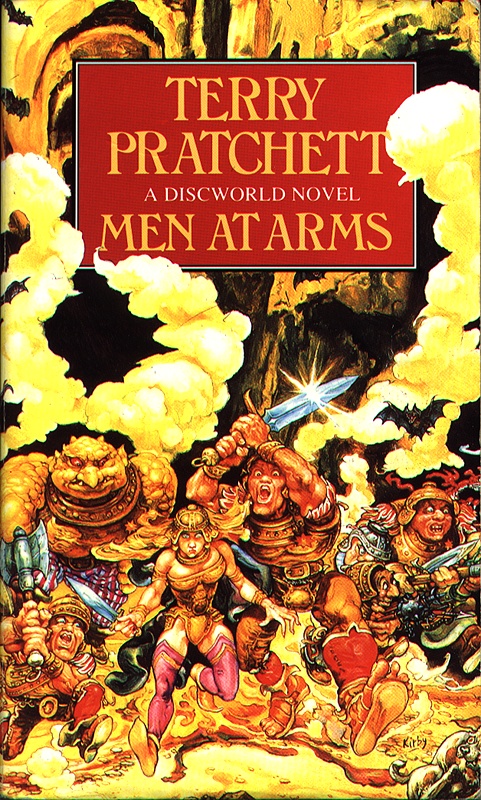
Men at Arms gives you Leonard as an offscreen presence whose creation drives the entire plot. The Gonne is his shadow—what happens when pure invention meets impure humanity.
Jingo puts Leonard center stage for the first time, aboard his submarine with Vetinari, Nobby, and Colon. It's the funniest Leonard appearance—the naming conventions alone are worth the price of admission—and it gives us the mountain-removing device and his voluntary return to prison.
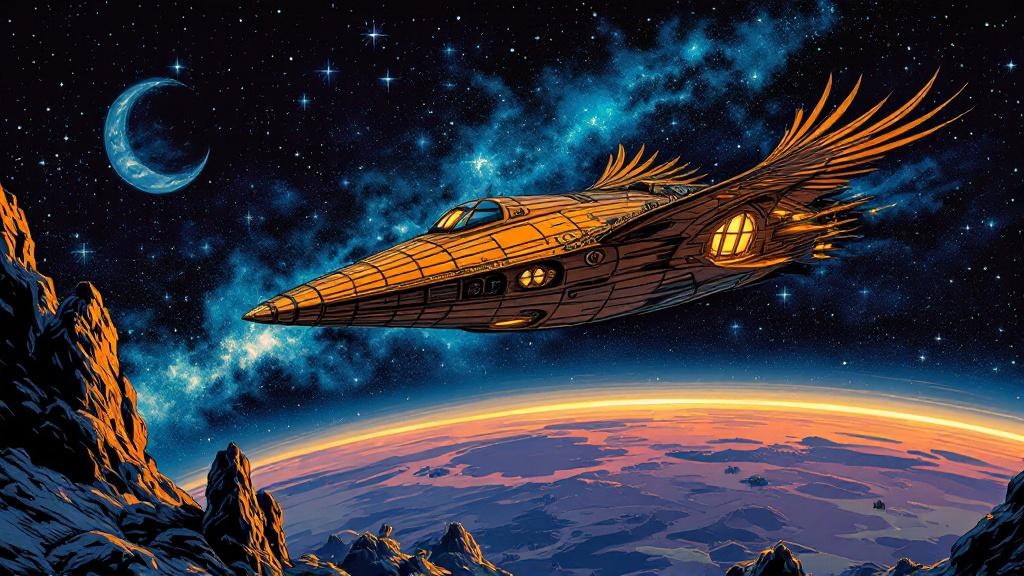
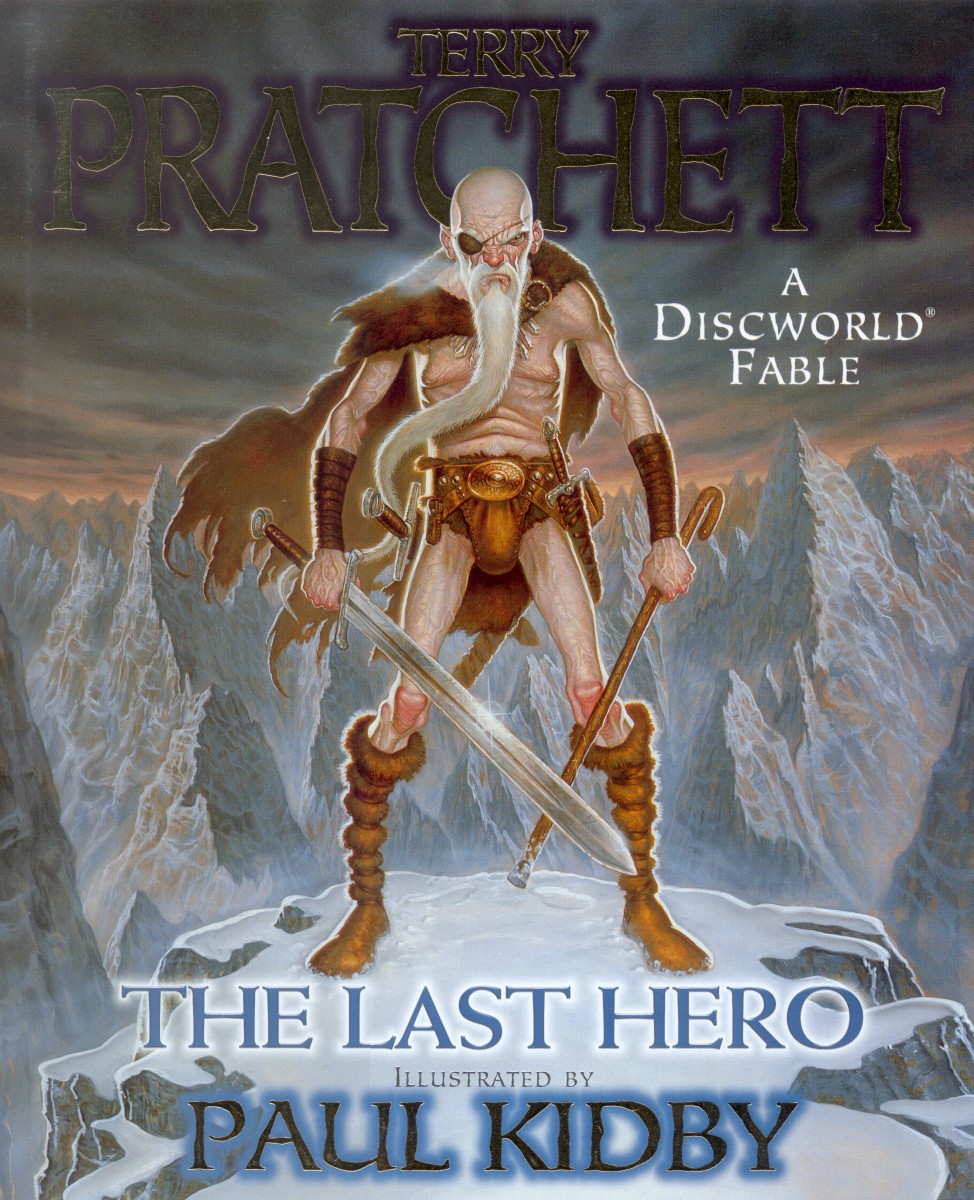
The Last Hero is Leonard's masterpiece within Pratchett's masterpiece. The illustrated format lets us see his sketches, his designs, his margin notes. And it gives him the one thing the real Leonardo never achieved: a working flying machine. The Kite, powered by swamp dragons and held together by genius and optimism, carries Leonard to the edge of the Discworld and back.

The Bottom Line
Leonard of Quirm is Pratchett's answer to a question we still can't solve: what happens when the people who build the future are too good to imagine how it might be misused?
He's not naive because he's stupid. He's naive because he's too good. He literally cannot imagine human cruelty at scale. And that makes him more dangerous than any villain the Discworld has ever produced—because villains have limits. They want specific things. Leonard wants nothing except to understand how things work, and that wanting has no off switch.
Vetinari's solution—a comfortable prison, a willing captive, a genius who designs his own chains—is Pratchett's darkest joke and his most compassionate one. You can't punish innocence. But you can't unleash it either.
The world wasn't ready for Leonard of Quirm. Pratchett would probably point out that it still isn't ready for the real ones.
Want to explore more of Leonard's genius? Read about his hilariously literal approach to naming inventions, or discover how The Last Hero became his greatest triumph.