Mort's Mistake: When Death's Apprentice Broke the Universe for Love
In Discworld's Mort, Death's apprentice saves a princess he was supposed to kill. What his rebellion reveals about Death, duty, and compassion.
Mort's Mistake: When Death's Apprentice Broke the Universe for Love
Nobody wanted Mort.
At the annual hiring fair in Sheepridge, the gangly, awkward teenager stood waiting while every other apprentice was claimed. Too clumsy for carpentry. Too dreamy for farming. Too... Mort for anything practical. His father Lezek had dragged him there hoping someone—anyone—would take the boy on.
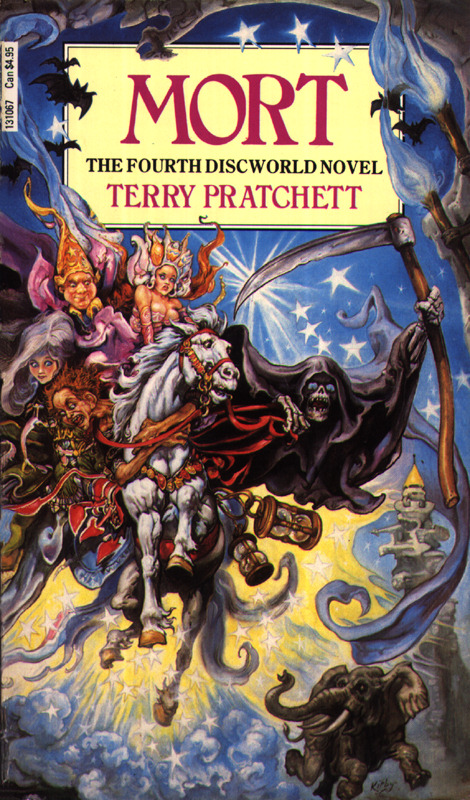
Then midnight struck, and Death arrived on a white horse.
The only master who'd take the apprentice nobody wanted. It's a setup that sounds like the beginning of a joke, and in a way it is—Terry Pratchett never met an opening he couldn't play for laughs. But Mort is the novel where Death stops being a punchline and becomes a person. And the reason he transforms is because his unwanted apprentice does the one thing Death never could: he breaks the rules for love.
The Education of an Apprentice
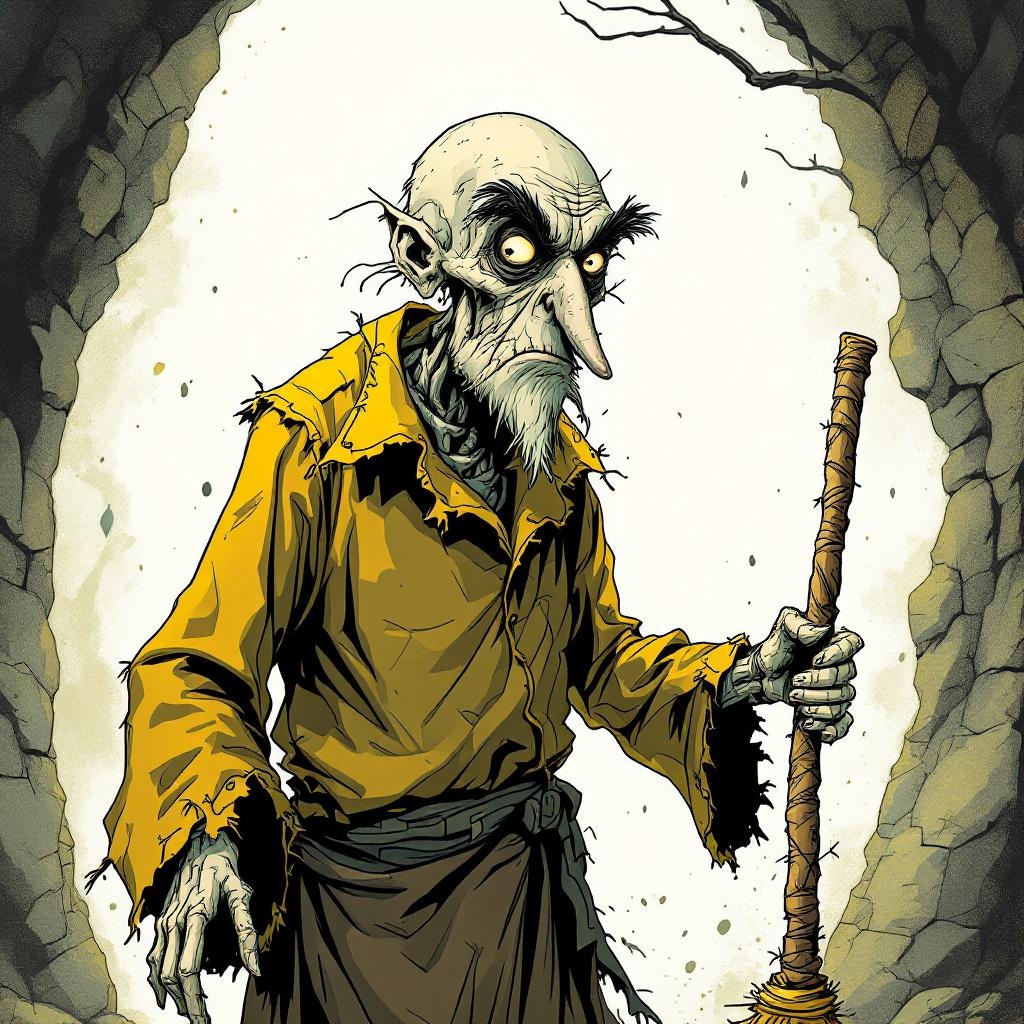
Death takes Mort to his domain—that strange, grey house where everything is built at human proportions because Death has been studying humanity for billions of years and still can't quite get the proportions right. There's a garden with black soil and pale flowers. There's a kitchen where Albert (Death's servant, formerly Alberto Malich, founder of Unseen University) makes greasy meals. There's a library containing every autobiography ever written, updating in real time.
And there's Ysabell. Death's adopted daughter, who has lived in this twilight realm for sixteen years and is thoroughly sick of it.
"YOU MUST LEARN THE COMPASSION PROPER TO YOUR TRADE."— Death
Death begins teaching Mort the family business. The scythe technique. The hourglasses. The schedules. And the most important lesson of all: compassion. "YOU MUST LEARN THE COMPASSION PROPER TO YOUR TRADE," Death tells him. Mort asks what that means. Death's answer: "A SHARP EDGE."
It's a perfect Pratchett line—funny and devastating simultaneously. Death's compassion is making the end quick and clean. Not saving people. Not interfering. Not caring who deserves to live and who deserves to die. Just being there, reliably, inevitably, professionally.
Mort learns this. He understands it intellectually. He watches Death work and sees the grace in it—the dignity of a being who treats every soul equally, from beggars to kings.
And then Death sends him on a solo job.
The Girl He Was Supposed to Kill
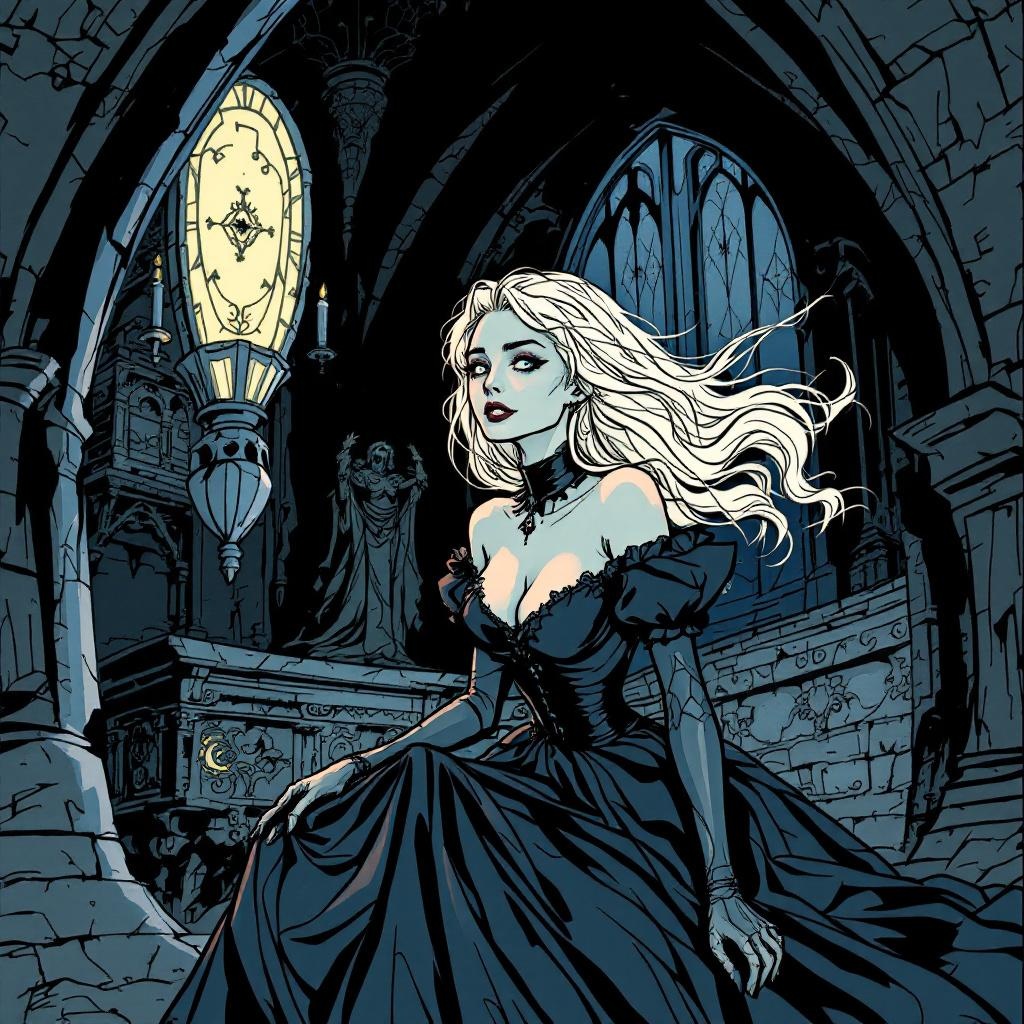
Princess Kelirehenna of Sto Lat is about to be assassinated. It's right there in the schedule. The Duke of Sto Helit has arranged her murder to seize the throne—standard Discworld politics—and Mort's job is to be there when it happens. Not to stop it. Not to judge it. Just to collect the soul and move on.
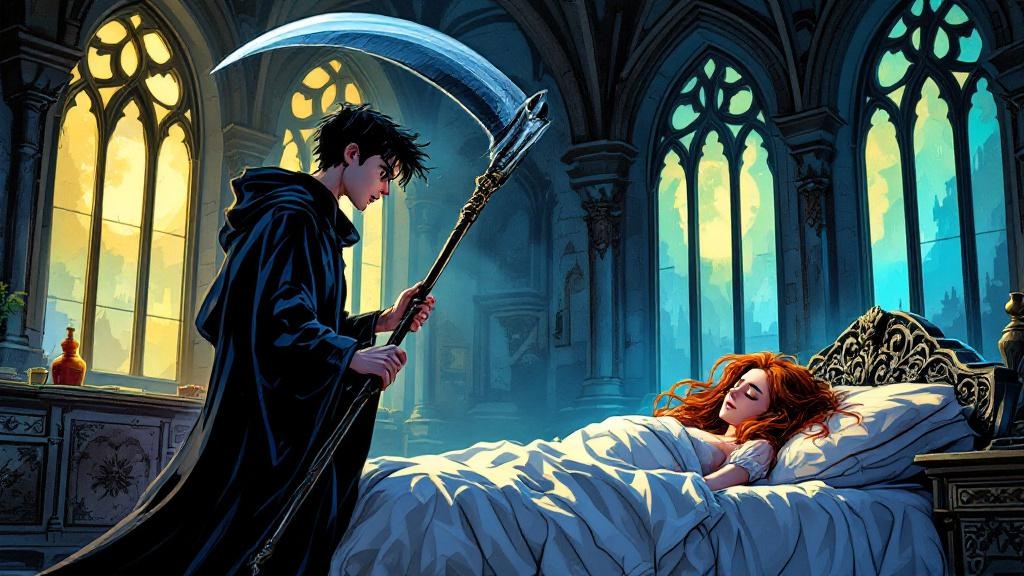
He can't do it.
In the moment the assassin strikes, Mort swings his borrowed scythe the wrong way—at the killer instead of the victim. Princess Keli lives. The assassin dies. And the universe, which had very specific plans for how this evening was supposed to go, begins to crack.
Here's the thing about what Mort does: it's not heroic in any traditional sense. He doesn't make a noble calculation about justice or destiny. He sees a young woman about to die, and something in him—something fundamentally, stubbornly human—simply refuses to let it happen. He falls in love at first sight, which is the most irrational reason imaginable to break the laws of reality.
Death would say that's exactly the problem.
The Universe Fights Back
Reality doesn't appreciate being rewritten by a teenager with a crush.
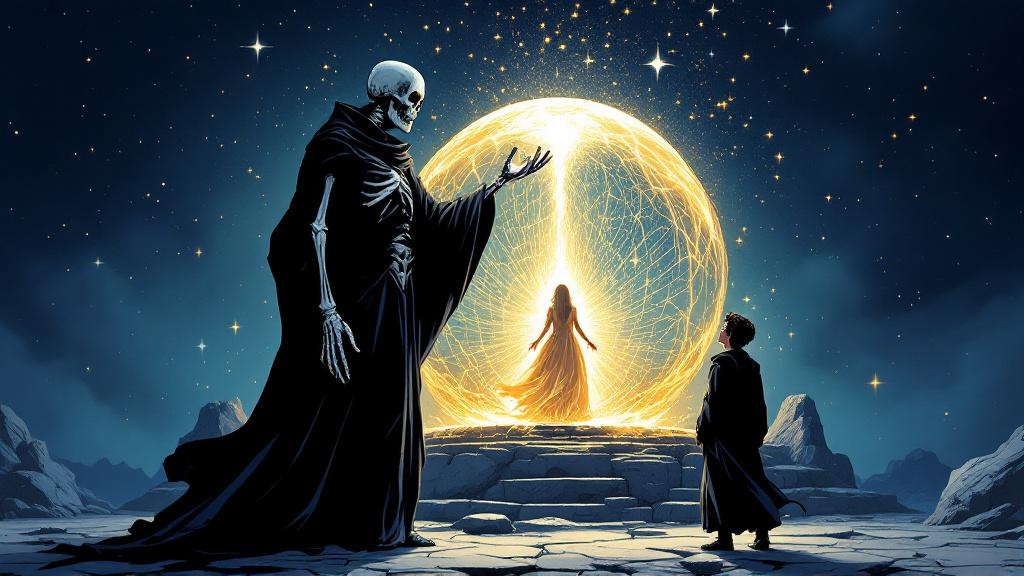
Around Sto Lat, a dome of shimmering light begins to form—the Interface, visible only to wizards and those touched by Death's power. Inside the dome, Princess Keli is alive. Outside, the rest of the world proceeds as if she's dead. The dome is shrinking, grinding toward her at walking speed, threatening to erase the version of reality where she survived.
"The universe had very specific plans for how this evening was supposed to go. Mort had other ideas."
And Keli herself begins to disappear. Not physically—she's still there, still breathing, still giving orders. But people can't see her. Their minds know she's supposed to be dead, and so they simply... stop noticing. She sits on her throne and courtiers walk past as if the chair were empty. She issues decrees and nobody hears them.
There's a particular cruelty to this that goes beyond fantasy worldbuilding. Keli doesn't vanish in a puff of smoke. She becomes irrelevant. The world agrees she shouldn't exist, and so it treats her as if she doesn't. If you've ever felt invisible—ever spoken and been unheard, ever been present and unacknowledged—Pratchett's metaphor lands with uncomfortable precision.
Only the wizard Igneous Cutwell, hired by Keli to find a magical solution, can consistently perceive her. And Mort, of course, who created this mess in the first place.
The Role Reversal
While Mort deals with the consequences of his rebellion, something strange happens to both him and his master.
Mort starts becoming more like Death. His brown eyes shift to icy blue. He begins speaking in CAPITALS. His personality becomes detached, cold, efficient—the mortal boy slowly overwritten by the role he's trying to fill. It's as if Death's job is a kind of possession, reshaping whoever wears the mantle into something less than human.
Meanwhile, Death goes on holiday.

Free from his duties for the first time in eternity, Death does what any overworked professional would do: he tries everything humans enjoy. He goes fishing (the fish die when he enters the water). He plays games at the fair (he wins everything, because nobody can cheat Death). He gets drunk at the Mended Drum and talks to strangers about how lonely he is.
"It struck Mort with sudden, terrible poignancy that Death must be the loneliest creature in the universe," Pratchett writes. "In the great party of Creation, he was always in the kitchen."
That line—casual, devastating, buried in the middle of a comedy—is where Mort pivots from funny fantasy to something deeper. Death isn't just an anthropomorphic personification doing a job. He's alone. He's been alone since the beginning of time. And the only person who ever volunteered to spend time with him is currently busy destroying the fabric of reality because he fell in love with a princess.
The Duel
When Death returns, he's not angry. Not exactly. What he feels is something more complicated—disappointment laced with understanding. He gets why Mort did what he did. He simply cannot allow it.
"THERE'S NO JUSTICE," Death says. "THERE'S JUST ME."
The duel between Death and his apprentice is one of the great set pieces of early Discworld. It shouldn't work—a teenage boy fighting the literal personification of death is absurd on its face. But Pratchett plays it straight. Mort, now half-transformed into something like Death himself, fights with borrowed power and desperate love. Death fights with the certainty of someone who has been doing this since before the mountains were young.
Death wins. Of course he does.
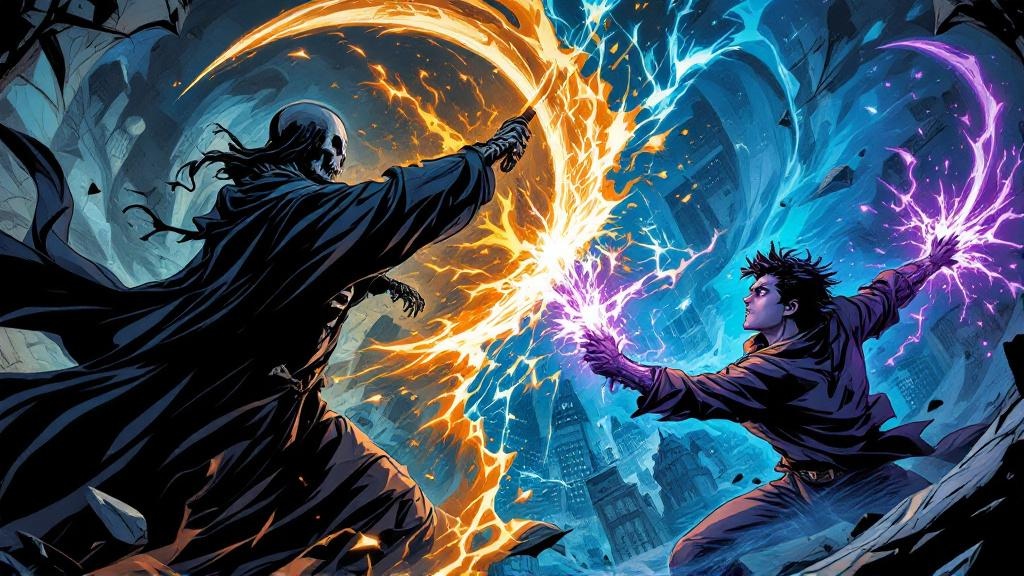
But here's where Mort's mistake reveals something extraordinary about Death: he doesn't finish it. Standing over his defeated apprentice, scythe raised, Death hesitates. And it's Ysabell—his own adopted daughter, who has fallen in love with Mort—who delivers the killing blow. Not with a weapon. With words.
She calls Death a hypocrite.
You're meddling with fate too, she tells him. You took an apprentice when you shouldn't have. You adopted a daughter. You felt loneliness and tried to fix it. How is that any different from what Mort did?
"Death's mercy isn't weakness. It's the moment he admits he understands exactly why Mort broke the rules."
Death takes Mort's hourglass—empty now, the sand run out—and turns it over. Mort lives.
What Death's Mercy Reveals
Here's what makes Mort essential to understanding Death as a character: his mercy isn't weakness. It isn't sentimentality. It's the moment he admits, perhaps for the first time, that he understands exactly why Mort broke the rules.
Death has been watching humanity for billions of years. He's seen every act of love and every act of cruelty. He's been present at every birth and every death. And in all that time, he's maintained professional distance—the sharp edge of compassion he taught Mort about.
But Mort's mistake holds up a mirror. If Death himself took an apprentice because he was lonely, if he adopted a daughter because he wanted family, then he's already broken his own rules. He's already chosen feeling over duty. Mort just did it louder.
The gods—being, as Pratchett notes, "sentimental"—agree to rewrite reality so that Keli was always meant to survive. The Duke dies instead. History reshuffles itself. Mort and Ysabell marry and become the Duke and Duchess of Sto Helit, fulfilling the political future the Duke would have occupied.
It's a neat resolution, but the neatness isn't the point. The point is that Death chose to ask the gods for help rather than enforce the rules. He chose love—Ysabell's love for Mort, Mort's love for Keli, his own love for the family he'd accidentally built—over cosmic order.
The Apprentice Who Changed Death Forever
Mort is where Discworld's Death begins his transformation from recurring bit player to the philosophical heart of the series. Before this book, he was a joke—a skeleton who shows up, delivers a one-liner in capitals, and moves on. After Mort, he's someone who understands loneliness, who values love even when it inconveniences him, who can be accused of hypocrisy by his own daughter and know she's right.
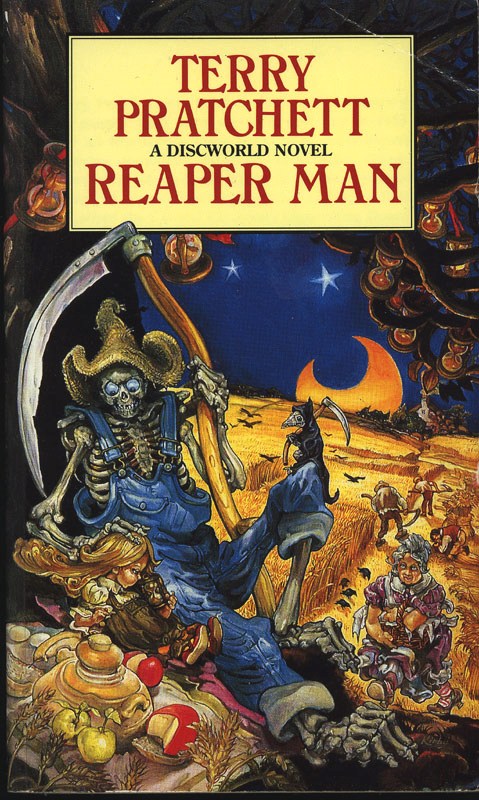
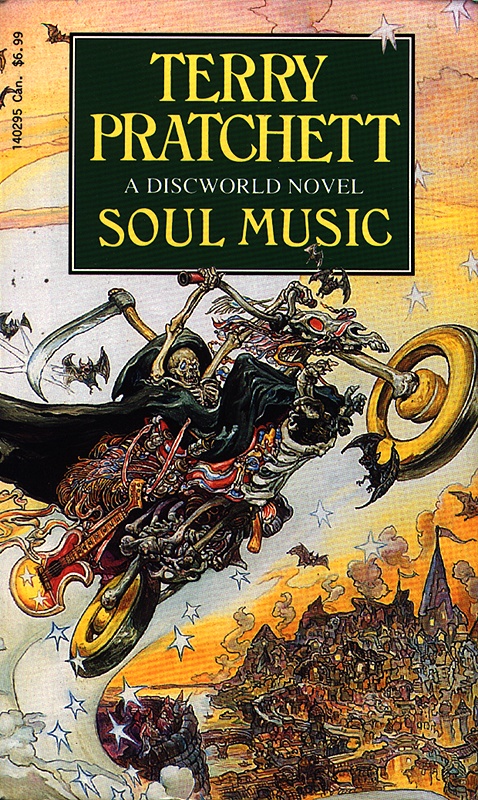
Everything that follows—Bill Door's humanity in Reaper Man, his grief in Soul Music, his defense of belief in Hogfather—flows from this moment. From the night a gangly apprentice nobody wanted decided to save a princess nobody could see, and Death chose not to punish him for it.
"THAT'S MORTALS FOR YOU," Death observes early in the book. "THEY'VE ONLY GOT A FEW YEARS IN THIS WORLD AND THEY SPEND THEM ALL IN MAKING THINGS COMPLICATED FOR THEMSELVES. FASCINATING."
Fascinating. Not contemptuous. Not dismissive. Fascinating. Death watches humans the way a scientist watches a particularly interesting species—with genuine curiosity and, increasingly, with something he'd never admit to feeling.
Affection.

If Mort's transformation of Death intrigues you, follow the thread forward: Reaper Man shows Death learning mortality firsthand as Bill Door, while Soul Music reveals what happens when Death faces his own grief after Mort and Ysabell's deaths. The apprentice's rebellion was just the beginning.