Twoflower: The Tourist Who Accidentally Burned Down a City and Started a Revolution
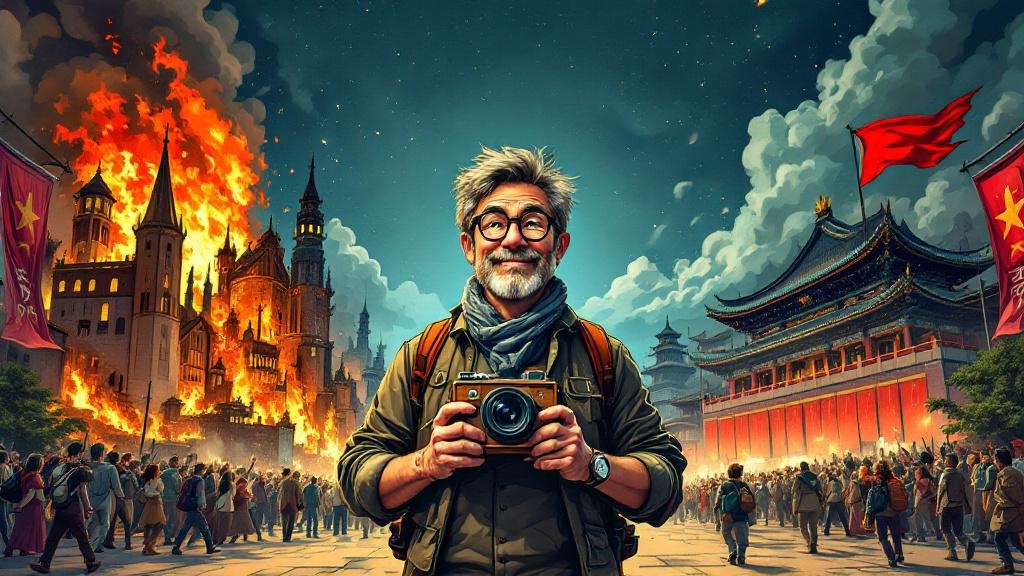
How Discworld's first tourist introduced insurance, destroyed half of Ankh-Morpork, and accidentally sparked a revolution with a travel diary.
Twoflower: The Tourist Who Accidentally Burned Down a City and Started a Revolution
Most dangerous characters in fantasy fiction carry swords, wield dark magic, or command armies. Twoflower carries a camera.
He's a short, cheerful insurance clerk from the Agatean Empire who wants to see interesting things, take pictures, and maybe try the local cuisine. He has no weapons, no combat skills, and no survival instincts whatsoever. Rincewind—the wizard hired to keep him alive—quickly decides that "tourist" means "idiot."
And yet this smiling, bespectacled man manages to burn down half of Ankh-Morpork, reshape the Disc's understanding of economics, and accidentally spark a revolution that topples a thousand-year-old empire. All without meaning to. All without even noticing.
Terry Pratchett loved examining how small actions cascade into enormous consequences. Twoflower is his purest expression of that idea: a man whose hobbies—tourism, photography, writing—reshape entire nations. He never tries to change anything. He's just a spectator. But as Pratchett understood perfectly well, spectators still affect what they observe.
The Man Who Invented Arson by Accident
"Tourist, Rincewind had decided, meant "idiot.""
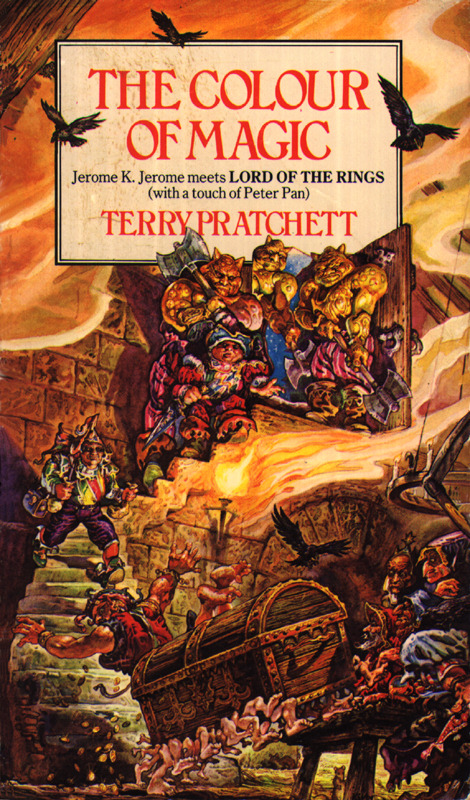
Twoflower arrives in Ankh-Morpork in The Colour of Magic carrying two things that will prove catastrophic: more gold than anyone has ever seen, and a concept that doesn't exist on the Disc.
The gold is a problem because Twoflower comes from the Counterweight Continent, where gold is as common as copper. He has no idea he's overpaying for everything by several hundred percent. But the real damage comes from the concept: "in-sewer-ants."
Insurance. Twoflower, who works as an actuary back home, explains it to Broadman, the owner of the Broken Drum tavern. The idea is simple: you pay a small amount regularly, and if your building burns down, you get paid its full value.
Broadman grasps the concept instantly. Perhaps too instantly.
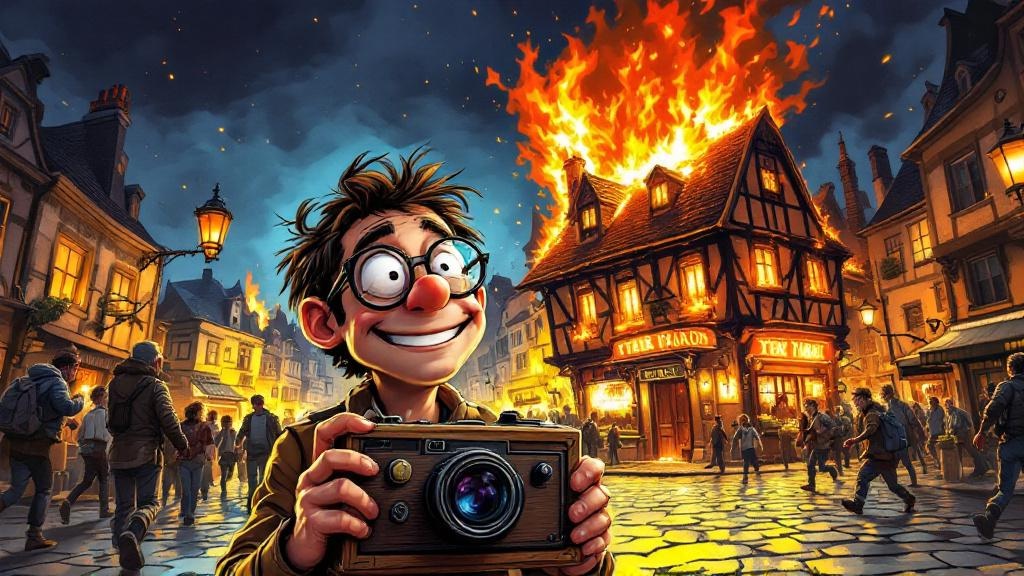
He burns down the Broken Drum that same night. The fire spreads. Half of Ankh-Morpork burns with it.
And Twoflower? Twoflower photographs the destruction. He finds it "picturesque"—a word that Rincewind eventually translates as meaning the scenery is "horribly precipitous." The city is literally on fire, and the man responsible is framing his shots.
This is the essential Twoflower joke, and it works because it's not really a joke at all. He introduces an idea—a perfectly reasonable idea, one that works fine in his home country—without understanding that ideas don't exist in vacuums. They land in specific cultures with specific people who will use them in specific ways. Twoflower doesn't understand consequences because he doesn't think of himself as a participant. He's watching. He's touring. Nothing that happens is really about him.
Pratchett wrote: "Fundamental to his very existence was the rock-hard belief that nothing bad could really happen to him because he was not involved."
That sentence is doing an extraordinary amount of work. It describes Twoflower. It describes tourists. And it describes a particular way of moving through the world that refuses to acknowledge your own impact on it.
The Rose-Tinted Everything
"He looked at the world through a rose-tinted brain, too, and heard it through rose-tinted ears."
What makes Twoflower genuinely fascinating—rather than merely irritating—is that his obliviousness isn't selective. It's total. Rincewind observes that "Twoflower didn't just look at the world through rose-tinted spectacles—he looked at it through a rose-tinted brain, too, and heard it through rose-tinted ears."
Every sense Twoflower possesses filters out unpleasantness. When he calls a landscape "picturesque," it means it's terrifyingly steep. When he calls a village "quaint," it means it's fever-ridden and tumbledown. When he walks into a pub full of murderers, he sees colorful locals.
This should get him killed. Rincewind certainly expects it to. But here's the thing Pratchett noticed about this kind of weaponized innocence: it actually works. On the face of it, Twoflower's survival value is "marginally less than, say, a soap herring." But his total obliviousness to danger somehow makes danger "so discouraged that it gave up and went away."
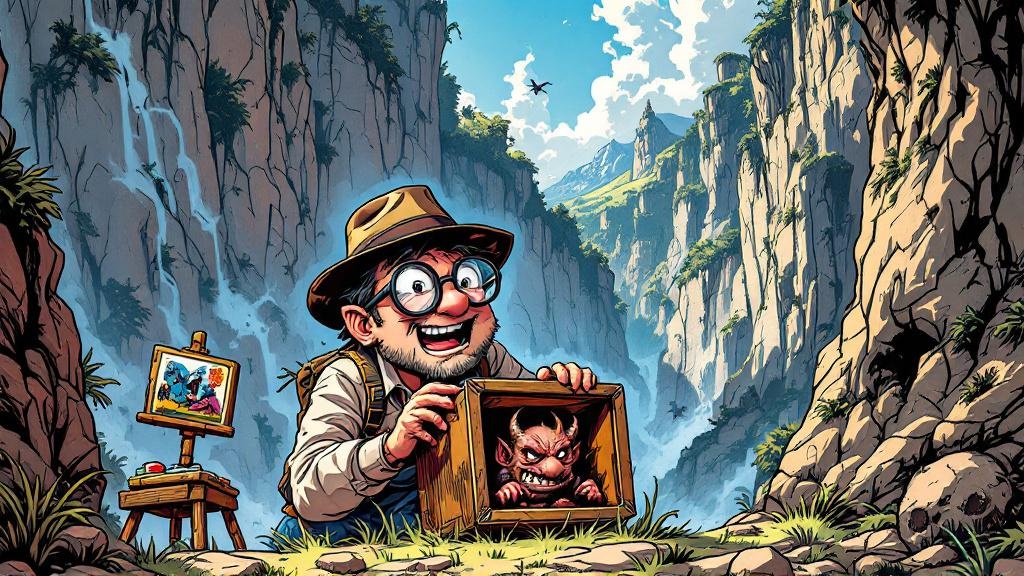
It's a beautiful observation about the relationship between fear and danger. Rincewind, who understands exactly how dangerous the world is, lives in constant terror. Twoflower, who understands nothing, wanders through the same dangers with cheerful immunity. The universe, Pratchett suggests, respects confidence—even when it's based on complete ignorance.
This isn't just comedy. It's a genuine philosophical position about the power of perception. Twoflower's reality is different from everyone else's, and within that reality, he's perfectly safe. The danger is real, but it can't touch someone who doesn't believe in it. It's headology for tourists.
Twenty Years Later, a Revolution
If the insurance disaster was Twoflower's opening act, his second act is even more spectacular. And this time, he doesn't even have to be present for the chaos to unfold.
After his adventures with Rincewind, Twoflower returns home to the Agatean Empire and does what any tourist does: he writes about his holiday. "What I Did On My Holidays" is a cheerful, naive account of his travels across the Disc. He describes the food, the sights, the excitement of nearly dying in interesting ways.
He also, almost as an afterthought, describes things like insurance. And voting. And personal freedoms. And the general idea that ordinary people might have some say in how they're governed.
In Ankh-Morpork, these concepts are unremarkable. In the Agatean Empire—a thousand-year-old totalitarian state that tells its citizens the outside world is a barbaric wasteland—they're dynamite.
"The most dangerous ideas aren't the ones that sound radical. They're the ones that make you realize things could be different."
The regime bans the book immediately. Twoflower is thrown in prison as an enemy of the state. He's baffled. He didn't write a manifesto. He wrote about what he had for lunch and how interesting it was that buildings could have "in-sewer-ants." He cannot comprehend that anyone found his holiday diary revolutionary.
But his daughters can. Pretty Butterfly and Lotus Blossom—inspired by their father's descriptions of freedoms he took for granted—become leaders of the Red Army, quoting Twoflower's travelogue like scripture. The naive tourist who needed constant protection has, without meaning to, become the most dangerous writer in his nation's history.
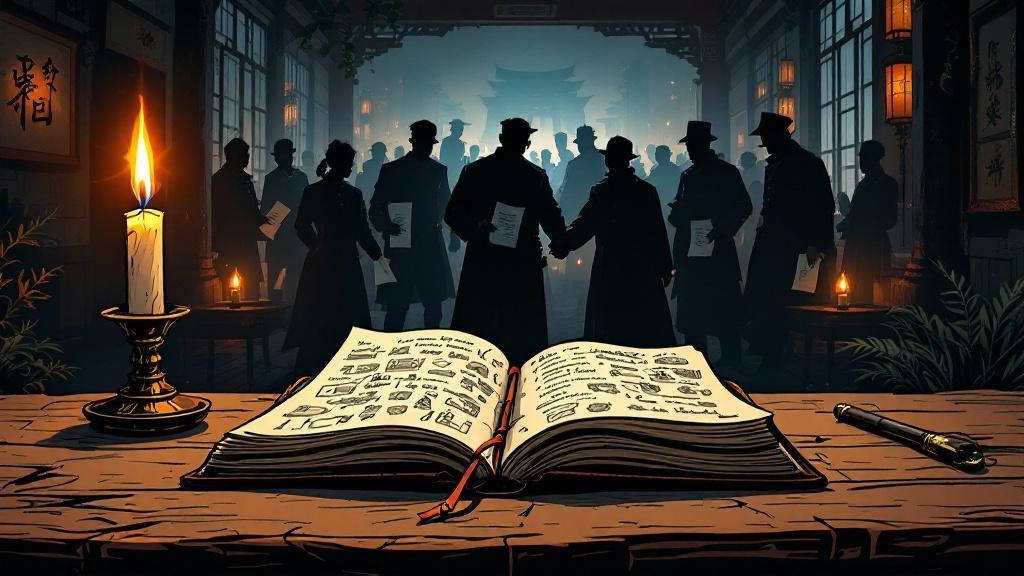
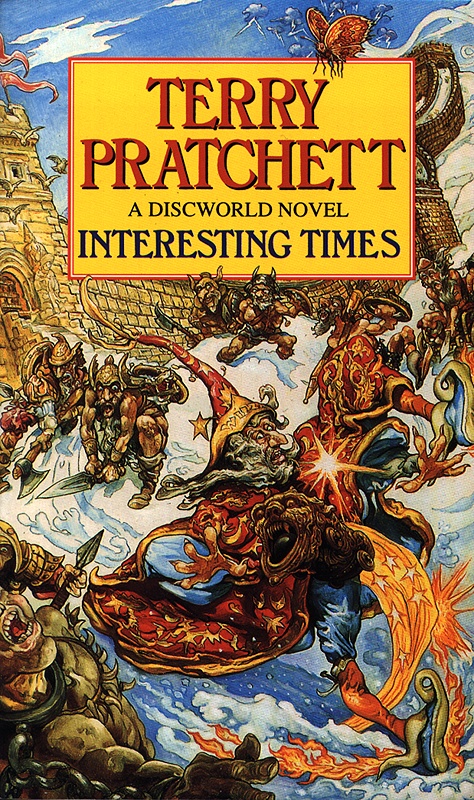
By the time Interesting Times begins, Twoflower's words have done what armies couldn't: they've cracked the empire's control over what people believe is possible.
The Spectator Who Changed Everything
Here's what connects the burning of Ankh-Morpork and the Agatean revolution: in both cases, Twoflower didn't do anything wrong. He explained insurance accurately. He described his holiday honestly. He introduced perfectly ordinary ideas to places where they happened to be explosive.
The pattern is consistent across all three of his books. Twoflower arrives somewhere, behaves exactly like himself, and the consequences ripple outward in ways he never imagined and barely notices. He's the butterfly in chaos theory—a small, colorful creature whose wing-flaps generate hurricanes on the other side of the world.
Pratchett uses Twoflower to make a point about the nature of disruption. The most transformative forces aren't always the ones that intend to transform. Sometimes they're insurance clerks with cameras. Sometimes a cheerful description of someone else's normal life is more revolutionary than any manifesto, because manifestos tell you what to fight for, but Twoflower's diary showed people what was possible to have.
"He's not brave. He just genuinely doesn't understand the danger."
That's not a small distinction. "What I Did On My Holidays" doesn't argue for freedom. It assumes freedom. It describes a world where people just... do things. Go places. Make choices. For readers who've never been told those options exist, that assumption is more subversive than any political argument.
And Twoflower himself? He remains cheerfully oblivious to his own impact. When Rincewind finds him imprisoned in the Agatean Empire, Twoflower isn't angry or radicalized. He's just happy to see his old friend. He still doesn't understand why anyone found his book interesting, let alone dangerous.
A Changed Man (But Not Too Much)
There's one moment in Interesting Times that breaks the Twoflower pattern, and it's devastating precisely because it's so unexpected.
Twoflower's wife was killed in political violence—caught in fighting between rival noble factions. The cheerful tourist who believed nothing bad could happen to spectators lost someone he loved because the powerful treated ordinary people as collateral.
When Lord Hong threatens Rincewind, Twoflower challenges him to a duel. It's absurd. The dumpy, four-eyed tourist against a ruthless warlord. But Twoflower means it. Something has changed. He's still optimistic, still naive in many ways, but he is no longer content to be a spectator. Grief has given him a stake in the outcome.
Pratchett handles this growth carefully. Twoflower doesn't become an action hero. He doesn't suddenly understand politics. He just stops believing that watching from the sidelines keeps you safe—because he's learned, in the worst possible way, that it doesn't.
When Cohen the Barbarian conquers the empire and names Twoflower his Grand Vizier, it's played for comedy. The naive tourist advising the savage barbarian emperor. But it also makes a kind of sense. Twoflower understands things Cohen doesn't—bureaucracy, economics, the daily mechanics of civilization. Someone has to make sure "heads will roll" stays metaphorical.
The Observation Effect
Physics has a principle called the observer effect: the act of measuring something changes it. Twoflower is the observer effect made flesh. He goes places. He looks at things. He writes them down. And nothing he looks at is ever the same again.
A poet, Pratchett notes, stares at a daffodil and writes a long poem about it. "But Twoflower wanders off to find a book on botany. He just looks at things, but nothing he looks at is ever the same again."
That line sounds like a throwaway gag, but it's actually a thesis statement. Twoflower doesn't impose meaning on the world the way artists or philosophers do. He just records what he sees. And somehow, that simple act of recording—of treating everything as interesting, as worth photographing, as worth writing about—transforms it.
The burning of Ankh-Morpork. The collapse of an empire. A generation of revolutionaries inspired by a holiday diary. All because one man from the Counterweight Continent wanted to see the sights.
He never carried a sword. He never cast a spell. He just looked at things, and the things he looked at were never the same again.
Reading Recommendations

The Bottom Line
Terry Pratchett understood something profound about how the world changes: it's rarely the people with swords and speeches who make the biggest difference. Sometimes it's the ones with cameras and curiosity. Twoflower never meant to burn down a city or topple an empire. He just wanted to see things. But seeing things—really seeing them, recording them, sharing them—turns out to be one of the most powerful and dangerous acts in the world.
The tourist meant no harm. That's what made him unstoppable.
Want to explore Twoflower's most important relationship? Read about why his friendship with Rincewind actually works, or discover how his travel diary became the most dangerous book in the Agatean Empire.